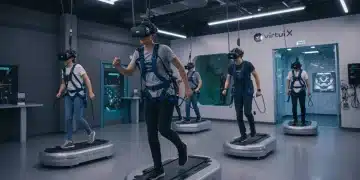
5G Integration & VR Hardware: 2026 Low-Latency Future
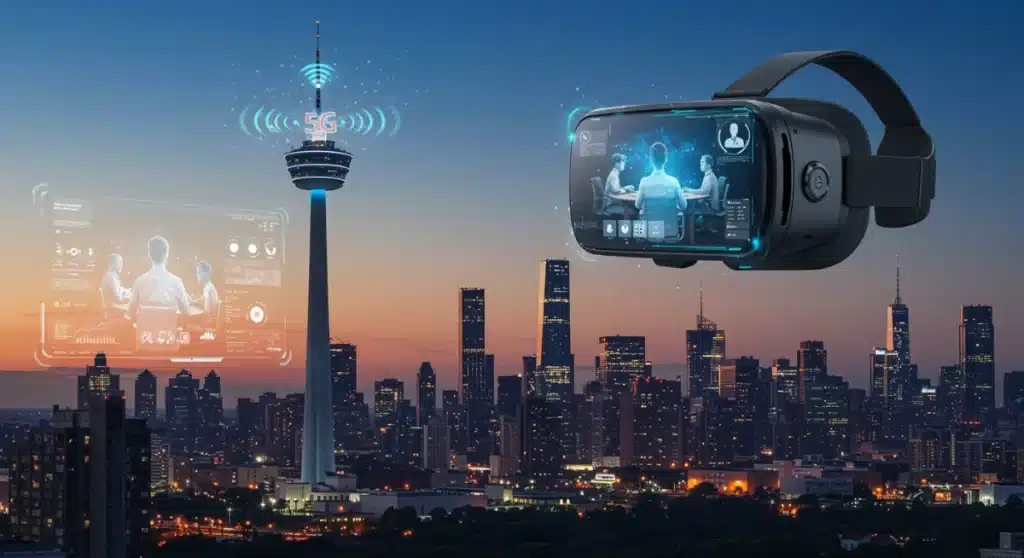
The integration of 5G technology is fundamentally transforming VR hardware performance by significantly reducing latency, thereby enabling unparalleled, immersive experiences vital for sophisticated remote collaboration in the U.S. by 2026.
The landscape of virtual reality is on the cusp of a profound transformation, driven largely by the pervasive rollout and increasing sophistication of 5G networks. In the U.S., the impact of 5G VR hardware performance is particularly critical, especially when considering its implications for low-latency devices in remote collaboration by 2026. This synergy promises to unlock new dimensions of immersive interaction, moving beyond mere entertainment to redefine how we work and connect across distances.
The foundational shift: 5G’s role in VR evolution
The advent of 5G is not merely an incremental upgrade to mobile connectivity; it represents a paradigm shift for data-intensive applications like virtual reality. Its core attributes—ultra-low latency, massive bandwidth, and high reliability—directly address the most significant bottlenecks hindering VR’s widespread adoption and advanced functionality.
Before 5G, VR experiences were often tethered to powerful local computers, limiting mobility and scalability. Wireless VR, while freeing users from cables, still struggled with latency issues over Wi-Fi, leading to motion sickness and a less convincing sense of presence. 5G fundamentally changes this equation, enabling a new era of untethered, cloud-rendered VR.
Overcoming latency: a critical hurdle
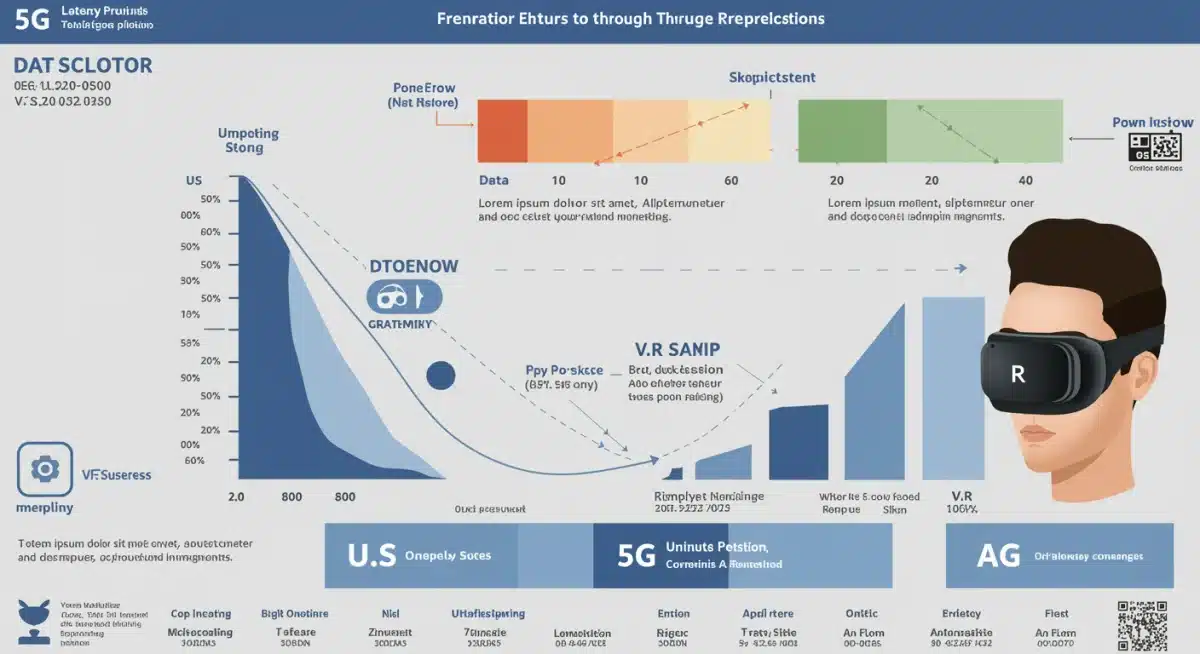
Latency, the delay between an action and its corresponding visual or auditory response, is the Achilles’ heel of immersive VR. High latency can cause disorientation, nausea, and break the illusion of presence. 5G’s promise of sub-10ms latency, and in some cases even sub-1ms, is a game-changer.
- Reduced Motion Sickness: Lower latency minimizes the discrepancy between head movement and visual feedback, drastically cutting down on simulation sickness.
- Enhanced Realism: Faster response times contribute to a more natural and believable interaction within virtual environments.
- Improved Interactivity: Real-time feedback allows for more precise and complex interactions with virtual objects and other users.
The ability of 5G to deliver data at such speeds means that complex graphical rendering can be offloaded to edge servers or the cloud, rather than relying solely on the local processing power of the VR headset. This allows for lighter, more comfortable, and less expensive VR devices, broadening their accessibility and utility.
Ultimately, 5G’s influence on VR hardware performance is about dissolving the technical barriers that have historically kept VR from reaching its full potential. By 2026, this foundational shift is expected to solidify VR as a powerful tool, particularly within professional domains.
Hardware innovations driven by 5G integration
The integration of 5G is directly catalyzing a new wave of innovation in VR hardware design and functionality. Manufacturers are no longer bound by the constraints of local processing power, leading to the development of sleeker, more sophisticated, and truly standalone VR devices.
The traditional VR headset, often bulky and requiring a powerful PC, is evolving. With 5G, the computational heavy lifting can occur remotely. This allows for smaller form factors, lighter materials, and extended battery life, making VR experiences more comfortable and practical for prolonged use.
Edge computing and cloud-based rendering
Edge computing, working in tandem with 5G, is a cornerstone of this hardware evolution. By processing data closer to the user, edge servers can deliver ultra-low latency rendering, eliminating the need for high-end GPUs within the headset itself. This decentralization of processing power significantly reduces the cost and weight of VR devices.
- Untethered Freedom: Users can move freely without physical cables or the need to be within range of a powerful local PC.
- Cost Reduction: Less powerful on-board processors translate to more affordable headsets, democratizing access to high-fidelity VR.
- Enhanced Graphics: Cloud infrastructure can render highly detailed, photorealistic environments that would be impossible for a mobile chip to handle.
Furthermore, developers can push the boundaries of graphical fidelity and simulation complexity, knowing that the network infrastructure can support their creations. This leads to richer, more believable virtual worlds that enhance the sense of presence and immersion. The synergy between 5G and edge computing is not just about faster data; it’s about fundamentally rethinking where and how VR experiences are generated and delivered.
Low-latency devices: the cornerstone of remote collaboration
For remote collaboration, low latency isn’t just a desirable feature; it’s an absolute necessity. The ability to interact with virtual objects and other participants in real-time, without discernible delay, is what separates a truly effective collaborative environment from a frustrating one. By 2026, 5G-enabled low-latency VR devices will be paramount for U.S. businesses.
Imagine a virtual boardroom where colleagues from across the globe can seamlessly share and manipulate 3D models, annotate designs, or conduct training simulations as if they were physically present. Any lag in interaction or visual feedback would undermine the entire experience, leading to miscommunications and inefficiency.
Real-time interaction and presence
Low-latency devices, powered by 5G, foster a strong sense of ‘presence’ – the feeling of actually being in a virtual space. This is critical for effective remote collaboration, as it enhances non-verbal cues, improves communication flow, and builds stronger connections between remote teams.
- Synchronized Movements: Participants’ avatars move and react in real-time, allowing for natural gestures and body language.
- Instant Feedback: Manipulating virtual objects or tools provides immediate visual and haptic feedback, mimicking real-world interaction.
- Reduced Cognitive Load: Eliminating delay means less mental effort spent compensating for lag, allowing users to focus on the collaborative task.
The advancements in low-latency hardware also extend to peripheral devices, such as haptic gloves and full-body tracking suits. These devices, when integrated with 5G, can transmit high-fidelity sensory data back and forth with minimal delay, enriching the immersive experience and making virtual interactions feel more tangible. This level of responsiveness is what will elevate VR from a niche tool to an indispensable platform for remote work.
U.S. remote collaboration: a 2026 outlook
By 2026, remote collaboration in the U.S. is expected to be significantly transformed by the widespread adoption of 5G-enabled VR. The pandemic accelerated the shift to remote work, and 5G provides the infrastructure to make these remote interactions more engaging, productive, and truly immersive.
Industries ranging from engineering and architecture to healthcare and education are poised to leverage VR for new forms of interaction. Design reviews, surgical training, and even virtual classrooms will benefit immensely from the ability to share high-fidelity, interactive 3D content without the geographical limitations of physical presence.
Industry-specific applications and benefits
The applications for 5G-enabled VR in U.S. remote collaboration are vast and varied, extending beyond simple virtual meetings.
- Engineering & Manufacturing: Collaborative design reviews of complex machinery, remote factory tours, and real-time troubleshooting with digital twins.
- Healthcare: Remote surgical training, collaborative diagnostics with 3D medical imaging, and virtual patient consultations.
- Education: Immersive virtual field trips, collaborative learning environments, and hands-on training simulations for vocational skills.
The ability to conduct these activities with ultra-low latency and high bandwidth means that geographically dispersed teams can work together as if they were in the same room. This not only enhances productivity but also fosters a stronger sense of team cohesion and innovation, breaking down barriers that traditional video conferencing cannot address. The U.S. market, with its strong emphasis on technological innovation and distributed workforces, is particularly ripe for this transformation.
Challenges and considerations for widespread adoption
While the promise of 5G-enabled VR for remote collaboration is immense, several challenges and considerations must be addressed for widespread adoption by 2026. These include ensuring equitable access to 5G infrastructure, addressing hardware costs, and developing robust, user-friendly software platforms.
The deployment of 5G is not uniform across the U.S., with urban areas typically having better coverage than rural regions. Bridging this digital divide is crucial to ensure that all businesses and individuals can benefit from advanced VR collaboration tools. Furthermore, while headset costs are decreasing, high-performance VR devices still represent a significant investment for many.
Key hurdles to overcome
Overcoming these challenges will require concerted effort from technology providers, telecommunication companies, and policymakers.
- 5G Infrastructure Gap: Ensuring consistent, high-quality 5G coverage across all relevant business and residential areas.
- Hardware Affordability: Driving down the cost of advanced VR headsets and peripherals to make them accessible to a broader market.
- Software Interoperability: Developing standardized platforms and protocols for seamless cross-platform VR collaboration.
- Data Security and Privacy: Implementing robust measures to protect sensitive business data transmitted and stored in cloud-based VR environments.
Addressing these points will be vital for realizing the full potential of 5G VR in remote collaboration. The ecosystem needs to mature, with a focus on creating intuitive, secure, and scalable solutions that meet the diverse needs of U.S. enterprises. Furthermore, user training and adaptation to new immersive workflows will be a continuous process.
The economic and social implications
The widespread integration of 5G into VR hardware for low-latency remote collaboration will have significant economic and social implications for the U.S. By 2026, we can expect shifts in employment, increased productivity, and new opportunities for innovation and economic growth.
Economically, businesses can reduce travel costs, access a global talent pool more effectively, and accelerate product development cycles through collaborative design. Socially, it offers new ways for people to connect, learn, and experience shared spaces, potentially reducing feelings of isolation for remote workers and fostering a more inclusive digital society.
Transforming industries and job markets
The enhanced capabilities of 5G VR will not only optimize existing industries but also give rise to entirely new ones, creating demands for specialized skills.
- New Job Roles: Increased demand for VR developers, 3D content creators, network engineers specializing in edge computing, and VR experience designers.
- Increased Productivity: Streamlined workflows, faster decision-making, and more effective training programs leading to higher output.
- Reduced Carbon Footprint: Less business travel translates to lower emissions, contributing to environmental sustainability goals.
- Enhanced Accessibility: Creating more inclusive work environments for individuals with mobility challenges or those in remote locations.
The economic ripple effects will extend to the telecommunications sector, hardware manufacturing, and software development, fueling investment and innovation. Socially, the ability to collaborate in highly immersive virtual spaces could redefine community and professional networking, blurring the lines between physical and digital presence. This evolution underscores the profound long-term impact of 5G VR on American society.
| Key Point | Brief Description |
|---|---|
| 5G & Latency Reduction | 5G’s ultra-low latency is crucial for eliminating motion sickness and enhancing realism in VR. |
| Hardware Evolution | 5G enables lighter, untethered VR headsets by offloading rendering to edge/cloud computing. |
| Remote Collaboration Impact | Low-latency 5G VR is essential for realistic, real-time interactions in U.S. remote work by 2026. |
| Challenges & Outlook | Challenges include 5G coverage, hardware costs, and software interoperability for widespread adoption. |
Frequently asked questions about 5G VR for collaboration
5G reduces latency through its advanced network architecture, including massive MIMO and beamforming, which allows for more efficient data transmission. Critically, it enables edge computing, moving processing power closer to the user, bypassing longer cloud routes and minimizing delays for VR content rendering and interaction data.
Standalone VR headsets will benefit immensely, becoming lighter and more powerful as 5G allows them to offload complex rendering to the cloud or edge. Additionally, peripheral devices like haptic feedback suits and advanced tracking systems will see improved responsiveness and data throughput, enhancing overall immersion and interaction quality.
The main advantages include a stronger sense of presence among remote team members, reduced motion sickness, and highly accurate real-time interactions with virtual objects and environments. This enables more effective collaborative design, training simulations, and virtual meetings, fostering better communication and productivity across distances.
Yes, key hurdles include ensuring ubiquitous and reliable 5G coverage across all regions, managing the ongoing cost of advanced VR hardware for widespread enterprise deployment, and developing standardized, interoperable software platforms. Data security and privacy concerns in cloud-rendered VR environments also need continuous attention and robust solutions.
5G VR is expected to create new job roles in VR development and network engineering, boost productivity in various industries by enabling more efficient remote operations, and reduce business travel costs. It will also foster innovation, drive investment in related tech sectors, and potentially lead to more inclusive work environments for diverse workforces.
Conclusion
The integration of 5G technology into VR hardware marks a pivotal moment, especially for low-latency devices in U.S. remote collaboration. By 2026, the foundational shifts brought about by 5G’s ultra-low latency and massive bandwidth will have largely dissolved the technical barriers that once limited VR’s potential. This synergy is poised to create truly immersive, untethered, and highly responsive virtual environments, transforming how American businesses operate, innovate, and connect. While challenges related to infrastructure, cost, and software remain, the trajectory is clear: 5G-enabled VR is not just an incremental improvement but a transformative force, set to redefine the future of work and interaction.