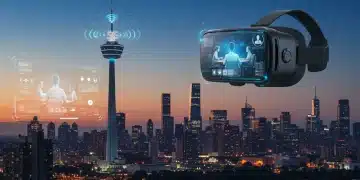
VR Hardware Connectivity: Wi-Fi 7 & 5G for Business in 2025

The integration of Wi-Fi 7 and 5G is set to revolutionize VR hardware connectivity for business applications by 2025, offering unprecedented bandwidth, ultra-low latency, and enhanced reliability for immersive enterprise experiences.
As we approach 2025, the landscape of virtual reality for business is rapidly evolving, driven significantly by advancements in connectivity. The core of this transformation lies in robust VR hardware connectivity, enabling seamless, high-fidelity immersive experiences crucial for enterprise applications. This article delves into how Wi-Fi 7 and 5G are poised to redefine this space, offering a critical comparison and analysis of their integration for business use.
the evolving demands of enterprise VR
The enterprise sector is increasingly adopting virtual reality for a myriad of applications, ranging from intricate product design and remote collaboration to high-stakes training simulations. These sophisticated use cases demand more than just visual fidelity; they require flawless, low-latency connectivity to prevent motion sickness, ensure real-time interaction, and support the vast data streams generated by high-resolution VR environments. Traditional wireless solutions often struggle to meet these stringent requirements, leading to a bottleneck in VR’s full potential for business. The sheer volume of data required for immersive, multi-user VR experiences necessitates a network infrastructure capable of handling immense throughput with minimal delay.
Furthermore, the mobility inherent in many enterprise VR scenarios – such as on a factory floor or a vast construction site – adds another layer of complexity. Users need to move freely without tethering, maintaining a stable and powerful connection. This combination of high bandwidth, ultra-low latency, and pervasive coverage is precisely where next-generation wireless technologies like Wi-Fi 7 and 5G step in as game-changers. Their distinct capabilities, when synergistically applied, promise to unlock new paradigms for how businesses leverage VR.
the need for speed and responsiveness
Enterprise VR applications are fundamentally dependent on two critical connectivity metrics: speed and responsiveness. Lag or dropped frames can severely impair the user experience, making training ineffective or collaborative sessions frustrating. The data transfer rates required for uncompressed 4K or even 8K per eye VR content are astronomical, pushing the limits of current wireless standards.
- High Throughput: Essential for transmitting large VR environment files and uncompressed video streams.
- Low Latency: Crucial for real-time interaction, reducing motion sickness, and ensuring immediate feedback.
- Jitter Reduction: Minimizing variations in data packet arrival times to maintain a smooth, consistent experience.
These technical demands underscore why incremental improvements are no longer sufficient; a fundamental leap in wireless technology is necessary to fully realize the promise of enterprise VR. The integration of VR hardware connectivity must deliver a seamless experience that mirrors physical interaction, removing any technological friction that could hinder adoption or effectiveness.
Ultimately, the success of VR in business hinges on its ability to provide an experience that is both compelling and practical. This means overcoming the inherent challenges of wireless data transmission to offer a level of performance that empowers users rather than restricts them. The future of enterprise VR is intrinsically linked to the evolution of its underlying connectivity infrastructure, making Wi-Fi 7 and 5G pivotal.
wi-fi 7: a local powerhouse for VR
Wi-Fi 7, also known as 802.11be or Extremely High Throughput (EHT), represents a significant leap forward for local wireless networks, offering capabilities that are particularly beneficial for enterprise VR deployments within confined spaces. Building upon the advancements of Wi-Fi 6E, Wi-Fi 7 introduces several key features designed to boost speed, reduce latency, and enhance network efficiency, making it an ideal candidate for high-density VR environments like training centers or collaborative design studios.
One of its most compelling features is the ability to utilize the 6 GHz band more effectively, unlocking a vast amount of contiguous spectrum that is less congested than the 2.4 GHz and 5 GHz bands. This wider spectrum allows for wider channels, up to 320 MHz, significantly increasing data throughput. Furthermore, Multi-Link Operation (MLO) is a game-changer, allowing devices to transmit and receive data simultaneously across different frequency bands and channels. This not only boosts aggregate bandwidth but also provides a more robust and resilient connection, crucial for the demanding and uninterrupted data flow required by VR applications.
key technical advantages of wi-fi 7
The technical specifications of Wi-Fi 7 are tailored to address the high-bandwidth, low-latency needs of virtual reality. It’s not just about raw speed; it’s about intelligent management of wireless resources to ensure optimal performance for every connected device.
- 320 MHz Channels: Doubling the channel width of Wi-Fi 6E, allowing for significantly higher data rates.
- 4096-QAM Modulation: A more efficient modulation scheme that packs more data into each signal, increasing throughput.
- Multi-Link Operation (MLO): Enables simultaneous use of multiple frequency bands (2.4 GHz, 5 GHz, 6 GHz) to enhance speed and reliability.
- Preamble Puncturing: Allows for more efficient use of spectrum by blocking out noisy portions of a channel.
These enhancements translate directly into a superior VR experience, where visual fidelity is maintained, and interactions are instantaneous. For businesses, this means more effective training, more realistic simulations, and smoother collaborative sessions without the visual artifacts or delays that plague less capable networks. Wi-Fi 7 essentially creates a high-speed, dedicated highway for VR data within an enterprise’s physical footprint, ensuring that local VR operations run at their peak.
The localized nature of Wi-Fi 7 makes it particularly suitable for scenarios where VR users are within a defined area. Its ability to handle multiple high-bandwidth devices concurrently without significant degradation in performance positions it as a cornerstone for future enterprise VR deployments. This robust local connectivity forms a critical part of the overall VR hardware connectivity ecosystem.
5G: extending VR’s reach beyond the local network
While Wi-Fi 7 excels in localized, high-density VR environments, 5G offers a complementary set of advantages by extending VR’s reach far beyond the confines of a single building or campus. 5G, with its foundational principles of enhanced mobile broadband (eMBB), ultra-reliable low-latency communication (URLLC), and massive machine-type communication (mMTC), is uniquely positioned to empower mobile and distributed enterprise VR applications. Imagine field technicians using VR overlays for remote assistance, or construction teams collaborating on digital twins from disparate locations – these scenarios demand the ubiquitous, low-latency connectivity that only 5G can provide.
The true power of 5G lies in its ability to deliver consistent high-speed connections across vast geographical areas, coupled with incredibly low latency. This is particularly vital for cloud-rendered VR, where the heavy computational load is offloaded to powerful edge or cloud servers, and only the rendered frames are streamed to the VR headset. Such an architecture demands a network that can handle the round-trip latency with absolute minimal delay, making the experience feel as if the processing is happening locally. 5G’s network slicing capabilities further enhance this by allowing dedicated virtual networks to be carved out for specific enterprise VR applications, guaranteeing performance and security.
the transformative impact of 5G on mobile VR
The mobility and broad coverage of 5G open up entirely new possibilities for enterprise VR, moving it from static installations to dynamic, on-the-go applications. This paradigm shift can revolutionize how businesses operate in many sectors.
- Ubiquitous Connectivity: Enables VR experiences anywhere with 5G coverage, ideal for remote workforces and field operations.
- Edge Computing Synergy: Facilitates cloud-rendered VR by providing ultra-low latency connections to edge servers, reducing headset processing power requirements.
- Network Slicing: Allows for dedicated virtual networks with guaranteed Quality of Service (QoS) for critical VR applications.
- Enhanced Security: 5G’s inherent security features provide a more secure environment for transmitting sensitive enterprise data in VR.
For businesses seeking to deploy VR solutions that transcend physical boundaries, 5G is not merely an option but a necessity. It liberates VR from the cable, from the local Wi-Fi router, and from the limitations of on-device processing power, ushering in an era of truly mobile, high-fidelity immersive experiences. This expansive capability significantly broadens the scope of VR hardware connectivity for enterprise use, allowing for unprecedented flexibility and scalability.
The integration of 5G effectively transforms the world into a potential canvas for VR applications, breaking down geographical barriers and enabling real-time collaboration and interaction regardless of physical location. This broadens the potential for VR to impact global operations and distributed teams, making 5G a critical enabler for the future of enterprise VR.
integrating wi-fi 7 and 5G for optimal VR performance
The question for businesses isn’t whether to choose Wi-Fi 7 or 5G, but rather how to intelligently integrate both technologies to create a seamless and highly performant VR ecosystem. Each technology possesses distinct strengths that, when combined, address the full spectrum of enterprise VR connectivity needs. Wi-Fi 7 serves as the high-throughput, ultra-low-latency backbone for stationary or localized VR setups, while 5G extends this performance to mobile and geographically dispersed scenarios, often leveraging edge computing for optimal results. This symbiotic relationship ensures that VR hardware maintains robust connectivity regardless of the operational context.
Consider a scenario where a company uses VR for design reviews in a dedicated studio. Wi-Fi 7 would provide the unparalleled local bandwidth and minimal latency needed for multiple users to interact with complex 3D models in real-time. Later, a project manager might need to share a subset of that design with a remote team member in the field. 5G, coupled with edge cloud rendering, would enable that remote user to access the VR experience with comparable performance, without being tethered to a local network. The transition between these connectivity modes should be transparent to the user, ensuring an uninterrupted workflow.
hybrid connectivity models for enterprise VR
Developing a hybrid connectivity strategy is paramount for maximizing the potential of enterprise VR. This involves creating an infrastructure that can intelligently switch or combine Wi-Fi 7 and 5G based on the specific application requirements and user location.
- Local High-Density: Wi-Fi 7 for in-office, multi-user VR training and collaboration.
- Mobile and Remote: 5G for field operations, remote assistance, and distributed team meetings with cloud-rendered VR.
- Seamless Handover: Intelligent systems that can switch between Wi-Fi 7 and 5G without disrupting the VR experience.
- Edge Computing Synergy: Leveraging 5G’s low latency to connect to nearby edge servers for cloud-based VR processing.
This integrated approach allows businesses to deploy VR solutions with unprecedented flexibility and scalability. It ensures that the investment in VR hardware is matched by an equally capable and adaptable network infrastructure, providing consistent, high-quality experiences across all operational scenarios. The future of VR hardware connectivity for businesses is undeniably hybrid, leveraging the best of both worlds.
The strategic deployment of both Wi-Fi 7 and 5G will allow enterprises to create truly ubiquitous VR environments. This means less compromise on performance and more opportunities for innovation, as the limitations of connectivity become less of a barrier and more of an enabler for advanced immersive applications.
challenges and considerations for 2025 integration
While the promise of Wi-Fi 7 and 5G for enterprise VR is immense, their effective integration by 2025 comes with its own set of challenges and considerations. Businesses must navigate these complexities to fully harness the benefits of these advanced connectivity solutions. One primary concern is the cost of upgrading existing infrastructure. Deploying new Wi-Fi 7 access points across an entire enterprise or ensuring robust 5G coverage, especially with private 5G networks, represents a significant capital investment. Furthermore, the interoperability between VR hardware and these new network standards needs to be seamless, requiring careful evaluation of device compatibility and software optimization.
Another crucial aspect is network management and security. With increased bandwidth and more devices connected, the complexity of managing these networks grows. Ensuring data privacy, preventing unauthorized access, and maintaining network stability become even more critical, especially when dealing with sensitive enterprise data within VR environments. The skills gap in IT departments to manage and optimize these cutting-edge wireless technologies also presents a hurdle that businesses must address through training or external expertise.
overcoming deployment hurdles
Successful integration requires a proactive approach to planning, deployment, and ongoing management. Addressing these challenges head-on will determine the effectiveness of VR hardware connectivity in 2025.
- Infrastructure Costs: Budgeting for new Wi-Fi 7 hardware and potential 5G private network deployments.
- Device Compatibility: Ensuring VR headsets and peripherals support the latest Wi-Fi 7 and 5G standards.
- Network Security: Implementing robust security protocols for both local and wide-area VR data transmission.
- Spectrum Availability: Navigating regulatory frameworks and ensuring access to necessary spectrum for 6 GHz Wi-Fi and 5G.
Beyond the technical hurdles, businesses also need to consider the human element. User adoption depends not just on technical performance but also on ease of use and perceived value. A well-designed network infrastructure that supports intuitive VR experiences will be key to driving widespread enterprise adoption. The strategic planning involved in migrating to these advanced connectivity solutions is as important as the technologies themselves.
Ultimately, the successful integration of Wi-Fi 7 and 5G into enterprise VR strategies by 2025 will hinge on a holistic approach that considers not only the technological capabilities but also the economic, operational, and human factors involved. Overcoming these challenges will unlock the full transformative power of connected VR.
real-world business applications and use cases
The enhanced VR hardware connectivity provided by Wi-Fi 7 and 5G is not merely a technical advancement; it’s a catalyst for transformative business applications across various industries. These technologies enable VR to move beyond niche applications into mainstream enterprise workflows, delivering tangible value and competitive advantages. From precision manufacturing to global retail, the potential impact is profound, allowing businesses to operate with greater efficiency, innovation, and reach.
In manufacturing, VR training simulations can become more realistic and accessible. Imagine factory workers undergoing complex machinery training in a virtual environment, with the VR headset connected wirelessly via Wi-Fi 7 to a local server, providing instant feedback and ultra-low latency interactions. This reduces risks, accelerates learning curves, and minimizes the need for expensive physical prototypes. For remote maintenance, 5G-enabled VR allows expert technicians to guide on-site personnel through intricate repairs, providing visual overlays and real-time instructions, regardless of geographical distance.
transforming industries with advanced VR connectivity
The fusion of Wi-Fi 7 and 5G connectivity is set to redefine how businesses leverage VR, leading to significant operational improvements and new strategic opportunities.
- Manufacturing & Engineering: Enhanced collaborative design reviews, remote quality inspection, and advanced employee training.
- Healthcare: Realistic surgical simulations, remote patient consultations, and therapeutic VR experiences with reliable connectivity.
- Retail & Real Estate: Immersive virtual showrooms, remote property tours, and personalized shopping experiences.
- Education & Training: Highly interactive virtual classrooms, simulations for hazardous environments, and skill development programs.
These examples illustrate how robust connectivity transforms VR from a novel technology into an indispensable business tool. The ability to deploy high-fidelity VR experiences without the constraints of wires or geographical proximity unlocks new models for collaboration, training, and service delivery. Businesses that strategically adopt these technologies will gain a significant edge in a competitive market, driving innovation and efficiency.
The impact extends beyond mere efficiency gains; it also fosters a new era of immersive collaboration and problem-solving. Teams can converge in virtual spaces, regardless of their physical location, to tackle complex challenges, design new products, or train for critical scenarios. This broadens the scope and accessibility of expertise, making VR hardware connectivity a cornerstone of future enterprise operations.
the future outlook for VR connectivity in business
Looking ahead to 2025 and beyond, the trajectory for VR hardware connectivity in business is one of continuous evolution and deeper integration. The foundational work laid by Wi-Fi 7 and 5G will serve as a springboard for even more advanced immersive experiences and applications. We can anticipate further optimization of these technologies, leading to even lower latencies, higher bandwidths, and more seamless handoffs between local and wide-area networks. The convergence of these wireless standards with other emerging technologies, such as edge AI and haptic feedback systems, promises to create truly indistinguishable virtual realities that will profoundly impact how businesses operate and innovate.
The industry will likely see a proliferation of specialized VR hardware designed from the ground up to leverage the full capabilities of Wi-Fi 7 and 5G. This includes lighter, more powerful standalone headsets with integrated cellular connectivity and advanced Wi-Fi modules, capable of dynamic switching. Furthermore, the development of sophisticated software platforms that intelligently manage network resources for VR applications will become crucial, ensuring optimal performance without requiring manual intervention. The focus will shift towards creating an ‘always-on, always-connected’ VR experience that is as reliable and ubiquitous as traditional communication methods.
emerging trends and next-gen integration
The future of enterprise VR connectivity will be characterized by a relentless pursuit of realism and seamless interaction, driven by ongoing advancements in wireless and computing technologies.
- Dynamic Network Switching: Intelligent algorithms for automatic and optimized switching between Wi-Fi 7 and 5G based on application needs.
- Edge AI Integration: Leveraging AI at the network edge to further reduce latency and enhance VR processing efficiency.
- Ubiquitous Private Networks: Increased deployment of private 5G networks for secure, high-performance enterprise VR.
- Standardization & Interoperability: Greater collaboration between hardware manufacturers and network providers to ensure seamless integration.
The ongoing refinement of these connectivity solutions will enable the development of VR applications that are currently only theoretical. Imagine truly photorealistic digital twins accessible from anywhere, or complex multi-sensory experiences that blur the lines between physical and virtual. The evolution of VR hardware connectivity is not just about faster internet; it’s about building the nervous system for the next generation of enterprise tools.
The coming years will undoubtedly solidify Wi-Fi 7 and 5G as indispensable components of the enterprise VR landscape. Businesses that embrace these technologies and plan for their strategic integration will be well-positioned to lead in an increasingly immersive and interconnected world, leveraging VR for unparalleled competitive advantage and operational excellence.
| Key Aspect | Description for VR Business |
|---|---|
| Wi-Fi 7 Benefits | Offers ultra-high local bandwidth, low latency, and efficient spectrum use for high-density indoor VR applications in enterprises. |
| 5G Advantages | Provides widespread mobility, ultra-low latency for cloud/edge VR rendering, and network slicing for distributed enterprise VR. |
| Integration Strategy | Optimal VR performance for businesses relies on a hybrid approach, leveraging Wi-Fi 7 for local and 5G for mobile/remote scenarios. |
| Key Challenges | Deployment costs, device compatibility, network security, and spectrum availability are critical considerations for 2025 integration. |
frequently asked questions about VR business connectivity
Advanced connectivity, particularly Wi-Fi 7 and 5G, is crucial for enterprise VR to deliver the high bandwidth and ultra-low latency required for realistic, immersive experiences. This prevents motion sickness, ensures real-time interaction, and supports large data streams for complex business applications like training and design.
Wi-Fi 7 offers significant advantages for local business VR, including wider 320 MHz channels, 4096-QAM modulation, and Multi-Link Operation (MLO). These features boost local throughput, reduce latency, and provide a more robust connection, ideal for high-density VR environments within offices or training centers.
5G extends VR’s reach by providing ubiquitous, low-latency connectivity for mobile and remote business applications. It enables cloud-rendered VR, where processing is offloaded to edge servers, and supports applications like remote assistance and on-site collaboration, freeing VR from local network constraints.
Businesses should adopt a hybrid approach, integrating both Wi-Fi 7 and 5G. Wi-Fi 7 is best for local, high-density VR, while 5G excels in mobile and remote scenarios. This combined strategy ensures optimal VR hardware connectivity for all enterprise use cases, providing flexibility and comprehensive coverage.
Key challenges include significant infrastructure upgrade costs for Wi-Fi 7 and 5G, ensuring VR hardware compatibility, implementing robust network security, and navigating spectrum availability. Addressing these requires strategic planning and investment in both technology and skilled personnel for effective deployment.
conclusion
The convergence of Wi-Fi 7 and 5G is set to fundamentally reshape VR hardware connectivity for business by 2025. These advanced wireless technologies are not just incremental upgrades; they represent a paradigm shift, providing the essential backbone for immersive, high-fidelity enterprise VR applications. While Wi-Fi 7 optimizes local, high-density environments with unparalleled speed and low latency, 5G extends VR’s reach globally, enabling mobile and cloud-rendered experiences. Businesses that strategically integrate both will unlock unprecedented opportunities for innovation, efficiency, and collaboration, overcoming previous limitations and ushering in a new era of enterprise virtual reality. The future of business is increasingly immersive, and robust connectivity is the key to unlocking its full potential.