VR Training Apps: 3 New Releases Transforming Industrial Skill Development
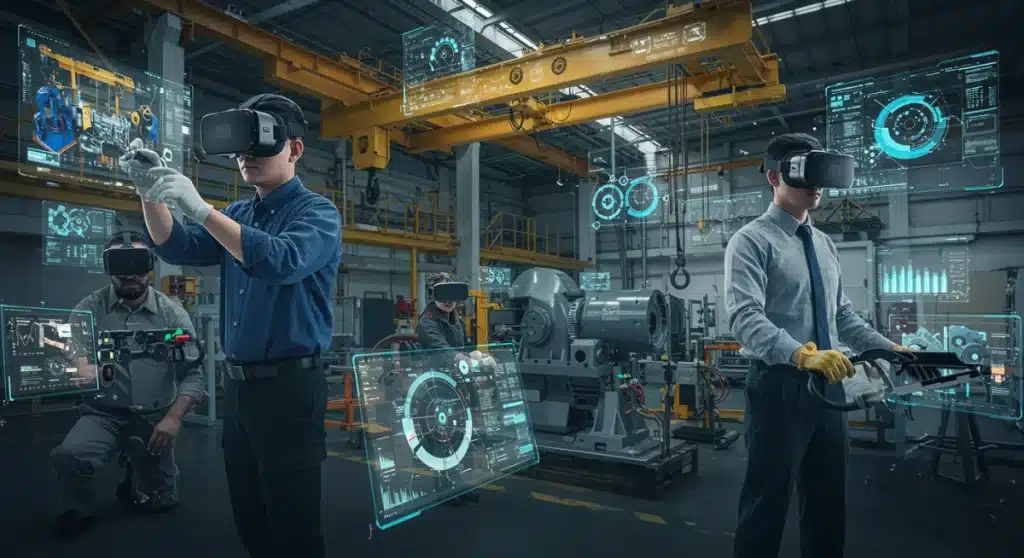
New VR training apps launching in 2026 are poised to redefine industrial skill development by providing highly immersive, realistic, and cost-effective learning environments for a variety of complex tasks.
The industrial sector is on the cusp of a profound transformation, driven by innovative technologies. Among these,
VR Training Apps: Uncovering 3 New Releases Transforming Industrial Skill Development in 2026
are emerging as a game-changer, promising to reshape how professionals acquire and refine critical skills. This evolution is not merely incremental; it represents a fundamental shift towards more immersive, efficient, and ultimately safer training methodologies.
The Dawn of Next-Gen Industrial VR Training
Virtual reality is no longer a futuristic concept confined to gaming; it has matured into a powerful tool for enterprise, particularly in industrial training. As we approach 2026, the capabilities of VR training apps are expanding dramatically, moving beyond basic simulations to offer highly sophisticated, data-driven learning experiences. These advancements are critical for industries facing complex operational challenges and the need for continuous skill upgrades.
The integration of artificial intelligence and haptic feedback into VR environments is creating training scenarios that are indistinguishable from real-world operations. This level of immersion not only accelerates learning but also significantly enhances retention and confidence among trainees. The new releases we are examining represent the pinnacle of this technological convergence.
Why VR is Critical for Industrial Skill Development
Traditional training methods, while foundational, often fall short in preparing workers for high-stakes, complex industrial environments. The cost of errors, the danger of physical training, and the logistical challenges of large-scale instruction necessitate a more innovative approach. VR offers a compelling solution.
- Safety First: Trainees can practice dangerous procedures without risk.
- Cost Efficiency: Reduces expenses associated with equipment damage, travel, and downtime.
- Scalability: Easily deployable to a large workforce across different locations.
- Consistent Quality: Ensures every trainee receives the same high-quality instruction.
The strategic adoption of VR training apps is not just about leveraging new technology; it’s about building a more resilient, skilled, and safer industrial workforce for the future. The forthcoming applications are designed to address these needs head-on, providing solutions that are both practical and transformative.
App Release 1: ‘Pro-Mech VR’ – Precision Assembly & Maintenance
Our first spotlighted application, ‘Pro-Mech VR,’ is poised to redefine precision assembly and maintenance training across various industrial sectors. Developed by Innovatech Solutions, this app focuses on intricate mechanical procedures, offering a level of detail and realism previously unattainable in virtual environments. Trainees interact with highly accurate 3D models of machinery, learning every bolt, wire, and component.
The core strength of Pro-Mech VR lies in its advanced haptic feedback system, which simulates the tactile sensations of working with tools and materials. This allows users to ‘feel’ resistance, torque, and even texture, providing a truly immersive and effective learning experience. The app also incorporates AI-driven performance analytics, offering personalized feedback and identifying areas for improvement in real-time.
Key Features of Pro-Mech VR
Pro-Mech VR is built around a modular learning system, allowing industrial trainers to customize modules based on specific equipment and operational needs. This flexibility ensures that the training is always relevant and up-to-date with evolving industry standards.
- Modular Training Scenarios: Adaptable content for diverse machinery.
- Real-time Performance Metrics: AI-powered feedback on accuracy and efficiency.
- Multi-user Collaboration: Enables team-based training in a shared virtual space.
- Troubleshooting Simulations: Challenges users to diagnose and fix virtual malfunctions.
The impact of Pro-Mech VR is expected to be significant, particularly in manufacturing, aerospace, and energy sectors where precision and attention to detail are paramount. By reducing training time and improving skill proficiency, this app promises substantial operational benefits. Its ability to simulate complex failure scenarios safely also means a reduction in real-world accidents and equipment damage, making it a valuable asset for any industrial operation.
App Release 2: ‘Site-Safe VR’ – Advanced Safety & Emergency Protocols
Safety is paramount in any industrial setting, and ‘Site-Safe VR’ by Guardian Systems is set to revolutionize how organizations train their workforce in advanced safety protocols and emergency response. This application excels in creating highly stressful yet controlled virtual environments where trainees can practice critical decision-making without any actual risk.
Site-Safe VR goes beyond basic hazard identification, immersing users in realistic scenarios such as chemical spills, equipment failures, and fire emergencies. The app dynamically adjusts conditions based on trainee actions, providing a truly adaptive learning path. This ensures that every individual learns to react effectively under pressure, a skill difficult to cultivate through traditional classroom methods.
Innovations in Safety Training
The developers of Site-Safe VR have integrated psychological stress simulations that mimic the cognitive load experienced in real emergencies. This feature, combined with detailed procedural checklists and immediate debriefing tools, makes it an unparalleled platform for safety education.
- Dynamic Emergency Scenarios: Adaptive challenges based on user input.
- Behavioral Analytics: Tracks decision-making and adherence to protocols.
- Virtual Incident Commander Module: Trains leaders in crisis management.
- Global Regulatory Compliance: Customizable modules for region-specific safety standards.
The potential for Site-Safe VR to reduce workplace accidents and improve emergency response times is immense. By providing a safe space for repeated practice and immediate feedback, industrial companies can ensure their employees are not just aware of safety procedures, but are truly proficient in executing them when it matters most. This app is a vital step forward in creating safer working environments across industries.
App Release 3: ‘LogisticsFlow VR’ – Optimized Supply Chain Operations
The efficiency of supply chain operations is a critical determinant of industrial success, and ‘LogisticsFlow VR’ from OmniLogistics is designed to optimize this complex domain. This innovative VR training app focuses on warehouse management, inventory control, and advanced logistics planning, offering a comprehensive virtual sandbox for operational excellence.
LogisticsFlow VR allows trainees to manage entire virtual warehouses, operating forklifts, managing stock, and optimizing picking routes in a highly detailed, simulated environment. The app integrates real-time data analytics, enabling users to understand the impact of their decisions on efficiency, cost, and delivery times. This experiential learning approach helps develop a holistic understanding of supply chain dynamics.
Revolutionizing Logistics Training
The app’s ability to simulate various logistical challenges, from sudden demand spikes to equipment breakdowns, provides invaluable experience. It fosters strategic thinking and problem-solving skills crucial for navigating the complexities of modern supply chains. The multi-user mode supports collaborative training, allowing teams to work together on optimizing a shared virtual logistics network.
- Warehouse Simulation: Realistic handling of inventory and equipment.
- Route Optimization Challenges: Practice efficient pathfinding and delivery.
- Demand Forecasting Exercises: Learn to anticipate and respond to market changes.
- Resource Allocation Drills: Optimize staffing and equipment deployment.
LogisticsFlow VR is set to transform the training landscape for logistics professionals, equipping them with the skills needed to enhance operational efficiency, reduce errors, and streamline global supply chains. Its practical, hands-on approach ensures that trainees are not just learning theory, but are actively applying and refining their skills in a realistic, consequence-free environment, making it an indispensable tool for the future of industrial logistics.
The Impact of VR Training on Industrial Skill Retention
One of the most compelling advantages of VR training apps is their profound impact on skill retention. Unlike passive learning methods, immersive VR experiences engage multiple senses and cognitive functions, leading to stronger memory consolidation. When trainees actively perform tasks in a realistic virtual environment, their brains process the information more deeply, resulting in longer-lasting knowledge and skill acquisition.
Research consistently shows that experiential learning, especially when combined with immediate feedback, significantly outperforms traditional classroom or video-based instruction in terms of retention. VR platforms provide this ideal combination, allowing for repeated practice until mastery is achieved, without the constraints or risks of the real world. This iterative process of learning, doing, and receiving feedback is crucial for building robust industrial skills.
Measuring Long-Term Efficacy
The new generation of VR training apps, including Pro-Mech VR, Site-Safe VR, and LogisticsFlow VR, incorporate sophisticated analytics engines. These systems track user performance, identify common errors, and measure progress over time. This data is invaluable for trainers, allowing them to pinpoint areas where additional practice is needed and to demonstrate the tangible benefits of VR training to stakeholders.
- Performance Analytics Dashboard: Visualizes individual and team progress.
- Skill Decay Tracking: Monitors how long skills are retained post-training.
- Personalized Learning Paths: Adapts content based on trainee performance.
- ROI Justification: Provides data to quantify the value of VR investment.
Ultimately, the goal of industrial training is to create a highly competent workforce capable of performing complex tasks safely and efficiently. By enhancing skill retention, VR training apps are not just improving individual capabilities; they are contributing to the overall productivity, safety, and resilience of entire industrial operations. The long-term efficacy of these platforms is set to redefine industry benchmarks for workforce development.
Integrating VR Training into Existing Industrial Workflows
The successful adoption of new VR training apps in industrial settings hinges on their seamless integration into existing workflows. It’s not enough to simply introduce cutting-edge technology; businesses must strategically embed VR training into their broader talent development and operational processes. This requires careful planning, stakeholder buy-in, and a clear understanding of how VR complements, rather than replaces, current methodologies.
Many organizations are exploring hybrid training models, where VR simulations provide initial skill acquisition and safe practice, followed by on-the-job experience under supervision. This blended approach maximizes the benefits of both virtual and real-world learning, ensuring that employees are well-prepared before they encounter high-stakes situations. The modular nature of modern VR apps facilitates this integration, allowing companies to deploy specific modules as needed.
Strategies for Smooth Implementation
Successful integration involves more than just purchasing headsets and software. It requires a cultural shift, IT infrastructure readiness, and ongoing support for both trainees and trainers. Companies should start with pilot programs, gather feedback, and scale up incrementally to ensure a smooth transition and maximize adoption rates.
- Phased Rollout: Implement VR in stages, starting with critical areas.
- Trainer Certification Programs: Equip instructors to leverage VR effectively.
- IT Infrastructure Assessment: Ensure network and hardware support VR demands.
- Feedback Loops: Continuously improve content based on user experience.
By treating VR training as an integral component of their human capital strategy, industrial businesses can unlock its full potential. The goal is to create a continuous learning environment where employees can access relevant, high-quality training whenever and wherever they need it, driving continuous improvement and innovation across the organization. The future of industrial skill development is collaborative, adaptive, and increasingly virtual, making thoughtful integration a top priority for businesses aiming to stay competitive.
The Future Outlook for Industrial Skill Development with VR
Looking ahead, the trajectory for industrial skill development with VR is incredibly promising. The three new VR training apps – Pro-Mech VR, Site-Safe VR, and LogisticsFlow VR – are just a glimpse into the innovations we can expect by 2026 and beyond. We are moving towards a future where VR training is not merely a supplementary tool but a core component of every industrial organization’s talent development strategy.
Further advancements in haptic technology, AI-driven adaptive learning, and cloud-based VR platforms will make these applications even more accessible, realistic, and personalized. Imagine VR environments that can perfectly replicate the atmospheric conditions, sounds, and even unpredictable variables of a real industrial site, offering an unparalleled level of preparedness for workers.
Emerging Trends and Beyond 2026
The convergence of VR with other emerging technologies, such as augmented reality (AR) and digital twins, will create even richer training ecosystems. AR could provide real-time guidance during physical tasks, while digital twins could offer hyper-realistic simulations of entire factory operations, allowing for predictive maintenance training and process optimization on an unprecedented scale.
- Hyper-Realistic Simulations: Enhanced sensory feedback and environmental replication.
- AI-Powered Mentors: Virtual instructors offering personalized, on-demand coaching.
- Integration with Digital Twins: Real-time training on virtual replicas of assets.
- Cross-Platform Compatibility: Seamless training experiences across various VR devices.
The continuous evolution of VR training apps will not only elevate individual skill levels but also foster a culture of continuous learning and innovation within the industrial sector. Companies that embrace these technologies will be better positioned to adapt to rapid technological changes, maintain competitive advantages, and ensure the safety and productivity of their workforce. The future of industrial skill development is immersive, intelligent, and incredibly exciting, with VR leading the charge.
| Key Aspect | Brief Description |
|---|---|
| Pro-Mech VR | Focuses on precision assembly and maintenance with advanced haptic feedback for intricate mechanical tasks. |
| Site-Safe VR | Specializes in advanced safety protocols and emergency response training in high-stress virtual scenarios. |
| LogisticsFlow VR | Optimizes supply chain operations, including warehouse management and inventory control, through immersive simulations. |
| Skill Retention | VR’s immersive nature significantly enhances long-term knowledge and skill retention compared to traditional methods. |
Frequently Asked Questions About VR Training Apps
VR training offers immersive, hands-on experiences in risk-free environments, allowing for repeated practice and immediate feedback. This active engagement leads to significantly higher skill retention and faster learning compared to passive methods like lectures or videos, making it ideal for complex industrial tasks.
While the highlighted apps focus on precision mechanics, safety, and logistics, the underlying VR technology is highly adaptable. Many VR training solutions are being developed or customized for a wide range of sectors, including healthcare, construction, and energy, addressing their unique skill development needs.
These advanced VR training apps typically require high-fidelity VR headsets, such as those from Meta Quest Pro, Varjo XR-3, or HTC Vive Focus 3, along with powerful computing systems to handle the complex simulations and graphics. Some also benefit from specialized haptic feedback devices for enhanced realism.
Modern VR training apps integrate sophisticated analytics engines that track user movements, decision-making, task completion times, and error rates. This data is then used to generate performance reports, identify areas for improvement, and personalize future training modules, ensuring continuous skill development.
Initial investment includes VR hardware and software licenses. However, the long-term benefits often outweigh these costs, through reduced accident rates, minimized equipment damage, decreased travel expenses for trainers, and accelerated skill acquisition, ultimately leading to a strong return on investment.
Conclusion
The advent of new VR Training Apps: Uncovering 3 New Releases Transforming Industrial Skill Development in 2026 marks a pivotal moment for industries worldwide. With applications like Pro-Mech VR, Site-Safe VR, and LogisticsFlow VR leading the charge, the future of workforce development is undeniably immersive, efficient, and safer. These platforms are not just technological novelties; they are essential tools that will empower professionals with the critical skills needed to navigate the complexities of modern industrial environments, driving innovation and operational excellence for years to come. The widespread adoption and continuous evolution of VR in training promise a more skilled, confident, and resilient global workforce.