6 Most Impactful VR Education Apps for K-12 Learning
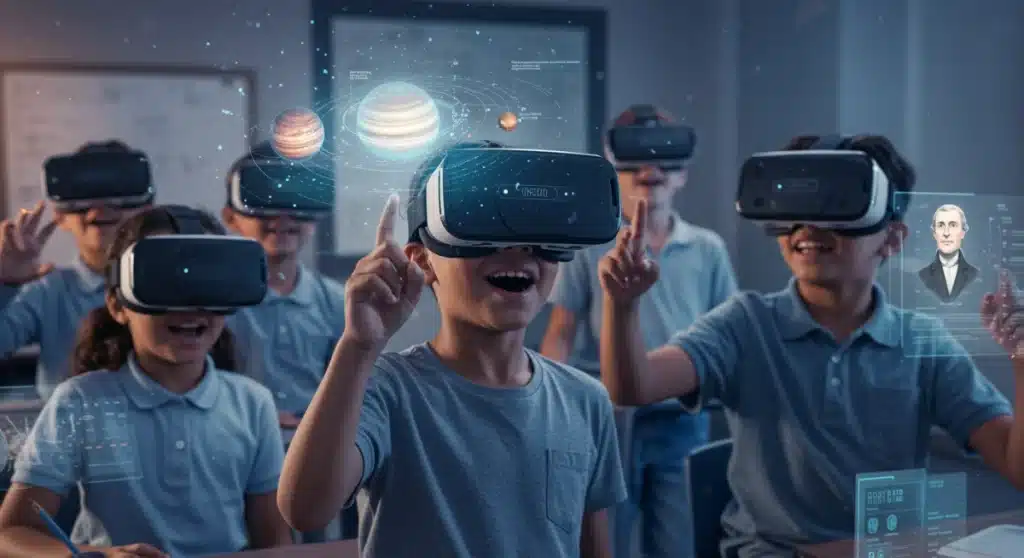
The past three months have seen a surge in innovative VR education apps for K-12 learning, offering transformative immersive experiences that are reshaping how students engage with complex subjects and fostering deeper understanding across various disciplines.
The landscape of educational technology is rapidly evolving, and virtual reality (VR) stands at the forefront of this transformation. For K-12 learning, the integration of VR promises not just engagement, but a profound shift in how students interact with information. We are particularly interested in VR education apps K-12 that have emerged as game-changers in the last quarter, offering unparalleled immersive experiences that go beyond traditional textbooks and lectures. These applications are not merely digital tools; they are gateways to understanding, exploration, and discovery.
The Rise of Immersive Learning in K-12 Education
Virtual reality is no longer a futuristic concept; it’s a present-day reality rapidly integrating into educational systems, especially within K-12 environments. The past few months have been particularly dynamic, with a significant increase in the development and release of sophisticated VR education apps designed to meet the unique needs of younger learners. This surge reflects a growing recognition among educators and developers of VR’s potential to create engaging, memorable, and effective learning experiences.
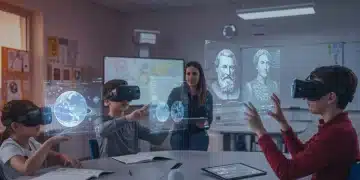
The shift towards immersive learning is driven by several factors, including the need for more interactive content, the desire to cater to diverse learning styles, and the proven ability of VR to enhance retention rates. By placing students directly within historical events, scientific phenomena, or complex mathematical concepts, VR transcends the limitations of two-dimensional learning, offering a depth of understanding previously unattainable. It’s about moving from passive consumption of information to active participation in the learning process.
Engaging Students Through Virtual Worlds
One of the primary benefits of VR in K-12 education is its unparalleled ability to engage students. Traditional classroom settings can sometimes struggle to capture and maintain student attention, especially with abstract or challenging subjects. VR, however, transforms these subjects into interactive adventures.
- Increased Motivation: Students are more eager to learn when the experience is fun and novel.
- Enhanced Curiosity: Immersive environments naturally spark questions and encourage exploration.
- Personalized Learning Paths: Many VR apps offer adaptive content that adjusts to individual student progress.
Furthermore, VR provides a safe space for experimentation. Imagine dissecting a virtual frog without the ethical concerns or mess, or exploring the surface of Mars from the comfort of a classroom. These experiences are not only highly engaging but also provide practical skills and knowledge that would be impossible to acquire through conventional methods. The recent wave of apps particularly focuses on making these complex topics accessible and exciting for young minds, paving the way for a generation of highly motivated learners.
The continued innovation in VR education apps for K-12 is setting new benchmarks for what’s possible in the classroom, offering tools that are both powerful and intuitive. This evolution signifies a broader trend towards experiential learning, where students learn by doing, seeing, and interacting within a simulated environment.
App 1: ‘Ancient Worlds VR’ – History Comes Alive
Among the most impactful releases is ‘Ancient Worlds VR,’ an application that has redefined how K-12 students experience history. Instead of reading about ancient civilizations, students are transported directly into them. Released just two months ago, this app allows users to walk through the streets of ancient Rome, explore the pyramids of Egypt, or witness a bustling marketplace in classical Greece. The attention to historical detail is meticulous, providing an authentic and deeply immersive journey through time.
The app’s developers collaborated with historians and archaeologists to ensure accuracy, making it a reliable resource for educators. Its intuitive interface means even younger K-12 students can navigate these complex environments with ease. The app features guided tours, interactive artifacts, and even opportunities to virtually converse with historical figures, all designed to make historical events tangible and relatable.
Key Features of Ancient Worlds VR
- Interactive Recreations: Detailed virtual environments of ancient cities and landmarks.
- Historical Narratives: Engaging stories and facts presented contextually within the virtual world.
- Artifact Exploration: Students can pick up, examine, and learn about various historical artifacts.
This app excels in bridging the gap between abstract historical facts and a student’s lived experience. By allowing students to literally step into the past, ‘Ancient Worlds VR’ fosters a deeper appreciation for history and culture. It moves beyond rote memorization, encouraging critical thinking and empathy as students observe and interact with past societies. Its impact on K-12 history curricula is already being felt, with many educators reporting increased student engagement and better comprehension of historical concepts.
‘Ancient Worlds VR’ is a testament to how VR can transform seemingly dry subjects into vibrant, unforgettable learning adventures. Its success lies in its ability to combine educational rigor with compelling immersive storytelling, making history accessible and exciting for every student.
App 2: ‘EcoExplorer’ – Environmental Science in Your Hands
‘EcoExplorer,’ launched a month and a half ago, is another standout application that brings environmental science to life for K-12 students. This app allows users to explore diverse ecosystems, from dense rainforests to fragile coral reefs, providing an unparalleled perspective on biodiversity and ecological processes. It’s designed to teach complex environmental concepts through direct observation and interaction, making abstract ideas like climate change and conservation tangible.
Students can observe wildlife in their natural habitats, understand food chains, and even simulate the impact of human activities on various environments. The app’s strength lies in its ability to present intricate scientific data in an accessible and visually stunning format. Teachers can guide students through specific modules, focusing on topics such as deforestation, pollution, or renewable energy sources, all within a safe and controlled virtual environment.
Understanding Ecosystems Through Immersion
‘EcoExplorer’ uses immersive scenarios to teach critical environmental principles. For instance, students might be tasked with managing a virtual forest, making decisions about logging, replanting, and wildlife protection, and then observing the long-term consequences of their choices. This hands-on approach reinforces learning far more effectively than traditional methods.
- Virtual Field Trips: Explore remote and endangered ecosystems without leaving the classroom.
- Interactive Simulations: Understand cause-and-effect relationships in environmental science.
- Conservation Challenges: Engage in problem-solving scenarios related to environmental protection.
The app fosters a sense of responsibility and global citizenship by allowing students to witness the delicate balance of nature and the impact of human actions. It encourages them to think critically about environmental issues and inspires potential solutions. ‘EcoExplorer’ is not just an educational tool; it’s a call to action, empowering K-12 students to become informed and active participants in protecting our planet. Its recent release marks a significant step forward in making environmental education both comprehensive and captivating.
App 3: ‘MathMatrix VR’ – Making Algebra Engaging
Mathematics, particularly algebra, often presents a significant challenge for K-12 students. ‘MathMatrix VR,’ released approximately two months ago, addresses this by transforming abstract mathematical concepts into interactive, three-dimensional puzzles and challenges. The app aims to demystify algebra by allowing students to manipulate variables, visualize equations, and solve problems in an engaging virtual space. It’s a fresh approach that moves beyond traditional whiteboards and textbooks.
The app introduces algebraic principles through a series of gamified levels, where students use virtual tools to balance equations, graph functions, and understand geometric transformations. The visual and kinesthetic learning opportunities provided by ‘MathMatrix VR’ are particularly beneficial for students who struggle with abstract mathematical concepts. It breaks down complex problems into manageable, interactive components, making the learning process less intimidating and more intuitive.
Visualizing Abstract Concepts
One of the core strengths of ‘MathMatrix VR’ is its ability to make abstract mathematical concepts tangible. Students can literally see how changing a variable affects a graph or how different geometric shapes interact in three dimensions. This visualization helps in building a stronger foundational understanding.
- Interactive Equation Solving: Manipulate virtual variables to solve algebraic problems.
- 3D Graphing: Visualize functions and their transformations in a three-dimensional space.
- Gamified Challenges: Solve math puzzles to advance through levels, making learning fun.
‘MathMatrix VR’ has quickly gained traction among educators for its innovative approach to teaching algebra. It not only improves problem-solving skills but also builds confidence in students who might otherwise be daunted by mathematics. By turning math into an interactive adventure, this app proves that even the most challenging subjects can be made accessible and enjoyable through VR. Its impact on K-12 math education is already notable, fostering a generation that views algebra as an exciting challenge rather than a daunting hurdle.
App 4: ‘Anatomy Atlas VR’ – Exploring the Human Body
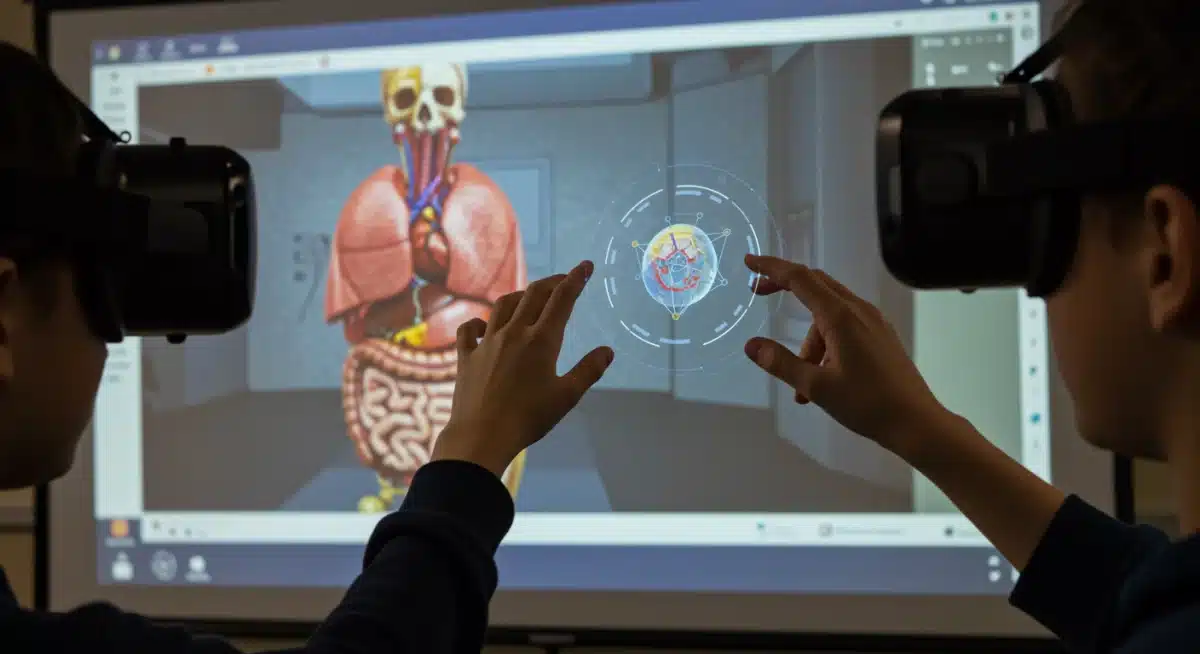
For biology and health classes, ‘Anatomy Atlas VR’ stands out as a revolutionary tool, having been released just last month. This application offers K-12 students an unprecedented opportunity to explore the human body in intricate detail. Far surpassing static diagrams or plastic models, ‘Anatomy Atlas VR’ provides a fully interactive, three-dimensional representation of organs, systems, and cellular structures. Students can virtually dissect, zoom in on microscopic details, and understand the complex interconnections within the human anatomy.
The app features guided tours through different body systems, allowing students to learn about the circulatory, nervous, skeletal, and muscular systems with a level of immersion that fosters deep comprehension. It also includes interactive quizzes and challenges to reinforce learning, making it a comprehensive resource for anatomical study. The accuracy and visual fidelity of the models are exceptional, providing a realistic and engaging learning experience for aspiring scientists and health professionals.
Detailed Anatomical Exploration
‘Anatomy Atlas VR’ allows students to virtually walk through arteries, examine the structure of a neuron, or observe the beating of a heart from within. This level of detail and interactivity transforms the study of anatomy from a memorization task into an exciting journey of discovery.
- Virtual Dissections: Explore organs and systems without the need for physical specimens.
- Microscopic Views: Zoom in to observe cellular structures and tissue organization.
- System Overviews: Understand the functions and relationships of various body systems.
This app is particularly impactful for K-12 students as it demystifies the human body, making complex biological processes understandable and engaging. It provides a foundational understanding that is crucial for further studies in science and medicine. ‘Anatomy Atlas VR’ is not just an educational tool; it’s an experience that can inspire a lifelong interest in biology and health, proving the immense value of VR in scientific education.
App 5: ‘CodeQuest VR’ – Introduction to Programming
‘CodeQuest VR,’ launched within the last three months, offers an innovative and highly engaging introduction to programming for K-12 students. Recognizing the growing importance of computational thinking and coding skills, this app transforms the often-abstract world of computer science into a series of interactive, gamified challenges within a virtual environment. Students learn foundational coding concepts, logic, and problem-solving through hands-on virtual activities.
The app introduces block-based coding, similar to popular educational programming languages, but elevates the experience by placing students within a 3D world where their code directly influences virtual robots, builds structures, or solves puzzles. This immediate visual feedback makes abstract coding concepts concrete and understandable. ‘CodeQuest VR’ is designed to be accessible for beginners, gradually introducing more complex ideas as students progress through its various modules.
Gamified Coding Challenges
The gamified approach of ‘CodeQuest VR’ keeps students motivated and encourages them to experiment with different coding solutions. Each challenge presents a new problem that requires logical thinking and the application of programming principles to solve, making learning an active process.
- Block-Based Coding: Learn programming fundamentals through visual, drag-and-drop blocks.
- Interactive Environments: See code come to life by controlling virtual objects and characters.
- Problem-Solving Puzzles: Develop computational thinking skills through engaging challenges.
‘CodeQuest VR’ is proving to be incredibly impactful in K-12 education by making programming less intimidating and more fun. It fosters critical thinking, creativity, and logical reasoning—skills that are essential in today’s digital age. By providing a playful yet rigorous introduction to coding, this app is helping to cultivate the next generation of innovators and technologists, ensuring K-12 students are well-prepared for a future driven by technology.
App 6: ‘Global Connect VR’ – Cultural Exchange and Language Learning
‘Global Connect VR,’ a recent release from the past three months, is an exceptional application designed to foster cultural understanding and facilitate language learning among K-12 students. This app creates virtual spaces where students can interact with peers from different countries, explore global landmarks, and participate in cultural exchanges, all within an immersive VR environment. It breaks down geographical barriers, offering a unique opportunity for students to experience the world without leaving their classroom.
The app features virtual tours of famous cities, museums, and historical sites around the globe, accompanied by information presented in multiple languages. Students can engage in guided conversations with AI characters fluent in various languages, practicing their speaking and listening skills in a low-pressure environment. It also includes collaborative projects where students from different schools can work together on virtual tasks, promoting teamwork and cross-cultural communication.
Fostering Global Citizenship
‘Global Connect VR’ is more than just a language learning tool; it’s a platform for global citizenship. By exposing students to diverse cultures and perspectives, it promotes empathy, understanding, and respect for differences. The interactive nature of the app makes learning about other cultures an exciting and personal experience.
- Virtual Cultural Tours: Explore landmarks and cultural sites worldwide.
- Language Practice: Engage in conversations with AI or other students in various languages.
- Collaborative Projects: Work with international peers on shared virtual tasks.
The impact of ‘Global Connect VR’ on K-12 education is significant, as it prepares students to thrive in an increasingly interconnected world. It not only enhances language proficiency but also broadens horizons and instills a sense of global awareness. This app exemplifies how VR can be used to connect students across continents, fostering a more inclusive and understanding global community, making it one of the most impactful VR education apps K-12 has seen recently.
| App Name | Key Educational Impact |
|---|---|
| Ancient Worlds VR | Transforms history learning into immersive experiences, making past events tangible. |
| EcoExplorer | Provides hands-on environmental science education and promotes conservation awareness. |
| MathMatrix VR | Makes algebra engaging and visual, helping students grasp abstract mathematical concepts. |
| Anatomy Atlas VR | Offers detailed, interactive exploration of the human body for biology and health classes. |
Frequently Asked Questions About VR Education Apps
VR education apps offer immersive and interactive learning experiences, boosting student engagement, retention, and comprehension. They provide access to content that is otherwise impossible or impractical, such as virtual field trips or complex simulations, fostering deeper understanding and critical thinking skills.
VR apps cater to visual, auditory, and kinesthetic learners by providing rich visual content, audio narratives, and interactive elements. Students can explore, manipulate virtual objects, and engage in hands-on simulations, making learning accessible and effective for a broad range of individual preferences.
Developers prioritize safety and accessibility, designing apps with age-appropriate content and intuitive interfaces. Many incorporate features to minimize motion sickness and ensure content aligns with educational standards. Accessibility features for diverse needs are also increasingly integrated into newer applications.
Most impactful VR education apps require a compatible VR headset (e.g., Oculus Quest, Pico Neo) and a stable internet connection for downloads and updates. Some advanced applications may benefit from a powerful PC, but many are designed for standalone VR devices, making them more accessible for K-12 classrooms.
Educators can integrate VR apps as supplementary tools for specific lessons, virtual field trips, or project-based learning. They can use them to introduce complex topics, reinforce concepts, or provide unique experiential learning opportunities that enhance traditional teaching methods, aligning with curriculum goals.
Conclusion
The six VR education apps highlighted—’Ancient Worlds VR,’ ‘EcoExplorer,’ ‘MathMatrix VR,’ ‘Anatomy Atlas VR,’ ‘CodeQuest VR,’ and ‘Global Connect VR’—represent a significant leap forward in K-12 learning. Released within the last three months, these applications are not just technological novelties; they are powerful educational instruments that are reshaping how students engage with complex subjects, fostering deeper understanding, and cultivating critical 21st-century skills. From bringing history to life to demystifying coding, these apps leverage the immersive power of virtual reality to create unparalleled learning experiences. As VR technology continues to advance, we can expect even more innovative solutions that will further revolutionize education, ensuring that K-12 students are equipped with the knowledge and skills needed to thrive in an increasingly digital and interconnected world. The future of education is indeed immersive, and these apps are leading the charge.