Augmented Reality in Remote Work: Boost US Team Productivity by 25% by 2026
Augmented Reality in Remote Work: Boosting US Team Productivity by 25% by 2026
The landscape of work has undergone a seismic shift, with remote collaboration becoming not just a necessity but a cornerstone of modern business. As organizations continue to adapt to distributed teams, the quest for enhanced productivity and seamless interaction remains paramount. Enter Augmented Reality (AR) – a technology poised to revolutionize how US teams collaborate, learn, and innovate. Forecasts suggest that AR integration could lead to a remarkable 25% boost in productivity for US remote teams by 2026. This isn’t merely a futuristic fantasy; it’s a tangible evolution in how we work, offering unprecedented opportunities for efficiency and engagement.
The COVID-19 pandemic accelerated the adoption of remote work models, forcing businesses to quickly embrace digital tools for communication and project management. While video conferencing and cloud-based platforms have proven invaluable, they often fall short in replicating the richness and spontaneity of in-person interactions. This is where AR steps in, bridging the physical and digital divide to create more immersive, intuitive, and ultimately, more productive remote experiences. For US businesses looking to stay competitive and foster a highly engaged workforce, understanding and strategically implementing AR in their remote operations is no longer optional – it’s essential.
This comprehensive guide will delve into the transformative power of AR in remote work, exploring its core mechanisms, diverse applications, and the compelling benefits it offers. We will examine the current state of AR technology, project its future impact on US productivity, and provide actionable insights for businesses considering its adoption. From enhanced training to collaborative design and efficient field service, AR is reshaping every facet of remote operations. Prepare to discover how this innovative technology is not just changing how we work, but fundamentally improving it, setting the stage for a new era of remote productivity.
Understanding Augmented Reality: More Than Just a Gimmick
Before we explore its impact on remote work, it’s crucial to grasp what Augmented Reality truly is. Unlike Virtual Reality (VR), which completely immerses users in a simulated environment, AR overlays digital information onto the real world. Think of it as enhancing your existing reality with computer-generated sensory input, such as sound, video, graphics, or GPS data. This real-time interaction with digital content in a real-world context is what makes AR so powerful and versatile, especially for remote collaboration.
Modern AR experiences are delivered through a variety of devices, from smartphones and tablets to specialized AR headsets and smart glasses. These devices use cameras to capture the real environment, and then software processes this visual data to accurately place virtual objects or information within the user’s field of view. The key is the seamless blending of the physical and digital, allowing users to interact with both simultaneously. This fundamental difference from VR means AR doesn’t isolate users from their surroundings but rather enhances their perception and interaction with it.
The evolution of AR has been rapid, moving from early experimental stages to sophisticated applications being adopted by industries worldwide. Initial applications often focused on entertainment, such as games like Pokémon GO, but the enterprise potential quickly became evident. Today, AR is being leveraged for everything from retail and healthcare to manufacturing and education. Its ability to provide contextual, on-demand information and facilitate hands-on learning makes it an invaluable tool for complex tasks and collaborative environments. For US businesses, this means a shift from viewing AR as a novelty to recognizing it as a strategic asset for future growth and efficiency.
The core components of AR systems typically include: a camera for capturing the real world; a display for showing the augmented view; sensors (accelerometer, gyroscope, GPS) for tracking position and orientation; and a processor to handle the complex computations required for rendering and interaction. As these technologies become more advanced, compact, and affordable, the accessibility and widespread adoption of AR will only continue to grow. This technological maturation is a critical factor in its projected impact on remote productivity, making sophisticated AR experiences available to a broader range of remote workers and organizations.
The Remote Work Challenge: Why AR is the Solution
Remote work, while offering immense flexibility and cost savings, presents unique challenges. Communication can be less nuanced, team cohesion can suffer without physical proximity, and complex tasks requiring hands-on demonstration or shared physical space become significantly more difficult. Traditional remote tools often struggle to convey spatial information, demonstrate intricate procedures, or foster a true sense of co-presence. This is precisely where AR shines, offering solutions to these persistent remote work hurdles.
Bridging the Communication Gap
Video calls, while effective for face-to-face discussions, lack the ability to interact with shared physical objects or environments. AR allows remote team members to literally point, draw, and annotate directly onto a shared virtual object or even a real-world scene captured by another team member’s camera. Imagine an engineer in New York providing guidance to a technician in California, virtually highlighting a specific circuit on a machine and drawing a diagram that appears in the technician’s field of view. This level of contextual communication dramatically reduces misinterpretations and speeds up problem-solving.
Enhancing Collaboration and Co-presence
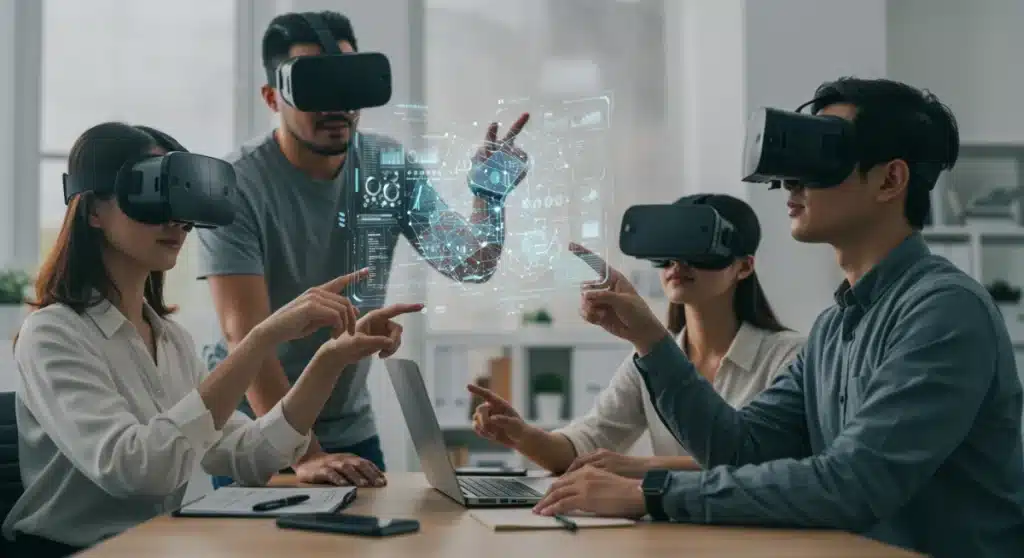
One of the biggest complaints about remote work is the feeling of isolation and the difficulty in fostering spontaneous collaboration. AR can create shared virtual workspaces where remote team members, represented by avatars, can interact with 3D models, diagrams, and data as if they were in the same room. This ‘co-presence’ can significantly improve brainstorming sessions, design reviews, and project planning, making remote collaboration feel more natural and engaging. The ability to manipulate and discuss virtual objects together in a shared AR space fosters a deeper level of understanding and teamwork.
Overcoming Geographical Barriers for Training and Support
Training new employees or providing expert support for complex equipment remotely can be a logistical nightmare. AR transforms this. Field technicians can receive real-time visual instructions overlaid onto the machinery they are working on, guided by a remote expert. New hires can undergo immersive, hands-on training simulations without needing to be physically present at a facility. This not only saves travel costs and time but also ensures a consistent and high-quality learning experience, regardless of location.
Key Applications of AR for Boosting Remote Productivity
The potential applications of AR in remote work are vast and continue to expand. Here are some of the most impactful areas where AR is already making a difference and is projected to drive significant productivity gains for US teams:
1. Remote Assistance and Field Service
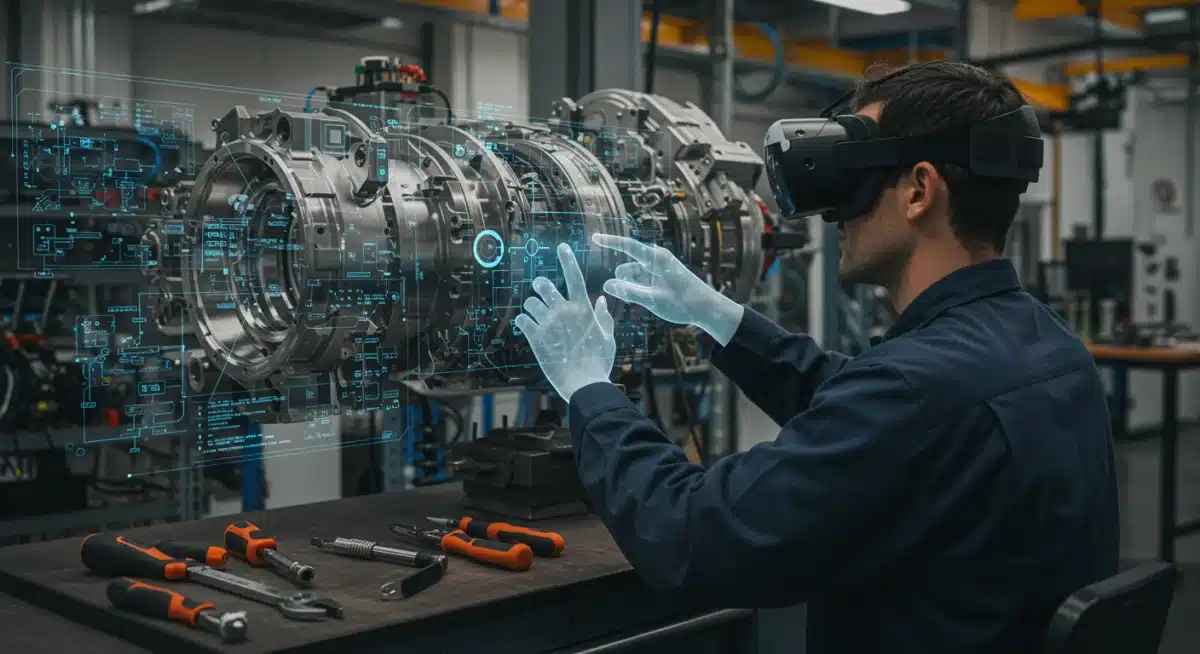
This is perhaps one of the most immediate and impactful applications of AR. Imagine a repair technician in a remote location encountering a complex issue with a piece of equipment. Instead of waiting for a specialist to travel, they can put on an AR headset. A remote expert can then see exactly what the technician sees, annotate the real-world view with instructions, diagrams, and arrows, guiding the technician step-by-step through the repair process. This reduces downtime, minimizes errors, and eliminates the need for expensive and time-consuming travel. Industries like manufacturing, energy, and utilities are already seeing massive returns on investment here.
2. Collaborative Design and Prototyping
For design teams working on anything from product development to architecture, AR offers an unparalleled collaborative environment. Instead of sharing 2D drawings or static 3D models, teams can review and manipulate holographic 3D prototypes in a shared AR space. Designers, engineers, and clients, regardless of their physical location, can walk around a virtual model, make real-time adjustments, and provide feedback as if they were together in a physical lab. This iterative and immersive design process significantly accelerates development cycles and reduces costly rework.
3. Immersive Training and Onboarding
Traditional remote training often relies on video tutorials and static manuals, which can be less engaging and effective for hands-on skills. AR transforms training by allowing remote employees to practice complex procedures in a safe, virtual environment. New factory workers can learn to operate machinery, medical students can practice surgical techniques, or sales teams can rehearse product demonstrations – all augmented with digital overlays and guided instructions. This leads to faster skill acquisition, higher retention rates, and a more confident workforce, all without the need for physical presence.
4. Enhanced Project Management and Visualization
Project managers can leverage AR to visualize project timelines, data analytics, and task assignments in a spatial, interactive format. Instead of looking at flat dashboards, they can see holographic representations of project progress, identify bottlenecks, and allocate resources more effectively. For construction projects, AR can overlay BIM (Building Information Modeling) data onto a physical site, allowing remote supervisors to monitor progress, identify discrepancies, and ensure compliance without being physically present.
5. Virtual Meetings and Presentations
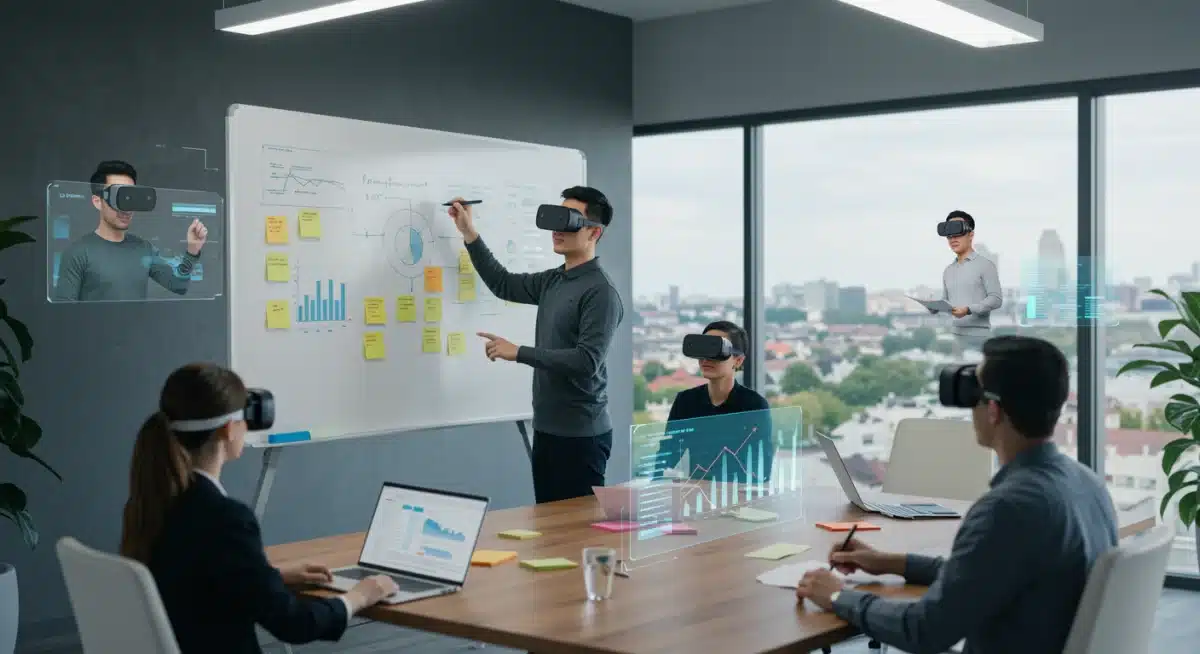
While video conferencing has become ubiquitous, AR takes virtual meetings to the next level. Imagine a boardroom where team members, represented by lifelike avatars, can interact with holographic presentations, 3D models, and shared documents. This creates a more engaging and immersive meeting experience, fostering better communication and decision-making than traditional screen-sharing. It helps to recreate the feeling of being in the same room, reducing ‘Zoom fatigue’ and enhancing the quality of remote interactions.
Quantifying the Productivity Boost: The 25% Projection by 2026
The prediction of a 25% boost in productivity for US remote teams by 2026 is not an arbitrary figure. It’s based on current trends, pilot program results, and expert analysis of AR’s capabilities. Several factors contribute to this significant projected increase:
- Reduced Travel and Downtime: AR-powered remote assistance drastically cuts the need for experts to travel, saving countless hours and associated costs. For field service alone, this can translate into faster repairs and reduced operational downtime.
- Faster Training and Skill Acquisition: Immersive AR training modules lead to quicker learning curves and higher retention rates, meaning employees become proficient faster and make fewer mistakes. This directly impacts efficiency and output.
- Improved Decision-Making: By providing contextual, real-time information and allowing for richer data visualization, AR enables better-informed and faster decision-making, particularly in complex scenarios.
- Fewer Errors and Rework: Enhanced visualization in design, coupled with guided instructions in manufacturing or maintenance, significantly reduces the likelihood of errors, saving time and resources that would otherwise be spent on corrections.
- Enhanced Collaboration and Engagement: More immersive and intuitive collaborative environments foster greater team cohesion and engagement, leading to more innovative solutions and a more motivated workforce.
Studies and early adopters have already reported impressive gains. For instance, companies using AR for remote field service have seen a 30-40% reduction in resolution times and a significant decrease in repeat visits. Manufacturing firms implementing AR for assembly and quality control have reported double-digit percentage improvements in efficiency and error reduction. As AR technology matures and becomes more accessible, these gains will become more widespread across diverse industries and job functions within the US remote workforce.
The 25% figure represents an aggregate productivity gain across various sectors, taking into account the varying levels of AR adoption and the specific types of tasks it can augment. It’s a conservative yet ambitious estimate, reflecting the transformative potential of this technology to optimize workflows, empower workers, and unlock new levels of efficiency in the remote paradigm.
Challenges and Considerations for AR Adoption
While the benefits are compelling, integrating AR into remote workforces isn’t without its challenges. US businesses must consider several factors before widespread adoption:
1. Cost of Hardware and Software
High-end AR headsets can be expensive, and developing custom AR applications requires specialized expertise and investment. However, as the technology matures, hardware costs are decreasing, and more off-the-shelf software solutions are becoming available. Businesses need to conduct a thorough cost-benefit analysis to justify the initial investment, focusing on long-term ROI.
2. Technical Infrastructure
Robust network connectivity (especially 5G) is crucial for seamless AR experiences, particularly for real-time remote assistance and large 3D model streaming. Companies must ensure their remote workers have access to adequate bandwidth and reliable internet infrastructure. Data security and privacy are also paramount, requiring secure AR platforms and data handling protocols.
3. User Adoption and Training
Introducing new technology always comes with a learning curve. Employees need proper training on how to use AR devices and software effectively. User-friendly interfaces and intuitive designs will be key to successful adoption. Overcoming initial resistance and demonstrating the clear benefits to end-users will be critical for widespread acceptance.
4. Integration with Existing Systems
For AR to be truly effective, it needs to integrate seamlessly with existing enterprise systems, such as CRM, ERP, and CAD software. This ensures that AR applications can access and leverage relevant company data, providing a holistic and integrated workflow rather than a standalone tool.
5. Ethical Considerations
As AR becomes more pervasive, ethical considerations regarding data privacy, surveillance, and potential digital fatigue must be addressed. Companies need to establish clear guidelines and policies to ensure responsible and ethical use of AR technology in the workplace.
Implementing AR in Your US Remote Team: A Strategic Roadmap
For US businesses eager to harness the power of AR, a strategic and phased approach to implementation is recommended:
1. Identify Pain Points and Use Cases
Start by identifying specific areas within your remote operations where traditional tools fall short and where AR could offer a significant improvement. This could be in remote diagnostics, complex assembly, collaborative design, or employee training. Focusing on high-impact use cases will provide early wins and build momentum.
2. Pilot Programs and Proof of Concept
Begin with small-scale pilot programs. Equip a limited number of remote teams or individuals with AR devices and software relevant to your identified use cases. Gather feedback, measure productivity gains, and refine the implementation based on real-world experience. A successful proof of concept is vital for securing wider organizational buy-in.
3. Choose the Right Technology Stack
Evaluate various AR hardware (headsets, smart glasses, mobile AR) and software platforms. Consider factors like ease of use, integration capabilities, scalability, and security. Partnering with experienced AR solution providers can be beneficial, especially for custom application development.
4. Comprehensive Training and Support
Invest in thorough training programs for all users. Provide ongoing technical support and create a culture where employees feel comfortable experimenting and providing feedback on the AR tools. Highlighting the personal and professional benefits of AR for individual employees will encourage adoption.
5. Measure and Iterate
Continuously monitor key performance indicators (KPIs) related to productivity, efficiency, error rates, and employee satisfaction. Use this data to iterate on your AR strategy, optimize applications, and expand implementation to other areas of your remote operations. The AR journey is an ongoing process of refinement and adaptation.
The Future is Augmented: A Competitive Edge for US Businesses
The integration of Augmented Reality into remote collaboration is not just a technological upgrade; it’s a fundamental shift in how work gets done. For US businesses, embracing AR offers a significant competitive advantage. It allows companies to attract and retain top talent by offering cutting-edge tools, enhances operational efficiency, reduces costs, and fosters innovation.
By 2026, the 25% productivity boost projected for US remote teams powered by AR will translate into billions of dollars in economic value, allowing businesses to achieve more with less, react faster to market changes, and deliver superior products and services. Companies that proactively invest in and strategically implement AR capabilities will be well-positioned to lead in the evolving global economy.
The future of remote work is augmented, collaborative, and highly efficient. As AR technology continues to advance, its applications will become even more sophisticated and integrated into our daily workflows. Prepare your US team for this transformation, and unlock a new era of productivity and innovation.