VR Hardware Connectivity 2026: USB-C & Wi-Fi 6E for US Business

The landscape of Virtual Reality (VR) in business is undergoing a profound transformation. As we look towards 2026, the adoption of VR technologies is no longer a niche endeavor but a strategic imperative for US businesses seeking to gain a competitive edge. From immersive training simulations and collaborative design reviews to virtual showrooms and remote assistance, VR offers unparalleled opportunities for innovation and efficiency. However, the seamless integration and optimal performance of these VR solutions hinge critically on robust and reliable hardware connectivity. This comprehensive review delves into the pivotal roles of USB-C and Wi-Fi 6E standards in shaping the future of VR business connectivity for US enterprises.
The evolution of VR hardware has been rapid, moving from bulky, tethered systems to increasingly standalone and wirelessly capable devices. This shift directly impacts how businesses approach deployment, infrastructure, and user experience. Understanding the nuances of connectivity standards like USB-C and Wi-Fi 6E is no longer just for IT departments; it’s essential for strategists, product developers, and business leaders alike. By 2026, these two technologies will be foundational pillars supporting the next generation of enterprise VR applications.
The Ascent of USB-C in VR Hardware Connectivity
USB-C has rapidly become the ubiquitous connector across a vast array of electronic devices, and its influence on VR hardware is undeniable. Its reversible design, compact size, and multifaceted capabilities make it an ideal candidate for managing the complex data and power demands of modern VR headsets. For US businesses, USB-C offers a standardized, high-performance solution for both tethered VR experiences and the crucial charging and data transfer needs of standalone devices.
Unpacking USB-C’s Advantages for Enterprise VR
The benefits of USB-C for VR business connectivity are manifold. Firstly, its versatility means a single port can handle power delivery, high-speed data transfer (up to 40 Gbps with USB4 and Thunderbolt 4), and even video output (DisplayPort Alternate Mode). This significantly streamlines the physical connectivity aspect of VR setups, reducing cable clutter and simplifying the user experience. Imagine a VR training room where a single USB-C cable connects a high-end tethered headset to a powerful workstation, simultaneously providing power, sending visual data to the headset, and receiving tracking information back.
Secondly, the power delivery capabilities of USB-C are crucial for VR. Modern VR headsets, especially those with advanced displays and powerful onboard processing, require substantial power. USB-C Power Delivery (PD) can supply up to 100W (and even higher with newer specifications), ensuring that headsets remain charged during prolonged use or can be rapidly recharged between sessions. This is particularly important in business environments where downtime needs to be minimized, such as in manufacturing plants utilizing VR for quality control or in design studios where continuous ideation is paramount.
Thirdly, USB-C’s high data transfer rates are vital for tethered VR experiences that demand uncompromised visual fidelity and minimal latency. Applications like CAD design reviews, architectural walkthroughs, and complex engineering simulations often require the raw processing power of a high-end PC, with data needing to be streamed to the VR headset with virtually no delay. USB-C, especially when leveraging technologies like Thunderbolt 4 or USB4, provides the necessary bandwidth to render photorealistic environments and complex models without introducing motion sickness or visual artifacts that could detract from the immersive experience. This ensures that the VR business connectivity remains robust and performant.
Challenges and Considerations for USB-C Deployment
Despite its advantages, businesses must navigate certain considerations when deploying USB-C for VR. Not all USB-C cables and ports are created equal. Different versions of USB-C (USB 3.1 Gen 1, Gen 2, USB 3.2, USB4, Thunderbolt 3, and 4) offer varying data transfer speeds and power delivery capabilities. Businesses need to ensure they are using the correct cables and ports that match the requirements of their VR hardware and applications. Using a low-spec USB-C cable for a high-bandwidth VR application can lead to performance bottlenecks and a suboptimal user experience.
Furthermore, cable length can be a limiting factor for tethered VR. While active USB-C cables can extend the reach, they often come at a higher cost and might introduce their own set of compatibility challenges. For scenarios requiring significant freedom of movement, wireless solutions often become more appealing, highlighting the complementary nature of USB-C and Wi-Fi 6E.
Wi-Fi 6E: Unleashing Wireless Freedom for Enterprise VR
While USB-C excels in specific tethered scenarios and for device management, the true promise of immersive VR in many business contexts lies in wireless freedom. This is where Wi-Fi 6E emerges as a game-changer for VR business connectivity. Building upon the strengths of Wi-Fi 6, Wi-Fi 6E introduces a crucial innovation: access to the 6 GHz frequency band.
The 6 GHz Advantage for VR
The 6 GHz band is a pristine, uncongested spectrum that offers significantly more bandwidth and channels than the crowded 2.4 GHz and 5 GHz bands. For VR applications, this translates directly into several critical benefits:
- Lower Latency: The reduced interference and wider channels in the 6 GHz band allow for faster and more consistent data transmission, dramatically lowering latency. Low latency is paramount for VR to prevent motion sickness and ensure a truly immersive and responsive experience. In professional settings like surgical training or heavy machinery operation, even milliseconds of delay can be critical.
- Higher Throughput: With increased bandwidth, Wi-Fi 6E can handle the massive data streams required for high-resolution VR content. This means businesses can deploy VR applications with richer graphics and more complex virtual environments without sacrificing performance. This is particularly beneficial for multi-user VR experiences where several headsets are simultaneously streaming high-fidelity data.
- Reduced Congestion: Unlike the 2.4 GHz and 5 GHz bands, which are often saturated with traditional Wi-Fi devices, Bluetooth, and other wireless technologies, the 6 GHz band is relatively empty. This dedicated ‘fast lane’ for Wi-Fi 6E devices ensures a cleaner, more reliable connection for VR headsets, minimizing dropped frames and stuttering that can ruin an immersive experience.
- Greater Capacity: The additional channels in the 6 GHz band mean more VR headsets can operate simultaneously within a given area without experiencing performance degradation. This scalability is vital for businesses planning large-scale VR deployments, such as corporate training centers or collaborative design studios with multiple users.
By 2026, Wi-Fi 6E is expected to be a standard feature in most enterprise-grade wireless access points and a growing number of VR headsets. US businesses investing in new networking infrastructure should prioritize Wi-Fi 6E compatibility to future-proof their VR business connectivity strategies.
Implementing Wi-Fi 6E for Optimal VR Performance
To fully leverage Wi-Fi 6E for VR, businesses need to consider more than just compatible hardware. Strategic deployment of access points (APs) is crucial. APs should be placed to ensure optimal coverage in VR-designated areas, minimizing dead zones and signal attenuation. Network segmentation can also be employed to create dedicated Wi-Fi 6E networks specifically for VR devices, further isolating them from other network traffic and guaranteeing performance.
Quality of Service (QoS) settings on network equipment will also play a vital role. By prioritizing VR traffic, businesses can ensure that even during peak network usage, VR applications maintain their low latency and high bandwidth requirements. Furthermore, robust security protocols are essential, especially when sensitive business data is being accessed or transmitted within VR environments.
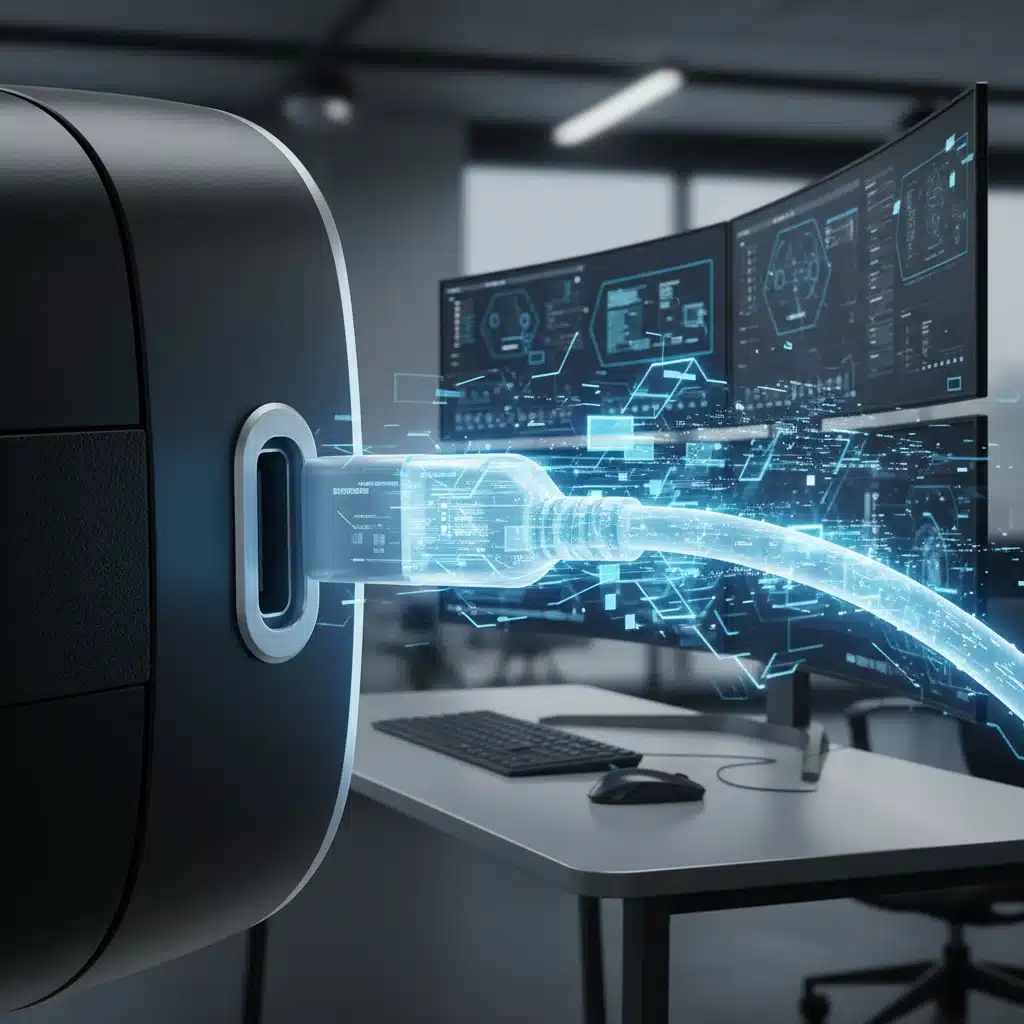
The Synergy: USB-C and Wi-Fi 6E in a 2026 Business Context
It’s important to recognize that USB-C and Wi-Fi 6E are not mutually exclusive; rather, they are complementary technologies that together form a comprehensive strategy for VR business connectivity. By 2026, a typical enterprise VR deployment in the US will likely leverage both standards in different capacities.
Hybrid Deployment Scenarios
Consider a scenario where a company develops complex 3D models for product design. Engineers might use high-fidelity, tethered VR headsets connected via USB-C to powerful workstations for detailed design reviews and precise manipulations. The immense bandwidth of USB-C (especially Thunderbolt 4) ensures every pixel is rendered perfectly and every movement is instantly reflected. Meanwhile, sales and marketing teams could use standalone VR headsets wirelessly connected via Wi-Fi 6E to showcase these designs in virtual showrooms or conduct remote collaborative sessions with clients. The wireless freedom allows for natural movement and interaction, enhancing the client experience without the need for high-end local processing power.
Another example is in VR-based training. Initial setup, software updates, and large content downloads for standalone headsets could be efficiently handled via USB-C connections, rapidly transferring gigabytes of data. During the actual training sessions, these headsets would operate wirelessly over Wi-Fi 6E, providing trainees with an untethered, immersive learning environment. This hybrid approach optimizes both data management and user experience, creating a resilient VR business connectivity ecosystem.
Edge Computing and VR
The rise of edge computing will further enhance the synergy between Wi-Fi 6E and VR. With edge servers processing VR content closer to the users, the need for direct tethering to powerful local PCs can be reduced. Instead, standalone VR headsets can stream high-fidelity content from nearby edge servers over ultra-low-latency Wi-Fi 6E connections. USB-C would still play a role in connecting these edge servers to high-speed networks or for initial provisioning and maintenance of the VR devices themselves. This distributed processing model promises to democratize access to high-end VR experiences within businesses, making VR business connectivity more scalable and flexible.
Security and Management of VR Connectivity
As VR becomes more ingrained in business operations, the security and management of its connectivity become paramount. Both USB-C and Wi-Fi 6E offer features that contribute to a secure and manageable VR environment, but businesses must implement best practices.
USB-C Security and Management
For USB-C, physical security of ports and cables is important, especially in public-facing or shared environments. Implementing policies for device connection and data transfer can prevent unauthorized access. From a management perspective, USB-C’s standardization simplifies inventory and procurement, as a single type of cable and port can serve multiple functions across various devices. Centralized charging stations leveraging USB-C PD can streamline device management for large fleets of standalone VR headsets.
Wi-Fi 6E Security and Management
Wi-Fi 6E, like its predecessors, supports robust security protocols such as WPA3, which is essential for protecting sensitive business data transmitted wirelessly. Businesses should implement strong authentication methods, network segmentation (VLANs), and potentially even dedicated VR-only SSIDs (Service Set Identifiers) on the 6 GHz band to isolate VR traffic and enhance security. Network monitoring tools can help identify and mitigate potential threats or performance issues, ensuring the integrity and reliability of VR business connectivity.
Furthermore, Mobile Device Management (MDM) solutions are evolving to support VR headsets. These platforms can manage software updates, application deployments, and security configurations across a fleet of VR devices, regardless of whether they connect via Wi-Fi 6E or are periodically tethered via USB-C for maintenance. This holistic approach to management is crucial for large-scale enterprise VR deployments.

Future Outlook: Beyond 2026
While USB-C and Wi-Fi 6E will be the dominant forces in VR business connectivity by 2026, the technological evolution won’t stop there. We can anticipate further advancements that will continue to refine and enhance VR experiences for businesses.
USB-C Evolution
Future iterations of USB-C, potentially offering even higher data rates and power delivery capabilities, will continue to push the boundaries of what’s possible for tethered and managed VR. Improved active cable technologies might extend reach without compromising performance, making tethered VR more flexible. The ongoing convergence of USB-C with display technologies and other standards will further cement its role as the universal physical connector.
Wi-Fi 7 (802.11be) and Beyond
Looking slightly beyond 2026, Wi-Fi 7 (802.11be), also known as Ultra-High Reliability and Low Latency (URLLC), is already on the horizon. Wi-Fi 7 promises even greater throughput, lower latency, and enhanced reliability by leveraging technologies like Multi-Link Operation (MLO) and even wider channels. This next generation of Wi-Fi will further solidify wireless VR as the preferred mode for many business applications, enabling even more complex and collaborative virtual environments with unprecedented fluidity. The journey for VR business connectivity is one of continuous improvement and innovation.
5G and Private Networks
Another significant factor will be the increasing maturity and deployment of 5G, particularly private 5G networks. For large industrial sites, warehouses, or expansive corporate campuses, private 5G can offer dedicated, high-bandwidth, and ultra-low-latency wireless connectivity that complements or even surpasses Wi-Fi 6E in specific scenarios. This could enable highly mobile VR applications across vast areas, crucial for sectors like logistics, manufacturing, and remote field operations. The integration of 5G with Wi-Fi 6E will create a powerful, multi-layered wireless infrastructure for the most demanding VR business applications.
Conclusion: A Connected Future for Business VR
By 2026, VR business connectivity in the US will be fundamentally shaped by the widespread adoption and strategic integration of USB-C and Wi-Fi 6E. USB-C will provide the reliable, high-bandwidth backbone for tethered experiences, rapid data transfer, and efficient device charging and management. Wi-Fi 6E, with its dedicated 6 GHz band, will unlock unprecedented wireless freedom, enabling scalable, low-latency, and high-throughput untethered VR experiences crucial for collaboration, training, and remote work.
Businesses that proactively plan and invest in infrastructure compatible with these standards will be best positioned to harness the full potential of VR. This means not just acquiring compatible hardware but also designing network architectures, implementing security protocols, and establishing robust device management practices that account for the unique demands of VR. The synergy between USB-C and Wi-Fi 6E, coupled with emerging technologies like edge computing and 5G, will create a powerful and flexible foundation for the next era of enterprise VR, driving innovation, enhancing productivity, and transforming the way US businesses operate.
The future of business is immersive, and the future of immersive business is connected. With USB-C and Wi-Fi 6E leading the charge, US enterprises are well on their way to building a truly connected and transformative VR ecosystem.