Augmented Reality in Manufacturing: Boost US Productivity 15% by 2025
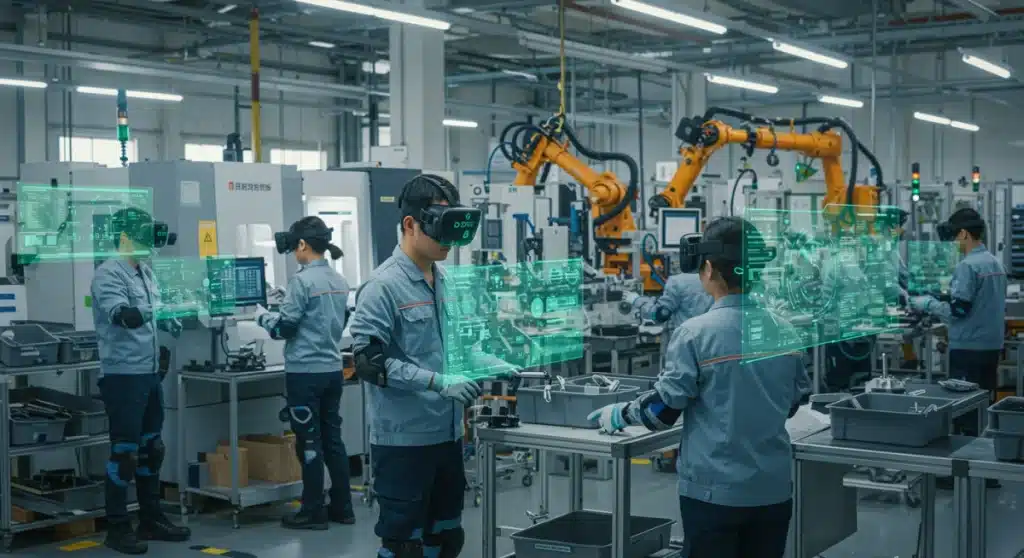
US manufacturing companies are poised to boost productivity by 15% by 2025 through the strategic implementation of augmented reality in three key areas: enhanced workforce training, real-time remote expert assistance, and advanced quality control processes.
The landscape of American manufacturing is undergoing a profound transformation, driven by innovative technologies. Among these, AR manufacturing productivity stands out as a powerful catalyst for change. As we approach 2025, augmented reality (AR) is no longer a futuristic concept but a tangible tool actively reshaping how US companies operate, promising a remarkable 15% increase in productivity across various sectors. This article explores the pivotal ways AR is achieving this, from empowering workers with overlaid digital information to streamlining complex operations, ensuring the US remains at the forefront of industrial innovation.
The Dawn of Augmented Reality in Manufacturing
Augmented reality (AR) is rapidly moving from niche applications to mainstream adoption within the manufacturing sector. This technology, which overlays digital information onto the real world, is proving to be a game-changer for US companies aiming to enhance efficiency and output. The integration of AR is not merely about digitizing processes; it’s about fundamentally rethinking how tasks are executed, how knowledge is transferred, and how quality is assured on the factory floor.
Early adopters in the United States have already demonstrated significant gains, validating AR’s potential to deliver on its promise of increased productivity. These benefits stem from a combination of improved operational visibility, reduced human error, and accelerated learning curves for employees. As the technology matures and becomes more accessible, its impact is expected to grow exponentially, cementing its role as a cornerstone of Industry 4.0 initiatives across the nation.
Understanding AR’s Core Contribution
- Enhanced situational awareness: Workers gain immediate access to critical data, schematics, and instructions directly within their field of view.
- Reduced cognitive load: Complex procedures are simplified through step-by-step visual guidance, minimizing guesswork.
- Faster problem resolution: Real-time information and expert collaboration accelerate troubleshooting and repair times.
The strategic implementation of AR solutions is enabling manufacturers to address long-standing challenges, such as skilled labor shortages and the increasing complexity of modern production lines. By providing intuitive, interactive digital assistance, AR empowers workers of all skill levels to perform tasks with greater precision and confidence. This foundational shift in how information is consumed and applied is at the heart of AR’s projected 15% productivity boost for US companies by 2025, setting a new standard for operational excellence.
Enhanced Workforce Training and Skill Development
One of the most immediate and impactful applications of augmented reality in manufacturing is in transforming workforce training. Traditional training methods, often costly and time-consuming, struggle to keep pace with the rapid advancements in machinery and processes. AR offers an immersive, hands-on learning experience that accelerates skill acquisition and improves retention, directly contributing to higher productivity.
Workers can learn complex assembly, maintenance, or quality control procedures in a safe, simulated environment, or with real equipment guided by digital overlays. This not only reduces the risk of errors during training but also ensures that new hires become proficient much faster. Experienced technicians can also use AR to refresh their skills or learn new procedures for specialized equipment, fostering a culture of continuous improvement.
Immersive Learning Experiences
- Interactive procedural guidance: AR headsets display step-by-step instructions, animations, and 3D models directly onto physical equipment.
- Safe simulated environments: Trainees can practice dangerous or complex operations without risk to equipment or personnel.
- Personalized learning pace: Each worker can progress at their own speed, reviewing content as needed until mastery is achieved.
Beyond initial training, AR tools support ongoing skill development by providing on-demand access to a wealth of information. A technician troubleshooting a machine can pull up its schematics, maintenance history, or diagnostic data instantly, without needing to consult manuals or leave their workstation. This immediate access to knowledge transforms every task into a learning opportunity, reducing downtime and enhancing overall operational efficiency.
By making training more engaging, effective, and accessible, AR significantly shortens the learning curve for manufacturing tasks. This leads to a more skilled, adaptable, and productive workforce, directly contributing to the 15% productivity increase projected for US manufacturers by 2025. It’s about building a smarter workforce, ready for the challenges of modern industrial production.
Real-time Remote Expert Assistance and Collaboration
The ability to connect on-site personnel with remote experts in real time is a cornerstone of augmented reality’s utility in manufacturing. This capability is particularly crucial for US companies operating across vast geographical areas or facing a shortage of specialized talent at every location. AR-powered remote assistance bridges this gap, enabling immediate problem-solving and reducing costly travel and downtime.
Imagine a technician in a remote factory encountering an unfamiliar machine malfunction. Instead of waiting for an expert to travel, they can don an AR headset and connect with a specialist anywhere in the world. The expert sees exactly what the technician sees, can annotate the technician’s field of view with digital instructions, highlight components, or share relevant documents, guiding them through the repair process step-by-step.
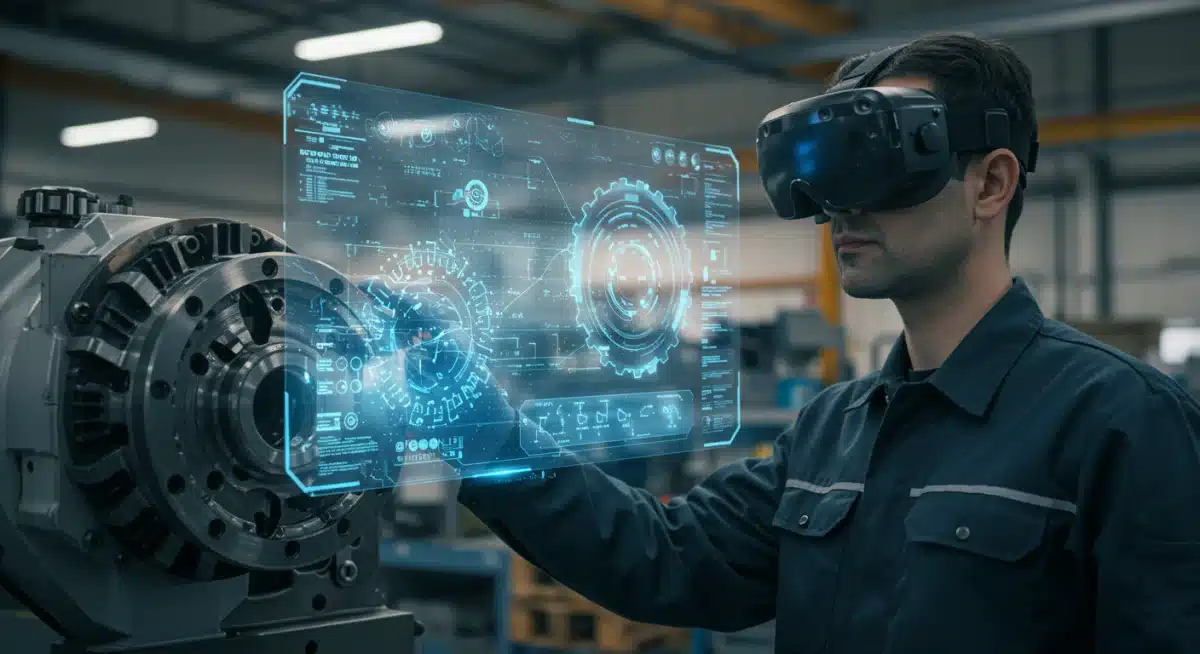
This immediate, visual collaboration dramatically cuts down on resolution times, minimizes production interruptions, and ensures that even the most complex issues can be tackled efficiently. It democratizes expertise, making specialized knowledge available on demand, irrespective of physical location.
The implications for productivity are profound. Reduced travel expenses, faster repairs, and minimized production stoppages all contribute directly to a more efficient operation. Furthermore, it empowers less experienced workers to perform tasks that would otherwise require senior personnel, effectively extending the reach of a company’s most skilled employees. This aspect of AR is a significant driver behind the projected productivity gains, allowing US manufacturers to optimize resource allocation and maintain continuous operations.
Precision-Driven Quality Control and Inspection
Maintaining high-quality standards is paramount in manufacturing, and augmented reality is revolutionizing how US companies approach quality control and inspection. By superimposing digital templates, tolerance parameters, and defect indicators onto physical products, AR systems enable workers to perform inspections with unprecedented accuracy and speed. This leads to a significant reduction in errors, rework, and waste, directly boosting overall productivity.
Instead of manually comparing parts to blueprints or relying on subjective visual checks, AR devices provide objective, real-time feedback. A worker can scan a manufactured component, and the AR system will highlight any deviations from the design specification, guiding them to identify and address potential flaws immediately. This proactive approach to quality assurance prevents minor issues from escalating into major defects down the line.
Key Benefits in Quality Assurance
- Automated defect detection: AR systems can use computer vision to identify anomalies and discrepancies against digital models.
- Guided inspection workflows: Workers are led through precise inspection routines, ensuring no critical checks are missed.
- Instant data capture: Inspection results can be logged automatically, creating a comprehensive digital record for compliance and analysis.
The enhanced precision offered by AR also extends to complex assembly processes where tolerances are tight. Workers can use AR overlays to ensure components are aligned perfectly, reducing the likelihood of assembly errors that would later require costly rework. This not only saves time and resources but also improves the overall reliability and performance of the final product.
By streamlining inspection processes and significantly reducing the margin for human error, AR plays a critical role in achieving superior product quality while accelerating production cycles. This directly contributes to the projected 15% productivity increase for US manufacturing by 2025, demonstrating AR’s power to deliver both efficiency and excellence.
Overcoming Implementation Challenges for Widespread Adoption
While the benefits of augmented reality in manufacturing are clear, widespread adoption in US companies faces certain implementation challenges. These include the initial capital investment, the need for robust IT infrastructure, and ensuring seamless integration with existing operational technology (OT) systems. Addressing these hurdles is crucial for realizing the full potential of AR and achieving the targeted productivity gains.
Companies must carefully plan their AR strategy, starting with pilot projects to demonstrate return on investment (ROI) before scaling up. This involves selecting the right AR hardware and software solutions that align with specific manufacturing needs and integrating them with enterprise resource planning (ERP) and manufacturing execution systems (MES).
Strategic Considerations for AR Deployment
- Cost-benefit analysis: Thorough evaluation of initial investment versus long-term productivity gains and cost savings.
- Infrastructure readiness: Ensuring adequate Wi-Fi coverage, computing power, and data storage to support AR applications.
- Employee training and acceptance: Preparing the workforce for new technologies and addressing concerns about job displacement.
Another significant challenge is data management and cybersecurity. AR applications often handle sensitive operational data, requiring stringent security protocols to protect against breaches. Furthermore, the user experience of AR interfaces needs to be intuitive and comfortable for workers to ensure high adoption rates and sustained use.
Overcoming these challenges requires a collaborative approach involving technology providers, internal IT departments, and operational teams. By strategically addressing these factors, US manufacturers can pave the way for successful AR integration, unlocking its full potential to drive productivity and maintain competitive advantage in the global market. This proactive approach is essential for achieving the ambitious productivity targets by 2025.
The Future Outlook: Sustaining AR-Driven Growth
Looking beyond 2025, the integration of augmented reality into US manufacturing is set to deepen and expand, driving sustained growth and innovation. The initial 15% productivity boost is likely just the beginning, as AR technology continues to evolve and its applications become even more sophisticated and integrated with other emerging technologies like artificial intelligence (AI) and the Internet of Things (IoT).
Future developments will likely see AR systems becoming more autonomous, capable of predicting maintenance needs, optimizing production flows, and even dynamically adjusting to real-time changes on the factory floor. The convergence of AR with AI, for instance, could enable truly intelligent assistance that not only guides workers but also learns from their actions to provide increasingly personalized and effective support.
Emerging Trends and Synergies
- AI-powered AR: Predictive maintenance alerts and intelligent process optimization through machine learning integration.
- IoT connectivity: Real-time data from sensors directly visualized via AR for enhanced operational insights and control.
- Digital twins: AR interfaces interacting with digital replicas of physical assets for comprehensive monitoring and simulation.
The ongoing development of lighter, more comfortable, and more powerful AR hardware will also play a crucial role in enhancing user acceptance and broadening the scope of AR applications. As the technology becomes more seamless and less obtrusive, it will become an indispensable tool for every worker on the manufacturing floor, from assembly line operators to senior management.
For US companies, sustaining AR-driven growth means continuous investment in research and development, fostering a culture of innovation, and adapting to new technological paradigms. By embracing AR as a long-term strategic asset, manufacturers can not only maintain their competitive edge but also redefine what’s possible in terms of efficiency, quality, and human-machine collaboration, ensuring a prosperous future for American industry.
| Key Impact Area | Description of Productivity Boost |
|---|---|
| Workforce Training | Accelerates skill acquisition and retention through immersive, guided learning experiences, reducing training time and errors. |
| Remote Assistance | Enables real-time, visual collaboration between on-site workers and remote experts, minimizing downtime and travel costs. |
| Quality Control | Enhances inspection accuracy and speed through digital overlays, reducing defects, rework, and waste. |
| Operational Efficiency | Overall optimization of processes by providing instant data access and reducing cognitive load on workers. |
Frequently Asked Questions about AR in Manufacturing
Augmented reality in manufacturing involves superimposing digital information, such as 3D models, instructions, or data, onto a worker’s view of the real physical environment. This enhances their perception and interaction with machinery, products, and processes, improving efficiency and accuracy on the factory floor.
AR achieves this by transforming three key areas: accelerating workforce training, enabling real-time remote expert assistance to minimize downtime, and enhancing precision in quality control and inspection. These applications collectively reduce errors, speed up tasks, and optimize operational workflows, leading to significant efficiency gains.
AR provides immersive, hands-on learning experiences with step-by-step visual guidance, reducing training time and improving skill retention. It allows trainees to practice complex procedures safely, leading to faster proficiency and fewer errors when working with real equipment, thus increasing overall workforce effectiveness.
AR allows on-site technicians to connect with remote specialists, who can see what the technician sees and provide digital annotations or instructions directly in their field of view. This enables immediate problem-solving, reduces the need for expert travel, and minimizes equipment downtime, enhancing operational continuity.
Challenges include the initial investment cost, the need for robust IT infrastructure, and seamless integration with existing systems. Additionally, ensuring data security, comfortable hardware, and adequate employee training and acceptance are crucial for successful and sustainable AR adoption in manufacturing environments.
Conclusion
The journey towards a 15% productivity increase in US manufacturing by 2025, largely driven by augmented reality, represents a significant paradigm shift. From revolutionizing workforce training and enabling real-time remote collaboration to ensuring unparalleled precision in quality control, AR is proving its worth as an indispensable tool. While implementation challenges exist, the clear benefits in efficiency, accuracy, and operational agility underscore AR’s transformative power. As US companies continue to embrace and integrate these advanced solutions, the future of manufacturing promises to be more intelligent, productive, and competitive than ever before, solidifying America’s position as a leader in industrial innovation.