
By 2026, advanced VR collaboration platforms are fundamentally transforming how remote teams in the United States connect and operate, offering immersive and highly interactive virtual environments that transcend the limitations of conventional online meetings.
The landscape of remote work is undergoing a profound transformation, and at its forefront are VR collaboration platforms. These innovative technologies are not merely enhancing virtual meetings; they are entirely redefining how remote teams in the United States interact, innovate, and achieve their goals by 2026, moving far beyond the static confines of traditional video conferencing.
The Evolution of Remote Collaboration: From 2D to 3D Immersion
Remote collaboration has journeyed significantly from its early days of teleconferencing to the sophisticated 3D immersive environments we see today. Initially, video calls offered a crucial visual link, yet often fell short in fostering genuine engagement and shared presence. The advent of virtual reality has ushered in a new era, providing a sense of co-location that was previously unattainable for distributed teams.
This shift isn’t just about adding a visual layer; it’s about creating a spatial computing experience where users feel truly present with their colleagues, regardless of geographical distance. This deeper sense of presence is critical for nuanced communication, creative brainstorming, and complex problem-solving, areas where traditional 2D platforms often struggle.
Bridging the Distance with Presence
One of the primary benefits of VR collaboration is the enhanced sense of presence it offers. Users wear VR headsets and enter shared virtual spaces, where their avatars represent them. This virtual embodiment helps to reduce the feelings of isolation often associated with remote work, fostering stronger team cohesion and psychological safety.
- Non-verbal cues: Avatars can convey body language and gestures, enriching communication.
- Shared focus: Everyone occupies the same virtual room, directing attention to shared objects or presentations.
- Reduced fatigue: The immersive nature can mitigate ‘Zoom fatigue’ by offering more dynamic interaction.
The evolution from basic video calls to immersive VR platforms represents a paradigm shift in how we conceive and execute remote work. It promises not just efficiency but a more human and engaging way for teams to connect and collaborate across distances.
Key Features Defining Leading VR Collaboration Platforms in 2026
As we move deeper into 2026, the leading VR collaboration platforms distinguish themselves through a suite of advanced features designed to maximize productivity and engagement for remote teams. These platforms go beyond simple meeting rooms, offering tools that mirror and often enhance real-world collaborative experiences.
From intuitive spatial audio to robust content sharing capabilities, these features are meticulously crafted to support diverse work styles and complex projects, ensuring that virtual environments are not just novelties but powerful productivity hubs. Understanding these core features is essential for organizations considering their adoption.
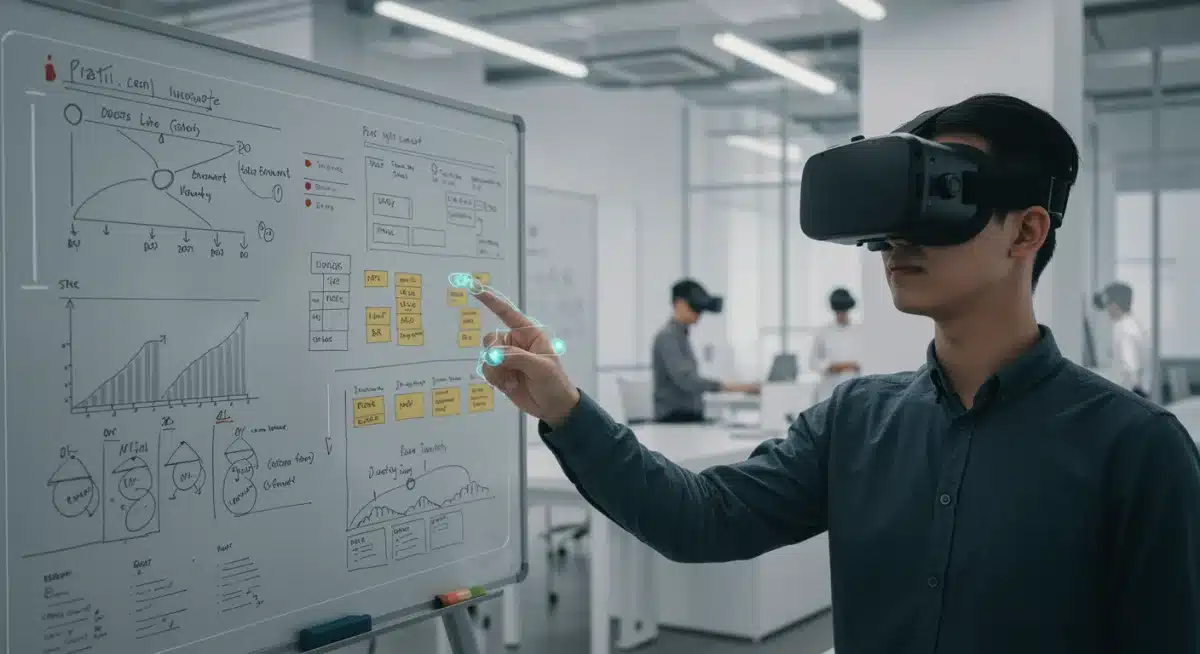
These platforms are characterized by their ability to provide a seamless and highly interactive experience, making virtual collaboration feel as natural and effective as in-person interaction. The integration of advanced haptics and eye-tracking further refines the immersive experience, allowing for more precise interactions and feedback.
Advanced Interaction and Content Sharing
Effective collaboration in VR relies heavily on the ability to interact with digital content naturally and share information effortlessly. Platforms are now incorporating sophisticated tools that allow for dynamic whiteboarding, 3D model manipulation, and direct document annotation within the virtual space.
- Persistent Workspaces: Virtual rooms and projects remain accessible, allowing asynchronous collaboration.
- Cross-Platform Compatibility: Support for various VR headsets and even 2D desktop users ensures broad accessibility.
- AI-Powered Tools: Integrated AI for transcription, translation, and intelligent content suggestions enhances productivity.
The defining features of today’s VR collaboration platforms center on creating a rich, interactive, and highly functional environment. These capabilities are pivotal in transforming how remote teams conduct business, from daily stand-ups to strategic planning sessions, by offering unparalleled depth of interaction.
Platform Spotlight: Meta Horizon Workrooms for Dynamic Team Engagement
Meta Horizon Workrooms has emerged as a significant player in the VR collaboration space, particularly for its focus on dynamic team engagement and integration with existing Meta ecosystems. Designed to bridge the gap between physical and virtual workspaces, Workrooms offers a compelling environment for meetings, brainstorming, and focused work sessions.
Its strength lies in providing a polished, user-friendly experience that leverages Meta’s extensive VR hardware and software development. For US remote teams, this platform presents an accessible entry point into immersive collaboration, offering a balance of advanced features and ease of use.
Seamless Integration and Intuitive Design
One of Workrooms’ standout attributes is its seamless integration with Meta Quest headsets and its intuitive interface. This allows users to quickly adapt to the virtual environment, minimizing the learning curve often associated with new technologies. The platform also offers a mixed-reality experience, allowing users to bring their physical desk and computer into VR.
- Virtual Whiteboard: An infinite whiteboard for drawing, writing, and pinning images.
- Spatial Audio: Realistic audio that simulates sound direction, enhancing natural conversation flow.
- Hand Tracking: Natural hand gestures for interaction, eliminating the need for controllers in many tasks.
Meta Horizon Workrooms is continuously evolving, with ongoing updates aimed at enhancing its collaborative tools and expanding its reach. Its commitment to creating an intuitive and integrated virtual workspace makes it a strong contender for remote teams seeking to elevate their collaboration experience.
Platform Spotlight: Spatial for Creative and Immersive Design Work
Spatial has carved out a unique niche in the VR collaboration landscape, distinguishing itself as a premier platform for creative professionals and teams engaged in immersive design work. Unlike general-purpose meeting solutions, Spatial excels in providing tools specifically tailored for visualizing, manipulating, and collaborating on 3D content.
Its emphasis on creating highly interactive and visually rich environments makes it invaluable for industries such as architecture, product design, and education. For US remote teams requiring advanced creative capabilities, Spatial offers a powerful and intuitive solution.
Unleashing Creativity in 3D Spaces
Spatial’s core strength lies in its ability to transform complex 3D models and data into collaborative, interactive experiences. Users can import CAD files, medical scans, or artistic creations and then interact with them as if they were physically present, enabling a level of detail and understanding impossible in 2D.
- 3D Model Import: Support for various 3D file formats, allowing detailed review and manipulation.
- Cross-Device Access: Available on VR headsets, web, and mobile, ensuring broad accessibility.
- Presentation Tools: Advanced features for showcasing and annotating 3D designs in real-time.
Spatial’s commitment to fostering creativity within immersive environments positions it as a leader for teams whose work revolves around visual and spatial concepts. The platform empowers users to collaborate on intricate designs, making it an indispensable tool for innovative US companies.
Platform Spotlight: Engage for Training and Large-Scale Events
Engage stands out as a robust VR collaboration platform particularly well-suited for professional training, educational programs, and hosting large-scale virtual events. Its comprehensive suite of tools allows organizations to create highly interactive and scalable experiences that go far beyond traditional webinars or e-learning modules.
For US enterprises and educational institutions looking to deliver impactful immersive content, Engage offers a powerful, customizable solution. The platform’s focus on structured learning and event management makes it ideal for complex virtual deployments.
Comprehensive Tools for Learning and Events
Engage provides a rich set of features designed to facilitate dynamic learning environments and engaging event experiences. From virtual classrooms and lecture halls to interactive simulations and remote field trips, the platform offers unparalleled versatility in content delivery and audience interaction.
- Customizable Environments: Ability to design bespoke virtual spaces for specific training or event needs.
- Interactive Content: Tools for quizzes, polls, 3D object interaction, and multimedia integration.
- Scalability: Supports hundreds of simultaneous users in a single virtual instance, ideal for large events.
Engage’s dedication to creating feature-rich, scalable virtual experiences makes it an invaluable asset for organizations prioritizing immersive training and large-scale virtual gatherings. Its capabilities are transforming how US businesses educate their workforce and connect with global audiences.
Strategic Implementation of VR Platforms for US Remote Teams
Implementing VR collaboration platforms effectively within US remote teams requires a strategic approach that considers not only the technology but also the organizational culture and specific use cases. Simply adopting a platform without a clear strategy can lead to underutilization and missed opportunities.
Successful integration involves careful planning, pilot programs, and continuous feedback loops to ensure the technology genuinely enhances productivity and team cohesion. It’s about aligning the VR solution with business objectives to unlock its full potential.
Best Practices for Adoption
To maximize the benefits of VR collaboration, organizations should focus on several key best practices. These include providing adequate hardware, comprehensive training, and fostering a culture of experimentation and adoption among team members. A phased rollout can also help in identifying and addressing challenges early on.
- Pilot Programs: Start with small, enthusiastic teams to test and refine usage scenarios.
- Dedicated Training: Offer workshops and resources to help users become proficient with VR tools.
- Technical Support: Ensure readily available support for hardware and software issues.
Strategic implementation of VR platforms is not just about installing software; it’s about fundamentally rethinking how work gets done in a remote context. By focusing on user experience, comprehensive support, and clear objectives, US remote teams can successfully leverage these advanced tools to redefine their collaborative future.
| Key Aspect | Brief Description |
|---|---|
| Enhanced Presence | VR platforms create a feeling of co-location, reducing isolation and enhancing engagement for remote teams. |
| Dynamic Interaction | Advanced tools like 3D model manipulation and spatial audio foster richer, more natural communication. |
| Specialized Use Cases | Platforms like Spatial (design) and Engage (training) offer tailored solutions for specific industry needs. |
| Strategic Adoption | Successful implementation requires planning, training, and aligning VR tools with organizational objectives. |
Frequently asked questions about VR collaboration platforms
VR platforms offer immersive 3D environments, providing a sense of shared presence and spatial interaction that 2D video calls lack. This enables more natural communication, non-verbal cues, and dynamic manipulation of virtual objects, enhancing engagement significantly.
Key benefits include increased team presence, reduced ‘Zoom fatigue,’ enhanced creativity through 3D interaction, and more effective training and large-scale event hosting. These platforms foster deeper engagement and more impactful communication than traditional methods.
While VR headsets offer the most immersive experience, many advanced platforms are increasingly offering cross-platform compatibility. This means users can often join virtual sessions via desktop, tablet, or even mobile devices, albeit with reduced immersion.
Industries like architecture, engineering, product design, education, and corporate training are seeing significant benefits. Any sector requiring visual collaboration, 3D model review, or immersive learning experiences finds immense value in these platforms.
By 2026, VR collaboration is expected to become a mainstream tool for US remote teams, driven by improved hardware, more sophisticated software, and a growing understanding of its productivity benefits. Its adoption will continue to redefine the nature of remote work.
Conclusion
The journey of remote work has reached a pivotal point with the widespread adoption and advancement of VR collaboration platforms. By 2026, these tools are not just augmenting existing remote operations; they are fundamentally redefining how US remote teams connect, create, and innovate. From fostering a profound sense of presence to enabling complex 3D design and scalable training, VR is proving to be an indispensable asset. Organizations that strategically embrace these immersive technologies will undoubtedly gain a significant competitive edge, transforming the future of work into a more engaging, productive, and boundless experience.