Future-Proofing VR Hardware: Modularity & Upgrade Paths for US Businesses
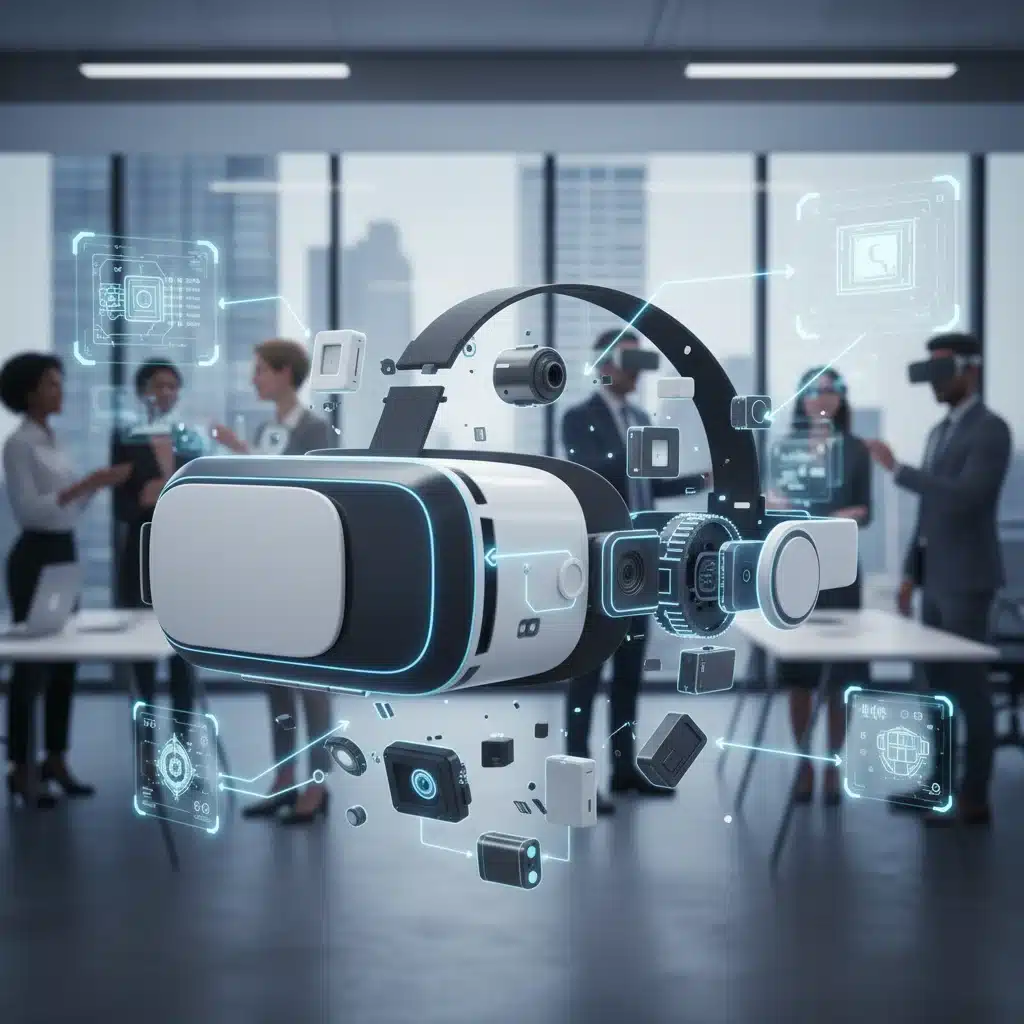
In the rapidly accelerating world of virtual reality (VR), businesses in the United States face a unique challenge: how to invest in cutting-edge hardware without the fear of rapid obsolescence. The solution, increasingly, lies in embracing VR Hardware Modularity and strategically planning for upgrade paths. As we look towards 2026, the landscape of enterprise VR is transforming, demanding more flexible, scalable, and cost-effective solutions. This comprehensive guide will delve into why modularity is not just a buzzword, but a crucial strategy for future-proofing your VR investments, ensuring longevity, and maximizing your return on investment.
The initial outlay for high-end VR hardware can be substantial. For US companies, this investment needs to be justified not just by immediate gains, but by its potential to adapt and evolve with technological advancements. A non-modular system risks becoming a costly paperweight within a few years, forcing companies into frequent, expensive full-system replacements. Conversely, a modular approach allows for targeted upgrades, extending the lifespan of the core investment and keeping businesses at the forefront of VR innovation without breaking the bank.
This article will explore the core concepts of VR Hardware Modularity, examine the various components that can benefit from an upgradeable design, and provide actionable insights for US businesses looking to make smart, forward-thinking VR hardware decisions. From understanding the economics of modularity to navigating vendor ecosystems, we will equip you with the knowledge needed to confidently step into the future of enterprise VR.
The Imperative of Modularity in 2026: Why Future-Proofing Matters for US Companies
The year 2026 is poised to be a pivotal moment for virtual reality adoption across various US industries. From architectural visualization and product design to medical training and remote collaboration, VR is moving beyond novelty into essential business infrastructure. However, the pace of technological innovation in VR is relentless. New display technologies, improved tracking systems, haptic feedback advancements, and more powerful processing units emerge with increasing frequency. For US companies, this rapid evolution presents a dilemma: how to leverage the latest VR capabilities without constant, large-scale hardware overhauls.
This is where VR Hardware Modularity becomes not just an advantage, but an imperative. Future-proofing your VR investment means designing for change, not against it. It means selecting systems that allow for individual components to be upgraded or replaced, rather than forcing a complete system replacement. Consider the analogy of a high-performance computer: instead of buying a new PC every time a faster graphics card or more RAM becomes available, you simply upgrade those specific components. The same principle applies, and is becoming increasingly vital, to virtual reality hardware.
Economic Advantages of Modular VR Systems
The financial benefits of adopting a modular approach are significant for US businesses. Firstly, it drastically reduces the total cost of ownership (TCO). Instead of budgeting for a full system replacement every 3-5 years, companies can allocate funds for incremental upgrades to specific components. This shifts capital expenditure (CapEx) towards more manageable operational expenditure (OpEx) for maintenance and targeted improvements.
Secondly, modularity helps in maintaining competitive edge. By being able to integrate the latest display technology or most accurate tracking sensors as they become available, businesses can ensure their VR experiences remain state-of-the-art. This is crucial for applications where visual fidelity, precision, or immersion directly impact business outcomes, such as in product prototyping or advanced training simulations. Companies that fail to adopt modularity risk falling behind competitors who can quickly integrate superior VR capabilities.
Enhancing Sustainability and Resource Efficiency
Beyond economics, VR Hardware Modularity also aligns with growing corporate sustainability goals. By extending the lifespan of hardware and reducing the frequency of complete replacements, companies minimize electronic waste. This not only contributes to a more sustainable business model but can also enhance a company’s brand image and appeal to environmentally conscious stakeholders. In the US, where corporate social responsibility is increasingly scrutinized, this aspect carries considerable weight.
Key Components for Modular VR Hardware
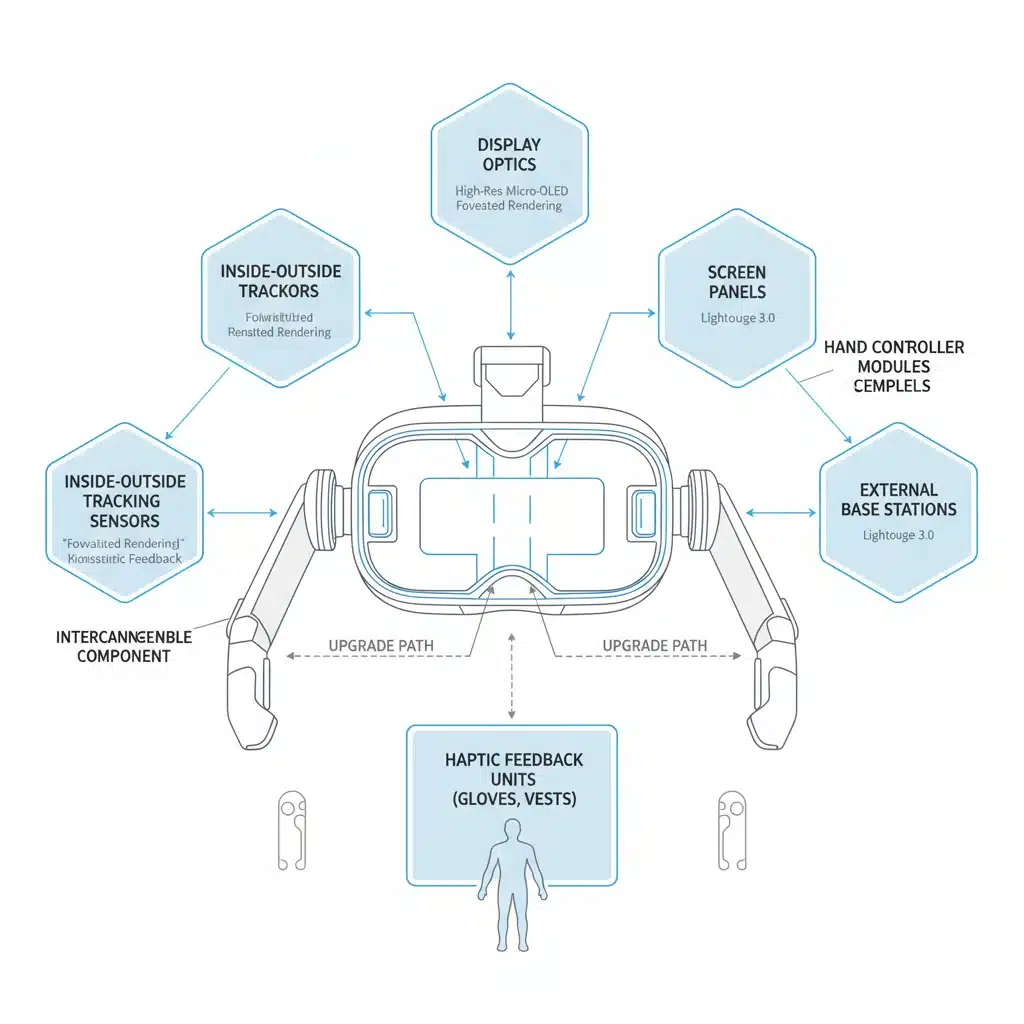
Understanding which parts of a VR system can and should be modular is crucial for effective future-proofing. While not every component can be easily swapped, several key areas offer significant opportunities for modular design and upgrade paths. When evaluating next-generation VR solutions for your US company, pay close attention to these elements:
1. Display Modules: The Window to Virtual Worlds
The display is arguably the most critical component of any VR headset, directly impacting visual fidelity, field of view (FOV), and overall immersion. Display technology is evolving rapidly, with advancements in resolution (e.g., 8K per eye and beyond), refresh rates, pixel density (PPD), and new display types like micro-OLED or light field displays. A modular display system would allow businesses to upgrade their headset’s visual engine without replacing the entire device.
Imagine a scenario where a new micro-LED display offers significantly higher brightness and color accuracy. With a modular design, your company could simply swap out the existing display module for the new one, immediately enhancing the visual experience for your users, whether for design reviews or immersive training. This flexibility ensures your VR applications always look their best and take advantage of the latest visual breakthroughs.
2. Tracking Systems: Precision in Motion
Accurate and low-latency tracking is fundamental to a comfortable and effective VR experience. Current tracking technologies include inside-out (camera-based), outside-in (base station-based), and hybrid systems. Future advancements could involve even more precise optical tracking, haptic-enhanced tracking, or novel sensor fusion techniques. A modular tracking system would enable companies to upgrade their positional tracking capabilities as new, more robust, or more expansive solutions become available.
For industrial applications requiring millimeter-level precision or large-scale room-scale VR deployments, the ability to upgrade tracking hardware independently of the main headset body is invaluable. This ensures that as your operational requirements evolve or new tracking standards emerge, your investment in the core VR system remains sound.
3. Processing Units: The Brains Behind the Experience
While many tethered VR systems rely on external PCs for processing power, standalone VR headsets integrate their own System-on-a-Chip (SoC). These SoCs are continuously improving in terms of CPU, GPU, and NPU (Neural Processing Unit) performance. For standalone enterprise VR solutions, a modular processing unit would be a game-changer. This would allow businesses to upgrade the computational power of their headsets, enabling more complex simulations, higher fidelity graphics, and more sophisticated AI-driven experiences without needing to replace the entire device.
This is particularly relevant for US companies developing or utilizing computationally intensive VR applications, where staying current with processing capabilities directly impacts performance and user experience. The ability to swap out an older SoC for a newer, more powerful one would significantly extend the useful life of the headset.
4. Optics and Lenses: Clarity and Comfort
The optical system of a VR headset, including its lenses, plays a critical role in visual clarity, distortion correction, and user comfort. Advancements in lens technology, such as pancake lenses for slimmer profiles or variable focal length optics, are continually emerging. A modular optical system would allow for upgrades that improve visual quality, reduce eye strain, or enhance the field of view.
For applications where extended use is common, or where visual comfort is paramount (e.g., medical training, long design sessions), the ability to upgrade to newer, more advanced lenses could significantly improve user satisfaction and productivity. This aspect of VR Hardware Modularity often goes overlooked but is vital for long-term usability.
5. Haptic Feedback and Input Devices: Touch and Interaction
While often considered peripheral, haptic feedback and input devices are integral to immersive VR experiences. From advanced haptic gloves that simulate texture and resistance to more sophisticated controllers with adaptive triggers, these technologies are constantly evolving. While a fully modular headset might not directly integrate these, the ecosystem around the headset should support easy integration and upgrading of external haptic and input solutions.
For US companies building bespoke VR training or simulation environments, the ability to integrate cutting-edge haptic feedback devices as they become available ensures that their experiences remain highly realistic and engaging. This enhances the learning transfer and operational effectiveness of VR applications.
6. Power Sources: Extending Operational Time
Battery technology is another area seeing continuous improvement, particularly for standalone VR headsets. Modular battery packs would allow for quick swaps, extending operational time for intensive sessions, and enabling upgrades to higher-capacity or faster-charging batteries as they become available. This is a practical aspect of VR Hardware Modularity that directly impacts the usability and uptime of VR deployments in a business setting.
Strategic Upgrade Paths: Planning for 2026 and Beyond
Beyond simply having modular components, businesses need a strategy for how and when to leverage these upgrade paths. This involves careful planning, understanding vendor roadmaps, and assessing the specific needs of your organization.
Vendor Ecosystems and Open Standards
When investing in VR hardware, US companies should prioritize vendors who are committed to modularity and open standards. A closed ecosystem can limit your upgrade options and tie you to a single vendor’s product cycle. Look for manufacturers who actively promote modular designs, offer clear upgrade policies, and ideally, support industry-standard interfaces that allow for cross-compatibility with components from different providers.
The emergence of open XR standards and initiatives aimed at hardware interoperability are positive signs. Supporting these initiatives through your purchasing decisions can help foster an industry where VR Hardware Modularity becomes the norm, rather than the exception.
Assessing Your Business Needs for Upgrade Paths
Not every component needs to be upgraded at the same frequency or to the same degree. Your upgrade strategy should be tailored to your specific business applications. For example:
- Design & Prototyping: High priority on display and optical upgrades for visual fidelity and comfort.
- Training & Simulation: Focus on tracking precision, haptic feedback, and processing power for realistic interactions.
- Remote Collaboration: Emphasis on display quality for clear visuals and potentially integrated communication modules.
Regularly review your VR applications and user feedback to identify bottlenecks or areas where new technology could provide a significant advantage. This iterative assessment will guide your upgrade decisions and ensure your investment in VR Hardware Modularity is always aligned with business value.
The Role of Software and Cloud Integration
While this article focuses on hardware, it’s important to acknowledge the symbiotic relationship between hardware and software. A robust VR software platform, particularly one that leverages cloud computing, can further enhance the longevity and utility of your hardware investments. Cloud-rendered VR experiences, for instance, can offload significant processing requirements from the local headset, potentially extending the useful life of less powerful processing units. When considering VR Hardware Modularity, also evaluate the software ecosystem and its ability to adapt and scale.
Challenges and Considerations for Adopting Modular VR Hardware
While the benefits of VR Hardware Modularity are clear, there are also challenges and considerations that US companies need to be aware of. Navigating these will be key to a successful implementation.
Initial Investment and Vendor Availability
Currently, truly modular VR systems are less common than monolithic designs. This means that the initial investment for a modular system might be higher, as it requires more sophisticated engineering and design. Furthermore, the availability of a wide range of modular components from various vendors is still evolving. Businesses may find their options limited in the short term.
However, as demand for modularity grows, more vendors are likely to enter this space, driving down costs and increasing options. Early adopters, while facing some initial hurdles, will be well-positioned to reap the long-term benefits as the market matures.
Complexity of Management and Integration
Managing a fleet of modular VR headsets could introduce some complexity. Ensuring compatibility between different generations of components, managing inventory of spare parts, and performing upgrades might require specialized IT knowledge. US companies will need to factor in the training and support costs associated with managing a more dynamic hardware ecosystem.
However, these challenges can be mitigated with clear documentation from vendors, standardized installation procedures, and potentially, service contracts that include upgrade and maintenance support. The long-term cost savings and flexibility often outweigh these initial management complexities.
Standardization and Interoperability
For VR Hardware Modularity to truly flourish, greater industry standardization is needed. Proprietary connectors, software interfaces, and physical form factors can hinder interoperability between components from different manufacturers. US companies should advocate for and support vendors who are committed to open standards and cross-platform compatibility.
The VR industry is still relatively young compared to other tech sectors, but the push for open standards is gaining momentum. As more enterprises demand modular, interoperable solutions, the industry will likely respond with more standardized offerings.
The Future of Enterprise VR: A Modular Vision for US Businesses
Looking ahead to 2026 and beyond, the trend towards VR Hardware Modularity is undeniable. It represents a mature approach to technology investment, recognizing that innovation is continuous and adaptability is paramount. For US companies, embracing modularity means:
- Maximized ROI: Extending hardware lifespan and reducing full replacement costs.
- Agility and Competitiveness: Rapidly integrating new technologies to maintain a leading edge.
- Sustainability: Reducing electronic waste and promoting responsible technology consumption.
- Scalability: Easier to expand and adapt VR deployments to evolving business needs.
The decision to invest in modular VR hardware is not just a technical one; it’s a strategic business decision that impacts budgets, operational efficiency, and long-term competitiveness. Companies that proactively plan for upgrade paths and prioritize modular designs will be better equipped to navigate the dynamic VR landscape and unlock the full potential of this transformative technology.
As you evaluate your next VR hardware purchase or plan for future upgrades, ask critical questions about modularity. Can the display be swapped? Is the tracking system upgradeable? What is the vendor’s roadmap for component refreshes? These questions will not only save your US company significant resources in the long run but will also ensure that your VR investments continue to deliver cutting-edge experiences for years to come.
The future of enterprise VR is flexible, sustainable, and highly adaptable. By championing VR Hardware Modularity, US businesses can build robust, future-proof virtual reality ecosystems that drive innovation and deliver lasting value.