VR Headset Resolution: New Display Tech & 2025 Impact
Advanced display technologies are poised to redefine VR headset resolution by 2025, delivering significantly sharper visuals and a more profound sense of presence for users.
The landscape of virtual reality is constantly evolving, with innovation driving us towards experiences that are ever more immersive and visually stunning. A critical component in this evolution is the advancement of display technology, particularly its profound impact of new display technologies on VR headset resolution. As we look towards 2025, insider knowledge and recent updates reveal a future where the ‘screen door effect’ becomes a relic of the past, and virtual worlds achieve a level of realism previously thought impossible. This deep dive explores the cutting-edge developments poised to transform how we perceive and interact with VR.
The Current State of VR Display Technology
Before we delve into the future, it’s essential to understand the foundation upon which these advancements are built. Today’s mainstream VR headsets primarily rely on LCD and OLED panels, each with its own set of advantages and limitations. While these technologies have brought virtual reality to millions, they still present compromises in terms of resolution, refresh rates, and color accuracy that developers and users alike are eager to overcome.
Current VR displays strive for a balance between pixel density, field of view, and cost. Many popular headsets offer resolutions ranging from 1832×1920 per eye to 2160×2160 per eye, which, while impressive, still fall short of truly replicating natural vision. The challenge lies in packing an enormous number of pixels into a very small area, magnified by lenses, without introducing artifacts or excessive latency.
LCD vs. OLED in Current VR
Both LCD (Liquid Crystal Display) and OLED (Organic Light Emitting Diode) technologies have their place in the current VR market. LCDs often offer higher refresh rates and a lower cost of production, making them popular in consumer-grade headsets. However, they typically struggle with true black levels and contrast ratios, which can detract from immersion.
- LCD Advantages: Higher refresh rates, lower cost, reduced motion blur.
- LCD Disadvantages: Poorer contrast, less vibrant colors, ‘gray’ blacks.
OLEDs, on the other hand, are celebrated for their vibrant colors, infinite contrast, and true black levels, as each pixel emits its own light. This makes them ideal for creating deep, realistic environments. The trade-off often comes in the form of higher cost and sometimes lower peak brightness compared to LCDs, alongside potential for sub-pixel arrangements that can introduce a visible screen door effect.
- OLED Advantages: Superior contrast, true blacks, vibrant colors.
- OLED Disadvantages: Higher cost, potential for burn-in, lower peak brightness.
The ongoing competition between these two display types has pushed both to improve, but the inherent limitations of their underlying structures mean that entirely new approaches are needed to achieve the next leap in VR headset resolution.
Micro-OLED: The Next Frontier for VR Displays
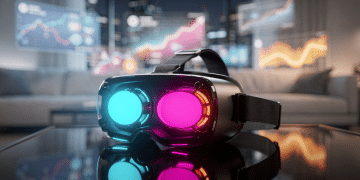
As we approach 2025, micro-OLED technology is emerging as a dominant force set to revolutionize VR headset resolution. Unlike traditional OLEDs that are deposited on glass substrates, micro-OLEDs are built directly onto silicon wafers, similar to how microprocessors are made. This allows for incredibly high pixel densities, far exceeding what’s possible with conventional panels.
The miniaturization achieved with micro-OLEDs means that manufacturers can pack millions of pixels into a display no larger than a postage stamp, leading to resolutions that can reach 4K or even 8K per eye in a compact form factor. This dramatic increase in pixel density directly addresses the ‘screen door effect,’ making individual pixels virtually indistinguishable to the human eye and significantly enhancing visual fidelity.
Advantages of Micro-OLED in VR
The benefits of micro-OLED extend beyond just raw pixel count. Their silicon-based design allows for extremely fast pixel response times, which is crucial for reducing motion blur and improving the overall smoothness of VR experiences. This rapid response minimizes latency, contributing to a more comfortable and less nauseating virtual environment.
- Ultra-High Pixel Density: Eliminates screen door effect, enabling photorealistic visuals.
- Fast Response Times: Reduces motion blur and VR sickness, improving comfort.
- Compact Form Factor: Allows for lighter, sleeker headset designs.
- High Contrast and Brightness: Delivers vivid colors and deep blacks, enhancing immersion.
Companies like Sony, Apple, and others are heavily investing in micro-OLED technology for their next-generation VR and AR devices. The promise of displays that offer desktop monitor-level clarity in a headset is a game-changer for everything from gaming to professional applications, truly bringing virtual reality closer to its full potential.

The Role of QLED and Mini-LED in Enhancing Resolution
While micro-OLED is a frontrunner, other display technologies like QLED (Quantum Dot Light Emitting Diode) and Mini-LED are also playing a significant role in pushing the boundaries of VR headset resolution and visual quality. These technologies offer compelling alternatives or complementary solutions, particularly for specific VR applications or headset designs.
QLED technology, often seen in high-end televisions, uses quantum dots to produce highly saturated and accurate colors. When applied to VR, QLED can deliver a wider color gamut and improved brightness compared to traditional LCDs, enhancing the vibrancy and realism of virtual worlds. While not inherently offering the same pixel density as micro-OLEDs, QLED can improve the perceived resolution through superior color reproduction and contrast.
Mini-LED Backlighting for LCD Panels
Mini-LED technology, on the other hand, primarily serves as an advanced backlighting solution for LCD panels. Instead of a single or a few large backlights, Mini-LED arrays use thousands of tiny LEDs to illuminate the screen. This allows for much more precise local dimming, meaning different areas of the screen can be lit or dimmed independently. The result is significantly improved contrast ratios, deeper blacks, and higher peak brightness, rivaling some OLED characteristics without the same cost or potential for burn-in.
- Mini-LED Benefits: Enhanced contrast, deeper blacks, higher brightness, reduced blooming.
- QLED Integration: Broader color gamut, increased color accuracy and vibrancy.
Combining Mini-LED backlighting with QLED color enhancement could lead to LCD-based VR displays that offer a compelling blend of high resolution, excellent contrast, and vibrant colors at a potentially more accessible price point than micro-OLED. These technologies demonstrate that the future of VR headset resolution isn’t a single path, but rather a convergence of various innovations.
Beyond Pixels: Refresh Rates and Field of View
While VR headset resolution is a primary focus, it’s crucial to remember that it’s only one piece of the puzzle for truly immersive VR. Refresh rates and field of view (FOV) are equally vital in creating a seamless and believable virtual experience. Even with incredibly high pixel counts, a low refresh rate can lead to stuttering and motion sickness, while a narrow FOV can make users feel like they’re looking through binoculars.
High refresh rates—ideally 90Hz, 120Hz, or even higher—are essential for smooth motion and reducing perceived latency. Modern display technologies, especially micro-OLEDs, are being designed with these high refresh rates in mind, ensuring that the visual information is updated quickly enough to match human perception and prevent discomfort.
Expanding the Field of View
The field of view in VR headsets refers to the extent of the observable virtual world. A wider FOV closely mimics natural human peripheral vision, making the experience feel more natural and less restrictive. Achieving a wider FOV often involves complex optical designs and larger display panels, which can add to the headset’s size and weight. However, advancements in lens technology, such as pancake lenses, are making it possible to achieve wider FOVs in more compact designs.
- Refresh Rate Importance: Reduces motion sickness, ensures smooth visuals.
- Field of View Impact: Enhances immersion, reduces tunnel vision effect.
The synergy between ultra-high resolution, rapid refresh rates, and an expansive field of view is what ultimately defines the next generation of VR immersion. As display technologies evolve, manufacturers are increasingly focusing on optimizing all three factors simultaneously to deliver a truly unparalleled virtual experience, pushing the boundaries of what VR headset resolution means in a broader context.
Challenges and Considerations for High-Resolution VR
While the promise of stunningly high VR headset resolution is exciting, its realization comes with significant technical and practical challenges. Pushing millions of pixels at high refresh rates demands immense processing power, efficient data transfer, and advanced optical systems. These factors contribute to the overall complexity and cost of VR hardware.
Processing power is perhaps the most immediate hurdle. Rendering 4K or 8K per eye requires GPUs far more powerful than what’s currently available in most consumer PCs, let alone standalone VR headsets. This necessitates continued advancements in graphics card technology and dedicated VR chipsets, along with sophisticated rendering techniques like foveated rendering, which only fully renders the area the user is directly looking at.
Data Transfer and Optics
Another challenge lies in the data transfer bandwidth required to send such high-resolution, high-refresh-rate video streams to the displays. New standards and more efficient compression techniques are crucial. Furthermore, the optical systems—the lenses that magnify the display to fill the user’s field of view—must be perfectly matched to the high-resolution panels to avoid distortions or chromatic aberrations that could negate the benefits of the advanced displays.
- Computational Demands: Requires powerful GPUs and efficient rendering.
- Bandwidth Limitations: Needs faster data transfer protocols.
- Optical Precision: Advanced lenses crucial for clarity and immersion.
Addressing these challenges is not just about raw power but also about intelligent system design and software optimization. The pursuit of higher VR headset resolution is a holistic endeavor, requiring innovation across the entire VR ecosystem.
The 2025 Outlook: What to Expect from VR Headset Resolution
Looking ahead to 2025, the landscape of VR headset resolution is poised for a dramatic transformation. We can anticipate a significant shift towards micro-OLED displays becoming more prevalent, especially in high-end and professional-grade headsets. This will lead to a noticeable reduction, and in many cases, complete elimination, of the screen door effect, ushering in an era of unprecedented visual clarity.
Mainstream consumer VR devices will likely see a continued improvement in resolution, with many pushing towards 4K per eye, potentially utilizing advanced LCDs with Mini-LED backlighting and QLED enhancements. The emphasis will be on delivering a premium visual experience that feels natural and deeply immersive, blurring the lines between the virtual and physical worlds.
Impact on User Experience and Applications
This leap in resolution will have a profound impact on user experience across all VR applications. For gaming, it means more realistic graphics and crisper details, making virtual environments feel more tangible. For professional use cases, such as design, engineering, and medical training, higher resolution translates to greater precision and accuracy, enhancing the utility of VR as a powerful tool.
- Consumer Market: Widespread adoption of 4K per eye for mainstream.
- High-End & Pro VR: Micro-OLEDs delivering 8K per eye or beyond.
- Enhanced Realism: Virtual objects and environments will appear more lifelike.
- Broader Applications: Improved clarity will unlock new uses for VR in various sectors.
By 2025, the advancements in display technology will not just be about seeing more pixels, but about experiencing virtual reality with a level of visual fidelity that truly convinces the brain of its reality, making the impact of new display technologies on VR headset resolution a cornerstone of future VR development.
| Key Technology | Impact on VR Resolution by 2025 |
|---|---|
| Micro-OLED | Enables 4K-8K per eye, eliminating screen door effect for premium headsets. |
| Mini-LED Backlighting | Significantly improves contrast and black levels on LCDs, enhancing perceived sharpness. |
| QLED Technology | Wider color gamut and increased vibrancy, complementing resolution for realism. |
| Pancake Lenses | Allows for wider field of view and compact headset designs, improving overall immersion. |
Frequently Asked Questions About VR Display Resolution
The ‘screen door effect’ refers to the visible grid lines between pixels on a VR display. It’s being addressed by increasing pixel density through technologies like micro-OLED, making individual pixels too small to discern and creating a smoother, more continuous image.
Both are crucial. High resolution provides visual clarity, while a high refresh rate (90Hz+) ensures smooth motion and reduces motion sickness. A balanced approach, optimizing both, is key for truly immersive and comfortable VR experiences.
Yes, rendering content for higher resolution displays demands significantly more computational power. This drives the need for more powerful GPUs and advanced rendering techniques like foveated rendering to optimize performance without sacrificing visual quality.
Micro-OLEDs are built on silicon wafers, allowing for vastly higher pixel densities and extremely compact form factors. This enables resolutions up to 8K per eye in a smaller display, significantly improving clarity and reducing headset bulk compared to traditional OLEDs.
Higher resolution and visual fidelity will greatly enhance professional applications like design, engineering, and medical training by providing greater detail and accuracy. It will also improve remote collaboration and virtual tourism, making experiences more lifelike and engaging.
Conclusion
The journey towards truly photorealistic virtual reality is accelerating, with advancements in display technology serving as a primary catalyst. As we peer into 2025, the impact of new display technologies on VR headset resolution is undeniable and transformative. Micro-OLED, alongside innovations in Mini-LED and QLED, is poised to deliver an unprecedented level of visual fidelity, effectively eliminating the ‘screen door effect’ and ushering in an era where virtual worlds are indistinguishable from reality. While challenges in processing power and optics remain, the concerted efforts of industry leaders are paving the way for a future where VR is not just an experience, but a seamless extension of our perception.