Wireless VR Hardware Solutions 2026: Latency & Performance US Market

The landscape of virtual reality is evolving at an unprecedented pace, with wireless freedom emerging as a pivotal factor in user immersion and adoption. As we look towards 2026, the demand for untethered VR experiences is pushing hardware manufacturers to innovate relentlessly, particularly in the critical areas of latency and performance. This comprehensive analysis delves into the anticipated wireless VR hardware solutions for 2026, offering a detailed comparative study of their latency and performance metrics within the dynamic US market. Understanding these elements is not just about appreciating technological advancements; it’s about identifying the devices that will truly redefine our interaction with digital worlds.
The journey to truly seamless wireless VR has been fraught with technical challenges. The sheer volume of data required to render high-fidelity virtual environments, combined with the stringent demands for minimal delay between user action and visual feedback, has historically made wireless VR a difficult proposition. However, breakthroughs in wireless communication protocols, processing power, and display technologies are rapidly bridging this gap. By 2026, we anticipate a mature market where several compelling wireless VR hardware solutions will vie for consumer attention, each promising a unique blend of features and capabilities.
Our focus on the US market is strategic. The United States continues to be a major hub for technological innovation and early adoption, often setting trends that resonate globally. Consumer expectations in the US are high, and the competitive environment fosters rapid development and refinement of VR technologies. Therefore, a deep dive into the US market provides valuable insights into the broader trajectory of wireless VR.
The Imperative of Low Latency in Wireless VR Hardware 2026
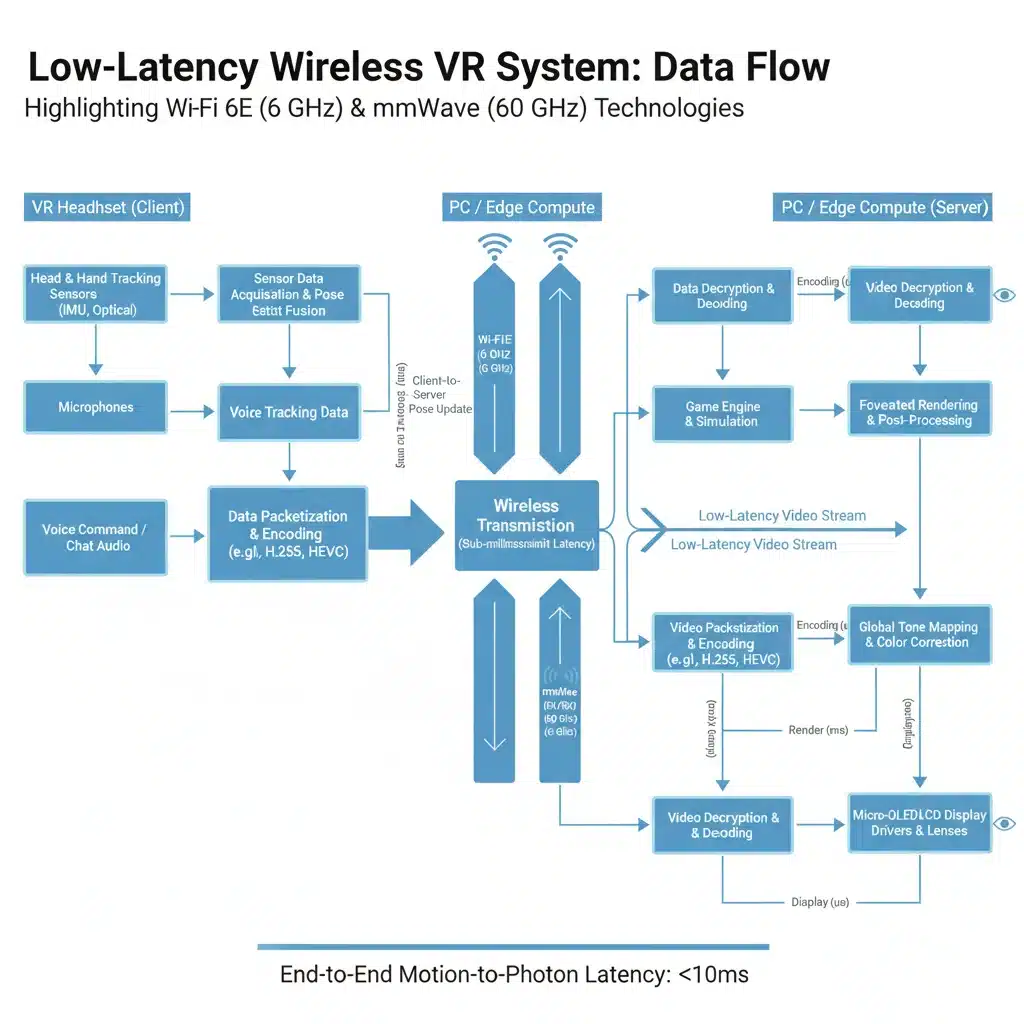
Latency, often referred to as ‘motion-to-photon’ latency, is perhaps the single most critical factor determining the quality of a VR experience. It measures the time delay between a user’s physical movement and the corresponding update of the virtual scene. High latency can lead to motion sickness, a disconnect between the user’s perception and the virtual environment, and a general degradation of immersion. For wireless VR, this challenge is amplified, as data must be transmitted wirelessly, processed, and then rendered, adding potential points of delay.
In 2026, the expectation for wireless VR hardware will be a motion-to-photon latency of under 10-15 milliseconds (ms). Anything above this threshold significantly increases the likelihood of discomfort and reduces the sense of presence. Achieving such low latency wirelessly requires a confluence of advanced technologies, including:
- High-Bandwidth Wireless Protocols: The transition from Wi-Fi 5 to Wi-Fi 6E and the increasing adoption of millimeter-wave (mmWave) technologies are crucial. Wi-Fi 6E offers a new 6 GHz band, providing wider channels and less interference, leading to higher throughput and lower latency. MmWave, operating in much higher frequency bands (e.g., 60 GHz), offers extremely high bandwidth and very low latency over short distances, making it ideal for room-scale VR.
- Optimized Encoding and Decoding: Efficient video compression and decompression algorithms are essential to transmit high-resolution VR content wirelessly without introducing significant delay. Modern codecs like H.265 (HEVC) and even newer, more efficient ones will play a vital role.
- Edge Computing and Local Processing: While some processing can be offloaded to a powerful PC, hybrid solutions that leverage on-device processing for critical tasks like head tracking can help reduce round-trip latency.
- Predictive Tracking Algorithms: Advanced algorithms that predict user head and body movements can compensate for inherent system delays, making the experience feel more immediate.
The leading wireless VR hardware 2026 contenders will undoubtedly showcase significant advancements in these areas, striving to push latency into the single-digit millisecond range for an almost imperceptible delay.
Performance Benchmarks: Beyond Latency
While latency is paramount, overall performance encompasses a broader range of metrics that contribute to a superior VR experience. For wireless VR hardware in 2026, these include:
Display Resolution and Refresh Rate
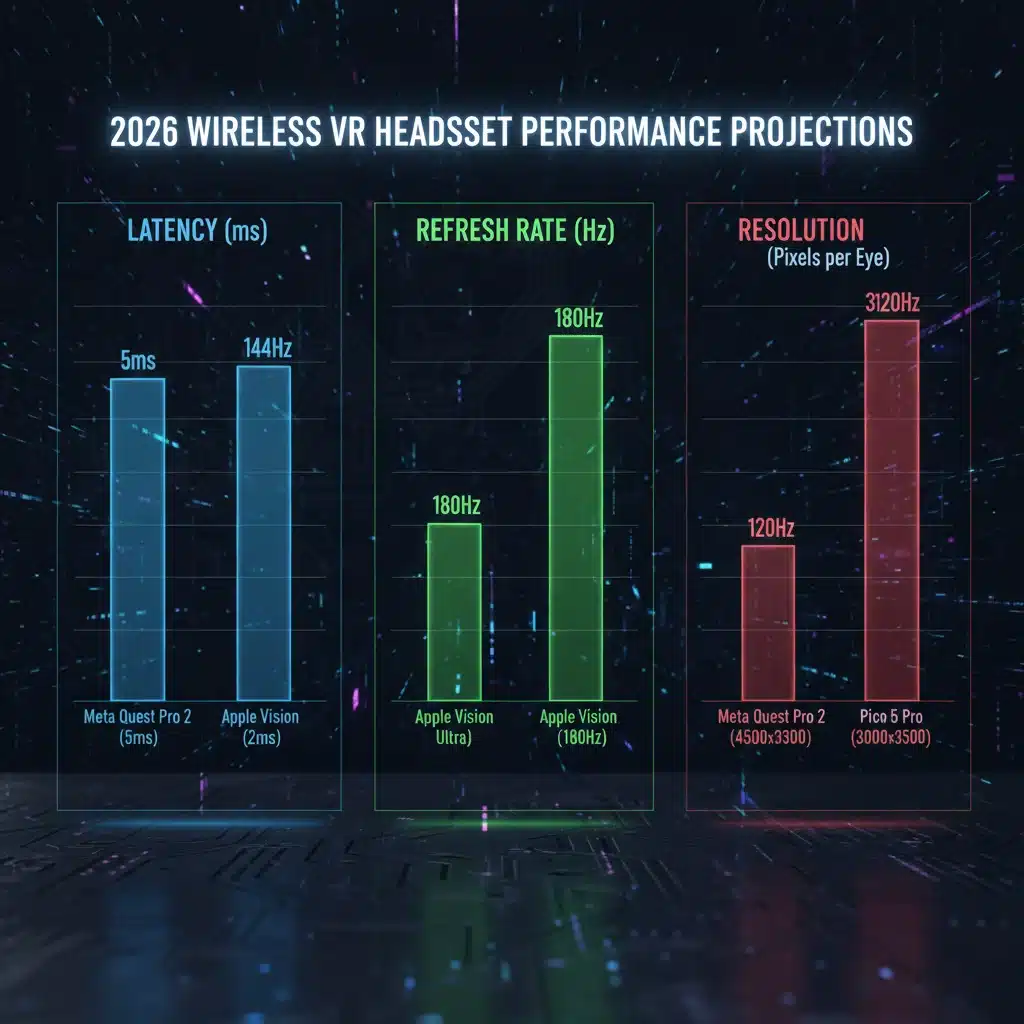
Higher resolution screens reduce the ‘screen-door effect’ (the visible gaps between pixels), leading to sharper, more realistic visuals. Coupled with a high refresh rate (e.g., 90 Hz, 120 Hz, or even higher), this ensures smooth motion and reduces eye strain. Wireless transmission of such high-fidelity video streams without compromise is a significant technical feat. We expect 2026 devices to target resolutions per eye that rival or exceed 4K, with refresh rates consistently at 90 Hz or above.
Field of View (FoV)
A wider field of view enhances immersion by making the virtual world feel more expansive and natural. While increasing FoV often comes with increased computational and transmission demands, advancements in optical designs and foveated rendering (where only the area the user is directly looking at is rendered in full resolution) will allow for broader FoVs without significant performance penalties.
Inside-Out Tracking Accuracy and Robustness
Most standalone and wireless PC VR solutions rely on inside-out tracking, using cameras on the headset to track the user’s position and orientation in space. The accuracy, precision, and robustness of this tracking system are crucial for a stable and believable VR experience. By 2026, these systems will be highly refined, offering precise sub-millimeter tracking and reliable performance even in challenging lighting conditions.
Battery Life and Ergonomics
For a truly wireless experience, battery life is a critical practical consideration. Users expect several hours of uninterrupted gameplay or productivity. This requires efficient power management and advanced battery technologies. Equally important are ergonomics: a headset must be comfortable to wear for extended periods, with balanced weight distribution and adjustable fit. The design of wireless VR hardware 2026 will heavily emphasize both aspects.
Processing Power (On-Device and PC-Tethered)
Whether it’s a standalone headset or a PC-tethered wireless solution, the underlying processing power dictates the complexity and fidelity of the virtual environments that can be rendered. Standalone headsets will feature increasingly powerful mobile chipsets, capable of rendering impressive graphics natively. PC-tethered solutions will leverage the immense power of dedicated GPUs, with the wireless link serving as a high-speed conduit for rendered frames.
Key Wireless VR Hardware Solutions for 2026 in the US Market
As we project into 2026, several companies are expected to lead the charge in the wireless VR hardware space within the US market. While specific product names and specifications are speculative, we can analyze the likely approaches and technological foundations of anticipated devices from major players.
Meta (Quest Series Evolution)
Meta, with its dominant Quest line, is a formidable player. The Quest 3, released in late 2023, already set a new standard for standalone wireless VR. By 2026, we can expect the Quest 4 or a successor device to push boundaries further. Key advancements will likely include:
- Enhanced Mobile Chipset: A custom-designed or next-generation Snapdragon XR platform offering significantly increased GPU and CPU performance, enabling more complex graphics and advanced AI features directly on the headset.
- Improved Wireless Connectivity: Full utilization of Wi-Fi 6E and potentially early implementations of Wi-Fi 7 for even lower latency and higher bandwidth streaming from PCs or cloud services.
- Advanced Display Technology: Higher resolution, potentially micro-OLED displays, with increased refresh rates and wider color gamut.
- Sophisticated Inside-Out Tracking: Even more precise and robust tracking, potentially incorporating eye-tracking for foveated rendering and more natural social interactions in VR.
- Mixed Reality Capabilities: Building upon the Quest 3’s passthrough, future Meta devices will likely offer even higher fidelity color passthrough for seamless transitions between physical and virtual worlds.
Meta’s strategy will likely continue to focus on accessibility and a broad content ecosystem, making their wireless VR hardware 2026 offerings highly competitive for the mainstream US consumer.
Valve (Decentralized Approach & High-End PC VR)
Valve, known for its SteamVR platform and the Index headset, has traditionally focused on high-fidelity PC VR. While they haven’t released a standalone headset, their influence on PC VR standards and their potential partnerships could lead to significant wireless advancements. Their approach might involve:
- Next-Gen Wireless Adapters: Building upon existing WiGig solutions, Valve might integrate or promote advanced wireless streaming technologies for their PC VR ecosystem, potentially leveraging partners like HTC or standalone device manufacturers.
- Open Standards and Ecosystem: Valve’s strength lies in its open platform. They may drive initiatives for standardized low-latency wireless streaming protocols that benefit a wider range of hardware.
- High-Fidelity PC VR Streaming: For users with powerful gaming PCs, Valve’s focus will be on ensuring that wireless streaming maintains the highest possible visual fidelity and lowest latency, leveraging advanced compression and transmission techniques.
Valve’s impact on wireless VR hardware 2026 in the US will likely be felt more in the high-end PC VR segment, influencing the performance ceilings of wirelessly connected PC VR systems.
HTC Vive (Business & Prosumer Focus)
HTC Vive has a strong presence in the enterprise and prosumer markets. Their past wireless adapters demonstrated early commitment to untethered VR. By 2026, HTC Vive’s wireless VR hardware will likely emphasize:
- Robust Enterprise Solutions: Durable, reliable wireless headsets designed for commercial applications, training, and location-based entertainment.
- Advanced Connectivity for Multiple Users: Solutions that can support multiple wireless VR users simultaneously in a confined space, minimizing interference and maintaining performance.
- Modular Design: Continued emphasis on modularity, allowing for upgrades to components like batteries, tracking systems, or even display modules.
- High-Resolution and Professional-Grade Optics: Catering to professional users who demand the highest visual clarity and precision.
HTC Vive’s wireless VR hardware 2026 will likely target specific niches within the US market, offering specialized solutions with uncompromising performance and reliability.
Emerging Players and Technologies
The VR market is dynamic, and new entrants or significant shifts from existing players are always possible. Companies like Apple, with its Vision Pro, are already exploring mixed reality with high-bandwidth local processing, and while not purely wireless VR in the traditional sense, their technological advancements could influence future wireless VR designs. Additionally, startups focusing on specific components (e.g., ultra-low latency wireless chips, advanced optics, or novel tracking methods) could disrupt the market.
The integration of AI and machine learning will also be crucial. AI can optimize wireless transmission, predict user movements more accurately, and even enhance rendering quality through techniques like AI-upscaling, all contributing to better latency and performance in wireless VR hardware 2026.
The Role of Wireless Technologies: Wi-Fi 6E, Wi-Fi 7, and MmWave
The backbone of future wireless VR is undoubtedly the underlying communication technology. In 2026, we will see a strong reliance on:
- Wi-Fi 6E: As mentioned, the 6 GHz band offers significant advantages. It provides a large, uncluttered spectrum, allowing for wider channels (up to 160 MHz) and higher data rates, which are critical for streaming high-resolution, high-refresh-rate VR content with minimal latency. Most wireless VR hardware 2026 will integrate Wi-Fi 6E for general-purpose high-speed connectivity.
- Wi-Fi 7 (802.11be – Extremely High Throughput): While still in development, Wi-Fi 7 is expected to be finalized around 2024. By 2026, we might see early adoption or integration of Wi-Fi 7 capabilities in premium wireless VR devices. Wi-Fi 7 promises even higher throughput, lower latency, and improved efficiency by leveraging wider channels (up to 320 MHz), 4096-QAM modulation, and multi-link operation (MLO), which allows devices to use multiple frequencies simultaneously. This could be a game-changer for truly uncompromised wireless VR streaming.
- Millimeter Wave (mmWave) Technologies: Operating in the 60 GHz band (e.g., WiGig/802.11ad/ay), mmWave offers extremely high bandwidth (several gigabits per second) and ultra-low latency over very short distances (a few meters). Its main drawback is its susceptibility to obstruction (it can’t pass through walls easily). For dedicated room-scale VR setups, mmWave remains an excellent option for direct, high-speed data links between the headset and a dedicated transmitter connected to a PC. Some wireless VR hardware 2026 might offer hybrid solutions, using Wi-Fi 6E/7 for general connectivity and mmWave for specific, high-demand streaming scenarios.
The combination and intelligent orchestration of these wireless technologies will be key to delivering the low-latency, high-performance wireless VR experiences expected in 2026.
Challenges and Opportunities in the US Market
Despite the rapid advancements, several challenges and opportunities will shape the wireless VR hardware market in the US by 2026:
Challenges:
- Price Point: High-performance wireless VR hardware often comes with a premium price tag. Making these technologies accessible to a broader audience will be crucial for mass adoption.
- Content Availability: A rich and diverse library of compelling VR content (games, educational experiences, productivity tools) is essential to drive hardware sales.
- Technical Complexity for Users: While wireless freedom simplifies setup in some ways, optimizing wireless networks for VR streaming can still be complex for the average user.
- Competition from Other Technologies: Augmented Reality (AR) and mixed reality (MR) devices will continue to evolve, potentially drawing consumer interest away from pure VR.
Opportunities:
- Enterprise Adoption: Wireless VR offers immense potential for training, design, collaboration, and remote work, driving significant market growth.
- Location-Based Entertainment (LBE): Arcades and VR experiences thrive on wireless freedom, allowing for untethered movement in large spaces.
- Esports and Social VR: The competitive gaming and social interaction aspects of VR are significantly enhanced by wireless capabilities, fostering new forms of entertainment.
- Healthcare and Education: From surgical training to immersive classroom experiences, wireless VR can revolutionize these sectors.
The US market, with its strong tech infrastructure and consumer demand for cutting-edge experiences, is uniquely positioned to capitalize on these opportunities, making it a critical battleground for wireless VR hardware 2026.
The User Experience: Beyond Specifications
Ultimately, the success of wireless VR hardware in 2026 will hinge on the overall user experience. This goes beyond raw specifications and delves into the intuitive nature of the hardware and software. Key aspects include:
- Ease of Setup and Use: A truly wireless experience should be plug-and-play, with minimal friction in getting started.
- Comfort and Wearability: Extended sessions demand lightweight, well-balanced headsets that don’t cause discomfort.
- Intuitive Interfaces: VR operating systems and interaction methods need to be natural and easy to navigate.
- Robust Software Ecosystem: Access to a wide range of high-quality applications and games that leverage the wireless capabilities.
- Reliability and Stability: Consistent performance without glitches, dropped connections, or tracking issues is paramount for immersion.
The wireless VR hardware 2026 leaders will be those that not only push the boundaries of latency and performance but also deliver a polished, user-friendly experience from start to finish. The US market, with its discerning consumers, will be a key driver in demanding this level of refinement.
Conclusion: A Glimpse into the Wireless VR Future
As we approach 2026, the promise of truly immersive, untethered virtual reality is closer than ever. The ongoing advancements in wireless communication (Wi-Fi 6E, Wi-Fi 7, mmWave), processing power, display technologies, and tracking algorithms are converging to deliver wireless VR hardware that significantly reduces latency and elevates overall performance. Companies like Meta, Valve, and HTC Vive, alongside innovative newcomers, will be at the forefront of this evolution, each bringing their unique strengths to the competitive US market.
The comparative study of wireless VR hardware 2026 will not just be about who has the lowest latency or the highest resolution, but also about which solutions offer the most compelling blend of performance, comfort, content, and accessibility. The journey towards ubiquitous wireless VR is an exciting one, promising to unlock new dimensions of entertainment, productivity, and social interaction. For consumers and businesses in the US, 2026 is poised to be a landmark year for experiencing virtual worlds without the constraints of a cable, ushering in an era of unprecedented freedom and immersion in virtual reality.