

Cutting-Edge AR in Healthcare: 4 Innovations Transforming US Patient Care by 2026
The landscape of healthcare is in a constant state of evolution, driven by relentless technological advancements. Among the most promising and disruptive technologies emerging today is Augmented Reality (AR). Far from being a mere gimmick for entertainment, AR is rapidly proving its profound potential to revolutionize medical practices, enhance patient outcomes, and streamline operational efficiencies across the healthcare sector. By overlaying digital information onto the real world, AR offers unprecedented ways for medical professionals to visualize, interact with, and understand complex data, leading to more informed decisions and precise interventions. The impact of AR healthcare innovation is not a distant dream; it is already unfolding, and by 2026, its presence in US patient care is expected to be transformative.
This article delves into four pivotal AR healthcare innovation trends that are not only on the horizon but are actively being developed and implemented, promising to reshape how healthcare is delivered and experienced in the United States. From the operating room to remote patient monitoring and medical education, these innovations are set to significantly impact patient safety, diagnostic accuracy, therapeutic effectiveness, and the overall quality of care. Understanding these advancements is crucial for healthcare providers, policymakers, and patients alike, as they represent the vanguard of a new era in medicine where technology and human expertise converge for optimal health outcomes. The integration of AR healthcare innovation is poised to create a more efficient, accurate, and personalized healthcare system, benefiting millions across the nation.
1. Precision Surgery and Enhanced Intraoperative Guidance with AR
One of the most impactful applications of AR healthcare innovation is in the realm of surgery. Surgical procedures, by their very nature, demand extreme precision, detailed anatomical knowledge, and the ability to navigate complex physiological structures. Traditional methods rely heavily on pre-operative imaging (CT, MRI), which surgeons must mentally transpose onto the patient during the operation. This process, while effective, introduces a cognitive load and potential for discrepancies between the static images and the dynamic reality of the surgical field.
Augmented Reality is changing this paradigm by providing surgeons with real-time, interactive, and superimposed anatomical data directly within their line of sight. Imagine a surgeon wearing an AR headset that projects a 3D model of the patient’s organs, tumors, blood vessels, or bone structures directly onto or within the patient’s body during an operation. This ‘X-ray vision’ allows for unparalleled spatial understanding and navigational accuracy. For instance, in complex spinal surgeries, AR can overlay 3D models of vertebrae and nerve pathways, guiding the surgeon in real-time to precisely place screws and implants, thereby minimizing the risk of nerve damage and improving fusion rates. In oncology, AR can highlight tumor margins that might otherwise be invisible to the naked eye, ensuring more complete resections while preserving healthy tissue.
Beyond visualization, AR systems can integrate with surgical robots and navigation platforms, creating a symbiotic relationship between human dexterity and technological precision. These systems can track surgical instruments in real-time, displaying their exact position relative to critical anatomical structures. This level of guidance is particularly beneficial in minimally invasive surgeries, where the surgeon’s direct view is limited. By 2026, we anticipate widespread adoption of AR-guided surgery in orthopedic, neurosurgical, and oncological procedures across major US hospitals. This AR healthcare innovation promises to reduce operation times, decrease complication rates, and accelerate patient recovery, fundamentally transforming the surgical experience for both practitioners and patients.
Furthermore, AR can facilitate collaborative surgery. A senior surgeon can remotely ‘annotate’ the live surgical field for a junior surgeon, guiding their movements and providing real-time instructions, effectively bridging geographical distances and enhancing training opportunities. This not only democratizes access to expert surgical knowledge but also improves the consistency and quality of surgical outcomes across different institutions. The ability to visualize critical structures, plan complex maneuvers with greater confidence, and receive immediate feedback makes AR an indispensable tool for the next generation of surgical excellence. The drive for higher precision and better outcomes will cement AR’s role as a cornerstone of modern surgical practice, making it a leading AR healthcare innovation.
2. Immersive Medical Training and Education
Medical education has traditionally relied on textbooks, cadaver labs, and clinical rotations. While invaluable, these methods often have limitations in terms of accessibility, cost, and the ability to simulate rare or complex scenarios repeatedly. Augmented Reality offers a groundbreaking solution, providing immersive, interactive, and highly effective training environments that were previously unimaginable. This AR healthcare innovation is set to redefine how future doctors, nurses, and allied health professionals are educated and trained.
AR allows students to explore human anatomy in unprecedented detail. Instead of static diagrams or preserved specimens, students can view dynamic, interactive 3D holographic models of organs, skeletal systems, and circulatory networks. They can rotate these models, zoom in on specific structures, peel back layers, and even simulate physiological processes. This hands-on, experiential learning significantly enhances comprehension and retention. Imagine a student dissecting a virtual heart, identifying each valve and chamber, and then seeing blood flow simulated in real-time, all within a classroom setting without the need for physical specimens.
Beyond anatomy, AR can simulate complex medical procedures and clinical scenarios. Students can practice venipuncture, intubation, or even intricate surgical steps on virtual patients, receiving immediate feedback on their technique. This allows for repeated practice in a risk-free environment, building confidence and competence before interacting with real patients. Furthermore, AR can create realistic simulations of emergency situations, allowing trainees to practice their diagnostic and decision-making skills under pressure, without endangering anyone.
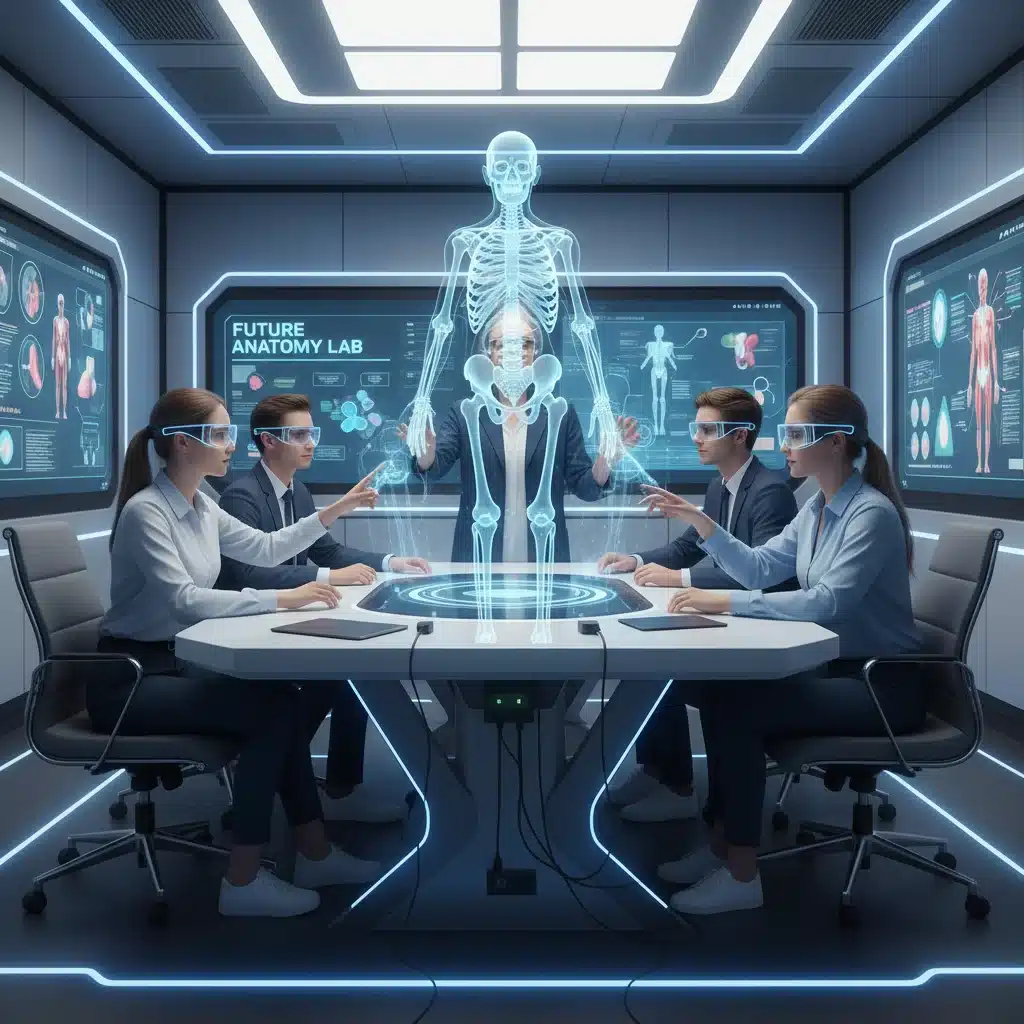
By 2026, AR-powered medical training modules are expected to be standard curriculum components in many US medical schools and teaching hospitals. This will not only accelerate the learning curve for new medical professionals but also provide continuous professional development opportunities for experienced practitioners to learn new techniques or refresh their skills. The ability to visualize complex medical conditions, practice procedures, and collaborate remotely with instructors and peers makes AR an indispensable tool for fostering a highly skilled and adaptable healthcare workforce. This profound impact on skill development and knowledge transfer solidifies AR’s position as a crucial AR healthcare innovation.
The cost-effectiveness of AR training is another significant benefit. While initial investment in AR hardware and software can be substantial, it can significantly reduce the long-term costs associated with cadaver labs, specialized training equipment, and travel for workshops. Moreover, AR allows for personalized learning paths, catering to individual student needs and paces, ultimately leading to a more competent and confident generation of healthcare providers. This shift towards immersive, accessible, and repeatable training methodologies underscores the transformative power of AR healthcare innovation in education.
3. Enhanced Diagnostics and Medical Imaging Visualization
Accurate and timely diagnosis is the cornerstone of effective patient care. Medical imaging, such as X-rays, CT scans, and MRIs, provides invaluable insights into a patient’s internal condition. However, interpreting these 2D images and mentally reconstructing them into a 3D understanding can be challenging, even for experienced radiologists and clinicians. This is where AR healthcare innovation steps in, offering a revolutionary approach to medical imaging visualization.
AR systems can transform flat 2D scans into interactive 3D holographic representations that can be viewed directly in the patient’s physical space or on a tabletop. This allows clinicians to manipulate, rotate, and section these virtual organs and structures, gaining a much deeper spatial understanding of pathologies. For example, a surgeon preparing for a complex liver resection can project a 3D model of the patient’s liver, complete with tumor location and surrounding vasculature, directly onto a mannequin or even a patient’s body (for planning purposes, not during surgery), allowing for meticulous pre-operative planning.
In diagnostic settings, AR can assist radiologists by overlaying patient data, such as pathology reports or historical scans, directly onto a current imaging study. This contextual information can help identify subtle anomalies or monitor disease progression with greater accuracy. For interventional radiologists, AR can guide needle biopsies or catheter placements by providing a real-time, superimposed view of the target area, minimizing invasiveness and improving precision.
By 2026, we expect AR to become an integral tool in diagnostic suites and pre-operative planning rooms across the US. This AR healthcare innovation will not only improve the accuracy of diagnoses but also enhance communication between different medical specialties. A surgeon can easily explain a complex condition to a patient or a referring physician by showing them an interactive 3D AR model, fostering better understanding and shared decision-making. The ability to visualize complex anatomical relationships and pathological conditions in a more intuitive and immersive way will lead to earlier and more precise diagnoses, ultimately improving patient outcomes.
Furthermore, AR can facilitate remote consultations. A specialist in one location can view an AR projection of a patient’s scan alongside a local physician, collaborating in real-time on diagnosis and treatment planning. This expands access to specialized expertise, particularly in rural or underserved areas, and ensures that patients receive the best possible care regardless of their geographical location. This collaborative potential significantly boosts the value of AR healthcare innovation in diagnostic fields.
4. Augmented Reality for Patient Rehabilitation and Therapy
Beyond the operating room and diagnostic labs, AR healthcare innovation is also making significant strides in patient rehabilitation and therapy. Traditional physical and occupational therapy often involves repetitive exercises that can be monotonous, leading to decreased patient engagement and adherence. AR offers a compelling solution by gamifying rehabilitation, making it more engaging, interactive, and measurable.
AR applications for rehabilitation can transform a patient’s environment into an interactive therapy space. For instance, stroke patients recovering motor function can perform prescribed exercises by interacting with virtual objects or games superimposed on their real-world surroundings. A patient needing to improve arm mobility might be tasked with virtually ‘catching’ falling objects or ‘painting’ a virtual wall, with the AR system tracking their movements and providing real-time feedback on range of motion, speed, and accuracy.
This gamified approach not only makes therapy more enjoyable but also provides objective data on patient progress, which can be shared with therapists. This data allows clinicians to tailor therapy plans more effectively and demonstrate tangible improvements to patients, boosting their motivation. For patients recovering from injuries or surgery, AR can provide guided exercises at home, allowing for continuous therapy outside of clinical visits. This is particularly beneficial for elderly patients or those with mobility issues who may find it difficult to travel to therapy centers frequently.
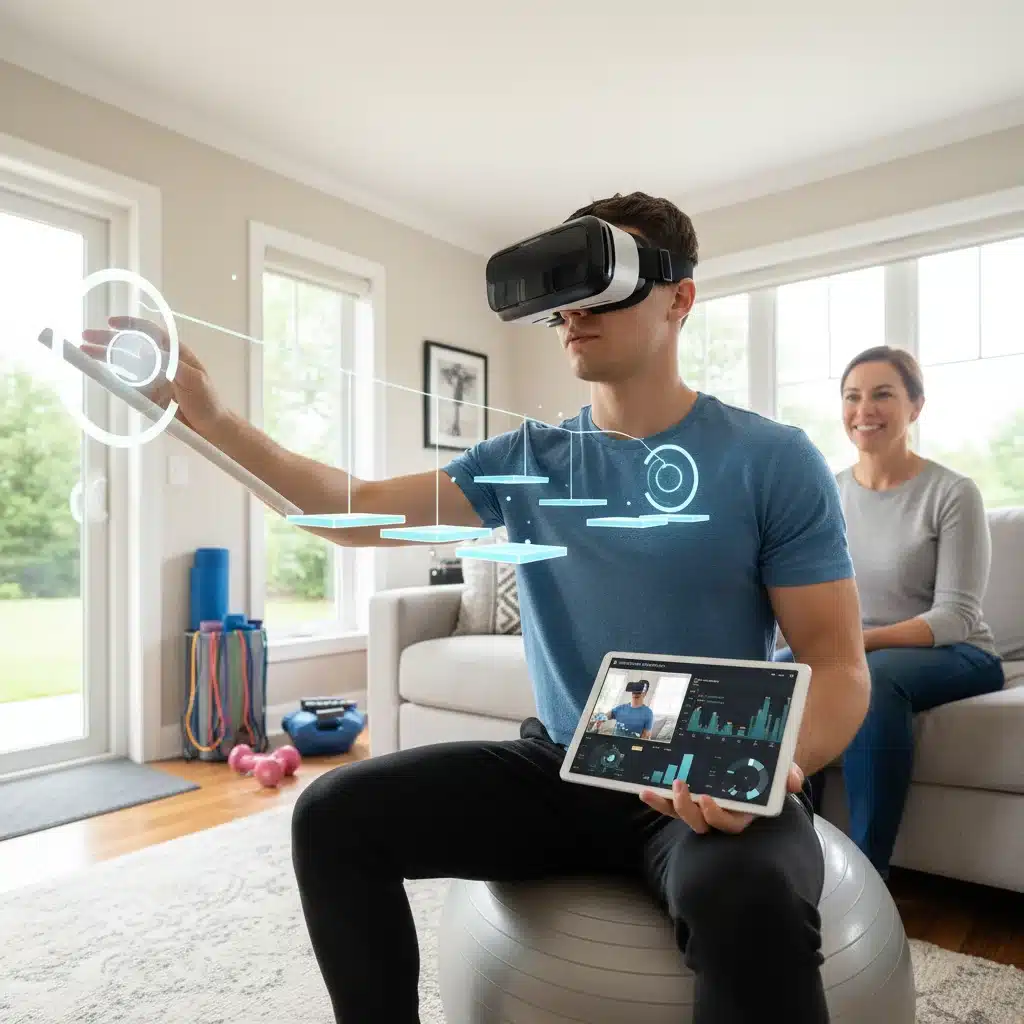
By 2026, AR-powered home rehabilitation programs are expected to gain considerable traction in the US, especially for chronic conditions and post-surgical recovery. These systems can also be used for cognitive rehabilitation, helping patients with neurological conditions improve memory, attention, and problem-solving skills through interactive AR games and exercises. The ability to personalize therapy, track progress accurately, and increase patient engagement makes AR a powerful tool in improving recovery outcomes and enhancing the overall quality of life for patients. This patient-centric approach makes AR healthcare innovation a game-changer in rehabilitation.
Moreover, AR can facilitate telerehabilitation, allowing therapists to remotely monitor and guide patients through their exercises. Through AR headsets, therapists can see what the patient sees, provide virtual annotations, and offer real-time verbal cues, making remote therapy sessions almost as effective as in-person ones. This expands access to specialized therapy, reduces healthcare costs associated with travel, and provides greater flexibility for patients. The integration of AR into rehabilitation signifies a monumental step towards more accessible, effective, and patient-friendly recovery pathways, solidifying its role as a key AR healthcare innovation.