Achieving Sub-10ms VR Latency: Practical Solutions for Immersive Experiences by Mid-2026
Virtual Reality (VR) has come a long way since its nascent stages, evolving from clunky prototypes to increasingly sophisticated devices. Yet, one persistent hurdle stands between current VR experiences and truly indistinguishable-from-reality immersion: latency. Specifically, hardware latency – the delay between a user’s physical action and the corresponding visual update on the display – remains a critical challenge. For VR to reach its full potential, achieving sub-10ms VR latency is not just an aspiration but a necessity. This ambitious target, aimed for by mid-2026, promises to unlock a new era of immersive computing, eliminating motion sickness, enhancing realism, and broadening the applications of VR across industries. This article delves into the practical solutions and technological advancements poised to make this low-latency future a reality.
Understanding the Latency Landscape in VR
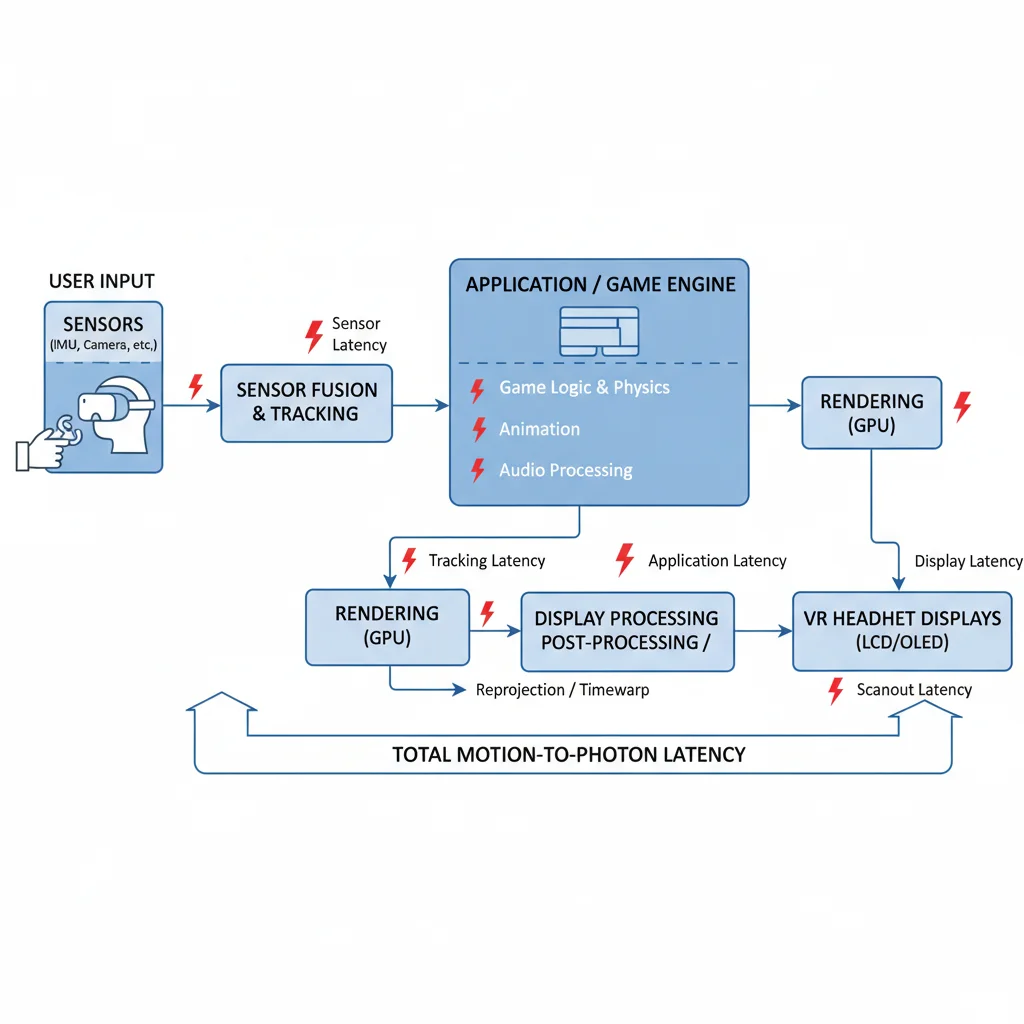
Before we explore solutions for sub-10ms VR latency, it’s crucial to understand the various components contributing to overall latency in a VR system. Latency can be broadly categorized into three main types:
- Motion-to-Photon Latency: This is the most critical metric for VR, representing the time from when a user moves their head or body to when that movement is reflected as updated pixels on the display. It’s the sum of all delays in the system.
- Input Latency: The delay between a physical input (e.g., controller button press, hand gesture) and the system registering that input.
- Photon-to-Photon Latency: The delay between an image being rendered and it actually being displayed to the user.
Each of these, in turn, is composed of several sub-components:
- Sensor Latency: Time taken for sensors (IMUs, cameras) to detect motion and transmit data.
- Tracking Latency: Processing time for raw sensor data to be translated into head and controller positions and orientations.
- Application Latency: Time taken for the VR application to process new tracking data and generate a new frame. This includes game logic, physics, and AI.
- Rendering Latency: Time taken by the GPU to render the new frame.
- Compositing Latency: Time taken for the VR runtime to combine the rendered frame with other layers (e.g., guardian boundaries) and prepare it for display.
- Display Latency: Time taken for the display panel to receive the frame and show it to the user. This includes scanout delay and pixel response time.
Currently, high-end VR systems typically achieve motion-to-photon latencies in the range of 15-25ms. While this is a significant improvement over earlier generations, it’s still perceptible to many users, contributing to simulator sickness and breaking the sense of presence. The 10ms barrier is widely considered the threshold below which latency becomes virtually imperceptible to the human eye and brain, making sub-10ms VR latency the holy grail for truly immersive experiences.
Hardware Innovations Driving Sub-10ms VR Latency
Achieving sub-10ms VR latency requires a concerted effort across all hardware components. Significant advancements are needed in displays, processing units, and communication protocols.
1. Next-Generation Display Technologies
The display panel itself is a major contributor to latency. Traditional LCDs and even current OLEDs can introduce delays due to their pixel response times and how they refresh. To achieve sub-10ms VR latency, new display technologies are paramount.
- Micro-LED and Mini-LED Displays: These technologies offer significantly faster pixel response times compared to OLEDs and LCDs. Micro-LEDs, in particular, are emissive displays where each tiny LED acts as an individual pixel, allowing for near-instantaneous light emission and extinction. This drastically reduces motion blur and display latency. While currently expensive and challenging to manufacture at VR resolutions, ongoing research and production scaling are expected to make them viable by mid-2026.
- High Refresh Rates: Pushing refresh rates beyond 90Hz, to 120Hz, 144Hz, or even higher, directly reduces the time between frames. A 120Hz display has a frame time of approximately 8.3ms, meaning a new image is presented every 8.3 milliseconds. This alone brings us closer to the sub-10ms VR latency target. Combined with faster pixel response times, this creates a much smoother and more responsive visual experience.
- Low Persistence Displays: This technique involves flashing frames for a very short duration, then turning the pixels off until the next frame is ready. This reduces the amount of time a single image is displayed, minimizing motion blur, especially during head movements. While common in current VR, combining it with ultra-fast displays and higher refresh rates will amplify its benefits.
2. Enhanced Processing Power and Architecture
The computational demands of VR are immense. Rendering two high-resolution images (one for each eye) at high frame rates, alongside complex physics, AI, and tracking algorithms, requires formidable processing power. To achieve sub-10ms VR latency, both CPUs and GPUs need to be more efficient and faster.
- Dedicated VR Processors/ASICs: Instead of relying solely on general-purpose CPUs and GPUs, future VR systems may incorporate dedicated Application-Specific Integrated Circuits (ASICs) optimized for specific VR tasks. These could handle tracking, distortion correction, foveated rendering, and other computationally intensive processes with extreme efficiency and minimal latency.
- Co-processors for Sensor Fusion: Advanced co-processors dedicated to sensor fusion – combining data from multiple sensors (IMUs, cameras, depth sensors) to create a highly accurate and low-latency understanding of head and hand positions – can significantly reduce tracking latency.
- Distributed Processing and Edge Computing: For standalone VR headsets, offloading some processing tasks to a powerful local server (edge computing) or even cloud servers could become a viable strategy, especially with the advent of 5G and future low-latency wireless communication standards. However, this introduces network latency, which itself needs to be meticulously managed to maintain sub-10ms VR latency.
- More Efficient GPU Architectures: Continuous improvements in GPU architecture, including larger caches, faster memory (e.g., HBM3), and more parallel processing units, will allow for faster rendering of complex scenes.
3. High-Bandwidth, Low-Latency Communication Interfaces
Data needs to flow rapidly and efficiently between components. Slow interfaces can introduce significant bottlenecks.
- Next-Generation USB (e.g., USB4 v2) and PCIe (e.g., PCIe 6.0): These standards offer massive increases in bandwidth, ensuring that sensor data, rendered frames, and other critical information can be transmitted between components with minimal delay.
- Wireless Technologies (Wi-Fi 7, 60GHz, UWB): For wireless VR, the challenge of maintaining sub-10ms VR latency is even greater. Wi-Fi 7 (802.11be) offers significantly lower latency and higher throughput than previous generations. Millimeter-wave (60GHz) wireless technologies, like WiGig, offer extremely high bandwidth over short distances, ideal for untethered VR within a room. Ultra-Wideband (UWB) can provide precise positioning and low-latency data transfer for controllers and accessories.
- Optical Interconnects: For internal headset communication or even short-range external connections, optical interconnects could replace traditional copper wires, offering superior bandwidth and immunity to electromagnetic interference, further reducing potential delays.
Software Optimization: The Unsung Hero in Achieving Sub-10ms VR Latency
While hardware provides the foundation, software is where much of the magic happens in reducing latency. Smart algorithms and efficient programming are crucial for hitting the sub-10ms VR latency target.
1. Advanced Prediction Algorithms
One of the most effective ways to combat latency is to predict future head and controller movements. If the system can accurately guess where the user will be looking or moving in the next few milliseconds, it can start rendering that view proactively.
- Extrapolated Tracking: Instead of waiting for new sensor data, the system uses past movement data to extrapolate the user’s likely position and orientation in the very near future. This can effectively reduce perceived latency by rendering frames for a predicted future state.
- Machine Learning for Prediction: AI and machine learning models can be trained on vast datasets of user movement patterns to make even more accurate predictions, accounting for individual user tendencies and context. This can significantly enhance the effectiveness of prediction algorithms, bringing us closer to sub-10ms VR latency.
2. Foveated Rendering
Human vision is only sharp in a small central area (the fovea). Foveated rendering leverages this by rendering the central part of the display at full resolution and detail, while progressively reducing the resolution and detail in the periphery. This requires accurate eye-tracking.
- Dynamic Foveated Rendering: With precise eye-tracking, the system can dynamically adjust the rendered resolution based on where the user is looking in real-time. This dramatically reduces the GPU workload, allowing for faster frame generation and contributing to lower overall latency. Less work for the GPU means frames are ready sooner, directly impacting sub-10ms VR latency goals.
- Fixed Foveated Rendering: Even without eye-tracking, a fixed foveated rendering approach (where the center is always high-res) can offer some performance benefits, though less dynamic.
3. Asynchronous Timewarp (ATW) and Spacewarp (ASW)
These techniques are crucial for maintaining a smooth experience even when the application can’t consistently hit the target frame rate. They don’t directly reduce the underlying motion-to-photon latency but mitigate its effects.
- Asynchronous Timewarp (ATW): If a new frame isn’t ready in time, ATW re-projects the last rendered frame based on the very latest head tracking data. This corrects for head rotation, reducing judder and motion sickness, even if the scene content itself isn’t updated.
- Asynchronous Spacewarp (ASW): Building on ATW, ASW generates entirely new synthetic frames between actual rendered frames, predicting not just head movement but also scene movement. This allows a VR application to run at half the target frame rate (e.g., 45fps for a 90Hz display) while still providing a smooth 90Hz experience. While these are compensation techniques, optimizing them to be extremely fast and efficient contributes to the overall perception of sub-10ms VR latency.
4. Optimized Rendering Pipelines and APIs
The way graphics are processed and presented to the display can also be optimized for latency.
- Direct Display Mode: In this mode, the VR headset is treated as a direct display device, bypassing the operating system’s desktop compositor. This eliminates an entire layer of processing and associated latency.
- Low-Level Graphics APIs (e.g., Vulkan, DirectX 12): These APIs provide developers with closer access to GPU hardware, allowing for more efficient resource management and rendering, which can reduce rendering latency.
- Multi-threaded Rendering: Utilizing multiple CPU cores to prepare rendering commands in parallel can reduce CPU-side bottlenecks, ensuring the GPU is fed data continuously and efficiently.
5. Operating System and Runtime Optimizations
The underlying operating system and VR runtime software also play a role in latency. Minimizing overhead, optimizing scheduling, and prioritizing VR processes are essential.
- Real-time Operating System (RTOS) Features: For embedded VR systems, adopting real-time operating system principles can ensure that critical VR processes are executed with guaranteed timing, minimizing unpredictable delays.
- Dedicated VR Runtimes: VR platforms like SteamVR and Oculus PC runtime are constantly being optimized to reduce their internal overhead and efficiently manage the rendering pipeline, working towards the sub-10ms VR latency goal.

The Role of Sensors and Tracking in Sub-10ms VR Latency
Accurate and fast tracking is fundamental. If the system doesn’t know precisely where the user is looking or moving, even the fastest display and rendering pipeline will struggle to provide a convincing experience.
1. High-Frequency, Low-Noise IMUs
Inertial Measurement Units (IMUs) – consisting of accelerometers and gyroscopes – are the backbone of head and controller tracking. Future IMUs need to be:
- Higher Sampling Rates: Sampling motion data at thousands of times per second provides more granular information, enabling more accurate prediction and reducing the lag between actual motion and detected motion.
- Lower Noise: Cleaner sensor data requires less filtering, which can introduce its own latency. Better sensor hardware reduces the need for aggressive filtering.
- Temperature Stability: IMU performance can drift with temperature changes. More stable designs reduce the need for constant recalibration and potential error accumulation.
2. Advanced Computer Vision for Inside-Out Tracking
Inside-out tracking, where cameras on the headset track the environment, has become standard for standalone VR. To achieve sub-10ms VR latency, these systems need to evolve:
- Faster Camera Sensors: Higher frame rate cameras (e.g., global shutter cameras) capture images more frequently, providing more up-to-date visual information for tracking.
- Dedicated Vision Processing Units (VPUs): Specialized hardware accelerators for computer vision tasks can process camera feeds with extremely low latency and high efficiency, performing tasks like feature detection, SLAM (Simultaneous Localization and Mapping), and object recognition.
- AI-powered Tracking: Machine learning algorithms can improve the robustness and accuracy of tracking, especially in challenging environments, and help predict user intent more effectively.
3. Multi-Sensor Fusion
Combining data from various sensor types (IMUs, cameras, depth sensors, even haptic feedback) through sophisticated sensor fusion algorithms can yield a more accurate and robust understanding of user and environment state, simultaneously reducing reliance on any single sensor and improving overall tracking latency, which is vital for sub-10ms VR latency.
The Mid-2026 Horizon: A Converging Effort
The goal of achieving sub-10ms VR latency by mid-2026 is ambitious but increasingly feasible due to the convergence of these technological advancements. It’s not a single silver bullet but rather a holistic approach where improvements in one area amplify the benefits in others.
- Hardware Synergy: Ultra-fast micro-LED displays paired with powerful, dedicated VR processors, communicating over high-bandwidth, low-latency interfaces, form the bedrock.
- Software Intelligence: Sophisticated prediction algorithms, dynamic foveated rendering, and highly optimized rendering pipelines will squeeze every millisecond out of the system.
- Advanced Tracking: High-frequency IMUs and AI-powered computer vision systems will provide the precise, real-time positional data needed to feed the low-latency pipeline.
The industry is already seeing glimpses of this future. Companies are investing heavily in custom silicon for VR, exploring novel display technologies, and pushing the boundaries of wireless communication. Research into neuromorphic computing and even direct brain-computer interfaces (BCIs) could offer even more radical reductions in perceived latency in the long term, though these are likely beyond the mid-2026 timeframe for widespread adoption.
Impact of Sub-10ms VR Latency on User Experience and Applications
The impact of achieving sub-10ms VR latency cannot be overstated. It will fundamentally transform the user experience and unlock new applications for VR.
1. Elimination of Motion Sickness
One of the biggest barriers to VR adoption has been simulator sickness, often caused by the disconnect between visual input and vestibular (inner ear) sensations. By making the visual response virtually instantaneous, sub-10ms VR latency will largely eliminate this issue, making VR accessible and comfortable for a much wider audience.
2. Enhanced Presence and Immersion
Presence – the feeling of ‘being there’ in a virtual environment – is the ultimate goal of VR. Latency is a significant presence-breaker. When your movements are instantly reflected, the virtual world feels more real, responsive, and tactile. This deeper immersion will make training simulations more effective, virtual meetings more engaging, and entertainment more captivating.
3. Precision Interaction
For applications requiring high precision, such as surgical training, industrial design, engineering, or even competitive VR esports, sub-10ms VR latency is critical. It allows for natural, intuitive interactions where every subtle movement is accurately and immediately reflected, enabling tasks that are currently too difficult or clunky in VR.
4. New Forms of VR Content
With latency largely out of the way, developers will be free to create more complex, dynamic, and realistic virtual worlds without having to compromise on responsiveness. This could lead to new genres of games, more sophisticated interactive narratives, and richer collaborative experiences.
5. Broader Enterprise Adoption
Industries like manufacturing, healthcare, architecture, and education are already using VR, but latency can limit its effectiveness for critical tasks. Sub-10ms VR latency will make VR an indispensable tool for remote assistance, complex assembly visualization, virtual prototyping, and high-fidelity training scenarios, leading to significant productivity gains and cost reductions.
Challenges on the Path to Sub-10ms VR Latency
While the path forward is becoming clearer, challenges remain:
- Cost: Many of the cutting-edge technologies (Micro-LEDs, custom ASICs) are currently expensive to produce. Scaling manufacturing and driving down costs will be crucial for widespread adoption.
- Power Consumption: High refresh rates, powerful processors, and advanced sensors consume significant power, especially for standalone headsets. Balancing performance with battery life remains a key engineering challenge.
- Thermal Management: More powerful components generate more heat. Efficient thermal dissipation is essential to maintain performance and user comfort.
- Standardization: Ensuring interoperability and common performance metrics across different VR platforms will help accelerate development and adoption.
Conclusion: The Sub-10ms VR Latency Future is Within Reach
The quest for sub-10ms VR latency is a multi-faceted endeavor requiring relentless innovation across hardware, software, and fundamental research. By mid-2026, the convergence of next-generation display technologies, vastly improved processing power, high-bandwidth communication, and intelligent software optimizations promises to deliver a new paradigm of virtual reality. This low-latency future will not only eradicate lingering discomforts but also unlock the true potential of VR, transforming how we interact with digital information, train for complex tasks, and connect with others in virtual spaces. The immersive experiences awaiting us, free from the shackles of perceptible delay, will undoubtedly redefine our understanding of presence and reality itself. The journey to sub-10ms VR latency is well underway, and its arrival will mark a pivotal moment in the evolution of human-computer interaction.