

The virtual reality (VR) landscape is evolving at an unprecedented pace, with new applications and experiences emerging daily. For both developers and consumers, navigating this burgeoning ecosystem requires reliable insights into app performance, user satisfaction, and overall quality. This is where VR app review platforms become indispensable. In 2026, the demand for accurate, comprehensive, and actionable data from these platforms is higher than ever. Developers need precise feedback to refine their creations, while users seek trustworthy recommendations to invest their time and money wisely. But with a growing number of platforms vying for dominance, a critical question arises: Which of 2026’s leading VR app review platforms offers the best data accuracy?
This comprehensive guide delves into the methodologies, features, and reliability of the top VR app review platforms expected to lead the market in 2026. We will compare their approaches to data collection, analysis, and presentation, scrutinizing their ability to provide genuinely accurate insights. Our goal is to equip you with the knowledge needed to choose the platform that best aligns with your needs, whether you’re a developer seeking honest critiques or a user searching for your next immersive adventure.
The Critical Role of Data Accuracy in VR App Reviews
Before we dissect individual platforms, it’s crucial to understand why data accuracy is paramount in the realm of VR app reviews. Inaccurate data can lead to a cascade of negative consequences. For developers, misguided feedback can result in wasted resources on unnecessary updates or, worse, overlooking critical bugs that alienate users. For consumers, unreliable reviews can lead to disappointing purchases, eroding trust in both the app and the review platform itself. Given the often-premium price point of VR hardware and software, making informed decisions based on precise data is non-negotiable.
What Constitutes Data Accuracy in VR App Reviews?
Data accuracy in this context isn’t just about the numerical rating. It encompasses several dimensions:
- Authenticity of Reviews: Are the reviews from genuine users who have actually experienced the app, or are they influenced by bots, paid reviewers, or competitive sabotage?
- Representativeness of Feedback: Does the feedback accurately reflect the diverse user base, or is it skewed towards a particular demographic or experience level?
- Timeliness of Data: Is the data current, reflecting the latest version of the app and recent user experiences, or is it outdated?
- Granularity and Specificity: Do reviews offer specific, actionable insights (e.g., ‘tracking issues in level 3’) rather than vague statements (e.g., ‘game is bad’)?
- Bias Detection and Mitigation: How effectively does the platform identify and neutralize biases, whether from the reviewers or the review collection process itself?
- Cross-Platform Consistency: For apps available on multiple VR platforms, how well does the review data correlate across different ecosystems?
A truly accurate VR app review platform excels in all these areas, providing a holistic and trustworthy picture of an application’s performance and user reception.
Leading VR App Review Platforms in 2026: An Overview
By 2026, several platforms have solidified their positions as key players in the VR app review space. While some are extensions of existing digital storefronts, others are specialized entities focusing solely on VR content. Let’s introduce the contenders:
1. Meta Quest Store Reviews (Integrated)
As the dominant player in standalone VR, Meta’s integrated review system within the Quest Store holds immense weight. Its strength lies in direct user access and a massive user base. However, its primary focus is on Meta’s ecosystem.
2. SteamVR User Reviews (Integrated)
For PC VR users, SteamVR remains a critical hub. Steam’s long-standing review system, known for its user-driven tags and detailed written reviews, is a significant source of feedback for PC VR titles.
3. VR Critic Collective (Third-Party Aggregator)
A relatively newer but rapidly growing platform, VR Critic Collective aims to aggregate reviews from various sources, including major storefronts, specialized VR blogs, and its own community of verified users. It emphasizes a comprehensive, cross-platform view.
4. Immersive Insights (AI-Powered Analytics)
Immersive Insights distinguishes itself with its heavy reliance on AI and machine learning for sentiment analysis, trend detection, and predictive analytics. It promises to go beyond raw ratings to uncover deeper user sentiments and potential market shifts.
5. XR Review Hub (Community-Driven & Developer-Focused)
XR Review Hub is designed with developers in mind, offering detailed analytics dashboards and tools for collecting specific feedback during beta testing phases. It boasts a highly engaged community of early adopters and professional testers.
Methodology for Data Accuracy Comparison
To assess the data accuracy of these VR app review platforms, we employ a multi-faceted approach:
- User Verification Protocols: Examining how each platform confirms that reviewers are genuine users who have purchased or played the app.
- Review Moderation & Anti-Spam Measures: Evaluating the effectiveness of systems designed to detect and remove fake, biased, or irrelevant reviews.
- Sentiment Analysis Capabilities: For platforms utilizing AI, assessing the precision of their natural language processing (NLP) models in understanding the nuances of user feedback.
- Data Aggregation & Normalization: For aggregators, analyzing how they collect, weigh, and normalize data from disparate sources to present a coherent picture.
- Transparency in Reporting: How clearly do platforms communicate their methodologies, potential biases, and the limitations of their data?
- Developer Feedback Integration: Do developers find the feedback actionable and reflective of actual user experience?
- Cross-Referencing with Expert Reviews: Comparing platform data with established VR media outlets and expert opinions to identify discrepancies.
Deep Dive into Data Accuracy of Each Platform
1. Meta Quest Store Reviews: Mass Appeal, Room for Refinement
Strengths:
- Direct Purchase Verification: Reviews are inherently linked to purchases or downloads within the Meta ecosystem, ensuring a high degree of authenticity for ownership.
- Massive User Base: The sheer volume of reviews provides a broad statistical sample, which can help average out individual biases.
- Integrated Feedback Loop: Developers can directly respond to reviews, fostering a dialogue.
Weaknesses:
- Limited Cross-Platform View: Reviews are specific to the Quest platform, offering no insight into the app’s performance on other VR headsets.
- Vulnerability to ‘Review Bombing’: Despite moderation, popular platforms can still be targets for coordinated negative (or positive) campaigns.
- Basic Sentiment Analysis: While ratings are clear, the textual analysis for deeper insights can be less sophisticated compared to specialized AI platforms.
Data Accuracy Verdict: Generally reliable for Meta Quest-specific performance, but lacks comprehensive sentiment analysis and cross-platform insights.
2. SteamVR User Reviews: Detailed, but Diverse Quality
Strengths:
- Playtime Verification: Steam’s system often displays a reviewer’s playtime, adding credibility to their feedback.
- Detailed Written Reviews: Users often provide extensive, nuanced reviews, offering deep qualitative insights.
- User-Driven Tags: Community-generated tags help categorize and highlight specific aspects of an app.
Weaknesses:
- Quality Variability: While some reviews are excellent, others can be unhelpful, biased, or contain irrelevant information.
- Platform-Specific: Primarily focused on PC VR titles, making it less useful for standalone VR experiences.
- Moderation Challenges: The sheer volume and open nature of Steam reviews can make consistent moderation difficult, occasionally leading to review manipulation.
Data Accuracy Verdict: High potential for detailed, accurate qualitative data, but the overall reliability can vary significantly due to the open nature and diverse user base.

3. VR Critic Collective: Aggregation with a Critical Eye
Strengths:
- Broad Source Aggregation: By pulling data from multiple storefronts and independent reviewers, it offers a more holistic view of an app’s reception across the VR ecosystem.
- Weighted Averaging: Employs sophisticated algorithms to weigh reviews based on source credibility, reviewer history, and perceived authenticity.
- Dedicated Reviewer Community: Cultivates a network of verified VR enthusiasts and critics for original, in-depth reviews.
Weaknesses:
- Algorithm Opacity: The exact weighting and normalization algorithms are proprietary, which can raise questions about transparency.
- Dependency on External Sources: The accuracy is partly reliant on the integrity of the platforms it aggregates from.
- Newer Platform: Still building its comprehensive historical data set compared to established storefronts.
Data Accuracy Verdict: Strong potential for cross-platform accuracy through intelligent aggregation, but transparency in its proprietary algorithms is key for full trust.
4. Immersive Insights: The AI Edge in Understanding Sentiment
Strengths:
- Advanced Sentiment Analysis: Utilizes cutting-edge AI to understand the emotional tone and specific points of praise or criticism within textual reviews, going beyond keywords.
- Predictive Analytics: Can identify emerging trends and potential issues before they become widespread, offering invaluable foresight to developers.
- Anomaly Detection: Highly effective at spotting unusual patterns in review data that might indicate review manipulation or bot activity.
Weaknesses:
- Reliance on AI Interpretation: While powerful, AI can sometimes misinterpret nuanced human language or sarcasm.
- Data Source Dependency: Still needs raw review data from various sources to feed its AI models, making its accuracy partly dependent on the quality of that input.
- Cost: Its advanced features often come with a premium subscription, potentially limiting accessibility for indie developers.
Data Accuracy Verdict: Exceptional for deep qualitative insights and trend analysis, offering a highly accurate understanding of user sentiment, though its interpretation relies on robust AI models.
5. XR Review Hub: Developer-Centric, Verified Feedback
Strengths:
- Verified Tester Community: Focuses on a curated community of experienced VR users and testers, often providing more technical and constructive feedback.
- Granular Feedback Tools: Offers developers specific tools to solicit feedback on particular features, performance aspects, or bugs.
- Early Access Insights: Provides valuable data during alpha/beta phases, allowing developers to iterate quickly based on accurate, targeted feedback.
Weaknesses:
- Smaller User Base: Its curated nature means a smaller overall volume of reviews compared to mass-market platforms.
- Potential for Groupthink: A smaller, more specialized community might sometimes exhibit a narrower range of opinions or biases.
- Less Representative of General Public: Feedback might be more ‘expert’ than ‘average user,’ which could be a pro or con depending on the developer’s goal.
Data Accuracy Verdict: Highly accurate for specific, technical, and early-stage development feedback, but less representative of broad consumer sentiment.
Comparative Analysis of Data Accuracy
Let’s synthesize our findings to directly compare the VR app review platforms on data accuracy metrics:
Authenticity of Reviews:
- Meta Quest Store & SteamVR: High due to purchase/playtime verification, but susceptible to ‘bombing.’
- VR Critic Collective: Good, with strong efforts in verification and aggregation weighting.
- Immersive Insights: Excellent, leveraging AI for anomaly detection.
- XR Review Hub: Very high, due to curated, verified tester community.
Representativeness of Feedback:
- Meta Quest Store & SteamVR: Broadest representation due to largest user bases.
- VR Critic Collective: Good, aims for broad representation through aggregation.
- Immersive Insights: Good, as it processes data from various broad sources.
- XR Review Hub: Lower, due to specialized, curated community.
Granularity and Specificity of Insights:
- Meta Quest Store: Moderate, varies by reviewer.
- SteamVR: High, often detailed written reviews.
- VR Critic Collective: Good, especially from its dedicated reviewers.
- Immersive Insights: Excellent, deep sentiment analysis provides granular insights.
- XR Review Hub: Excellent, focused on actionable, technical feedback.
Bias Detection and Mitigation:
- Meta Quest Store & SteamVR: Moderate, relies on user reporting and basic moderation.
- VR Critic Collective: Good, through weighted aggregation and moderation.
- Immersive Insights: Excellent, AI-driven anomaly and bias detection.
- XR Review Hub: Good, through community guidelines and professional testing standards.
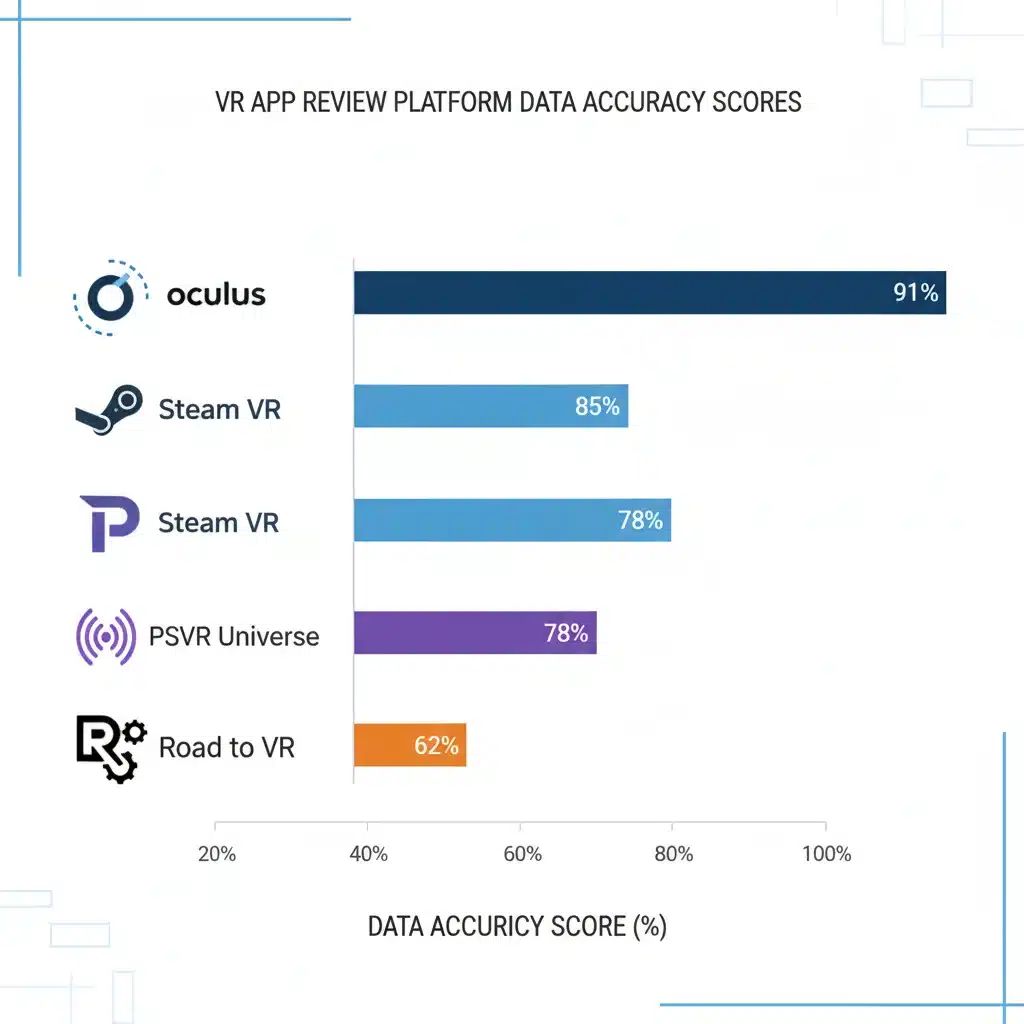
Which Platform Offers the Best Data Accuracy?
The answer to which VR app review platform offers the best data accuracy isn’t a simple one-size-fits-all. It largely depends on what kind of accuracy you prioritize and for what purpose:
- For Developers Needing Deep, Actionable Insights: Immersive Insights stands out due to its AI-powered sentiment analysis and predictive capabilities. For early-stage and technical feedback, XR Review Hub is unparalleled with its curated tester community.
- For Developers Seeking Broad Market Sentiment & Authenticity: The integrated reviews from the Meta Quest Store and SteamVR offer the most direct pulse from the largest user bases, with high authenticity verification through purchase/playtime.
- For Users and Developers Desiring a Comprehensive, Cross-Platform View: VR Critic Collective provides the best aggregated data, attempting to normalize and weigh reviews from diverse sources to offer a balanced perspective.
In 2026, the ideal strategy for developers might involve leveraging multiple platforms. Using XR Review Hub for early testing, then monitoring Meta Quest Store and SteamVR for broad launch feedback, and finally employing Immersive Insights for deep sentiment analysis and trend spotting, would create a robust data ecosystem. For users, consulting VR Critic Collective alongside direct storefront reviews offers the most rounded perspective.
Future Trends in VR App Review Data Accuracy
The quest for ever-greater data accuracy in VR app review platforms will continue to drive innovation. We can anticipate several key trends:
- Enhanced AI and Machine Learning: Expect more sophisticated AI models capable of understanding context, sarcasm, and nuanced emotional states in reviews, leading to even more precise sentiment analysis.
- Blockchain for Review Authenticity: Decentralized ledger technology could be used to verify reviewer identity and ensure the immutability of reviews, making fake reviews virtually impossible.
- Biometric Feedback Integration: Future VR headsets might incorporate biometric sensors that could provide objective data on user engagement, stress levels, or immersion during gameplay, offering a new layer of quantitative review data.
- Standardization of Metrics: A push towards more standardized review metrics and categories across platforms could make cross-platform comparisons easier and more reliable.
- Interactive Review Systems: Imagine VR environments where users can leave ‘spatial reviews’ by pointing out specific elements within an app, providing highly contextual feedback.
Conclusion
The landscape of VR app review platforms in 2026 is dynamic and diverse, each offering unique strengths in data collection and analysis. While platforms like the Meta Quest Store and SteamVR provide broad, authentic feedback from massive user bases, specialized platforms like Immersive Insights and XR Review Hub excel in delivering deep, actionable, and verified data. VR Critic Collective bridges the gap by offering a comprehensive, aggregated view.
Ultimately, the ‘best’ platform for data accuracy depends on the specific needs of the user or developer. For the most reliable and actionable insights, a multi-platform approach is highly recommended. As VR technology continues its rapid advancement, the accuracy and sophistication of these review platforms will be crucial in shaping the future of immersive experiences, ensuring that both creators and consumers can navigate this exciting new world with confidence and clarity.
Staying informed about the capabilities and limitations of each of these VR app review platforms will be key to making the most of the burgeoning virtual reality market in 2026 and beyond. Choose wisely, and let accurate data guide your journey through the metaverse.