The landscape of business intelligence (BI) is constantly evolving, driven by the relentless pursuit of deeper, more actionable insights. For decades, businesses have relied on spreadsheets, dashboards, and traditional analytical tools to make sense of vast datasets. While these methods have served us well, a new frontier is emerging that promises to revolutionize how we interact with and understand data: Virtual Reality (VR). The integration of VR business intelligence is not merely a technological novelty; it represents a paradigm shift with the potential to unlock up to 50% more insights for U.S. business intelligence by 2026. This isn’t just a bold prediction; it’s an insider’s view into the inevitable evolution of data analytics.
The Current State of Business Intelligence: A Foundation for Transformation
Before delving into the transformative power of VR, it’s crucial to understand the current state of business intelligence. Organizations across the U.S. are drowning in data, yet often starved for true insight. Traditional BI tools excel at presenting data in structured formats, identifying trends, and generating reports. However, they frequently fall short in fostering intuitive understanding, collaborative exploration, and the discovery of hidden relationships within multi-dimensional datasets. The human brain is inherently wired for spatial understanding and interaction, capabilities that conventional 2D interfaces struggle to fully leverage. This limitation creates a bottleneck in the insight generation process, where valuable information remains buried beneath layers of complexity.
The demand for more sophisticated analytical capabilities is growing exponentially. Businesses need to react faster, predict more accurately, and understand their customers and markets with unprecedented depth. This pressure is driving the adoption of advanced analytics, machine learning, and now, immersive technologies like VR. The quest for competitive advantage in a rapidly changing global economy means that businesses cannot afford to overlook any tool that promises to enhance their decision-making prowess. The promise of VR business intelligence lies in its ability to bridge the gap between raw data and profound human understanding, making complex information accessible and intuitive.
Why VR is the Next Frontier for Data Visualization
Virtual Reality offers a fundamentally different way to interact with data. Instead of viewing flat charts and graphs on a screen, users can step inside their data, manipulate it in three dimensions, and experience it in an entirely immersive environment. This shift from passive observation to active engagement is where the 50% increase in insights truly begins. Consider the following advantages:
- Enhanced Spatial Understanding: The human brain is exceptionally good at processing spatial information. VR allows data to be mapped onto 3D spaces, making it easier to identify patterns, outliers, and relationships that might be invisible in 2D. Imagine walking through a virtual city where buildings represent market segments and their height indicates revenue, or exploring a molecular structure of customer pathways. This spatial context provides a cognitive shortcut to understanding.
- Deeper Immersion and Focus: VR environments eliminate distractions, allowing users to fully immerse themselves in the data. This focused attention can lead to a more thorough analysis and a greater capacity for discovery. When you’re literally surrounded by your data, your brain is fully engaged in processing it.
- Intuitive Interaction: With hand controllers or even hand tracking, users can directly manipulate data points, filter information, zoom in on details, and rearrange visualizations with natural gestures. This intuitive interaction reduces the cognitive load associated with navigating complex interfaces, freeing up mental resources for analysis.
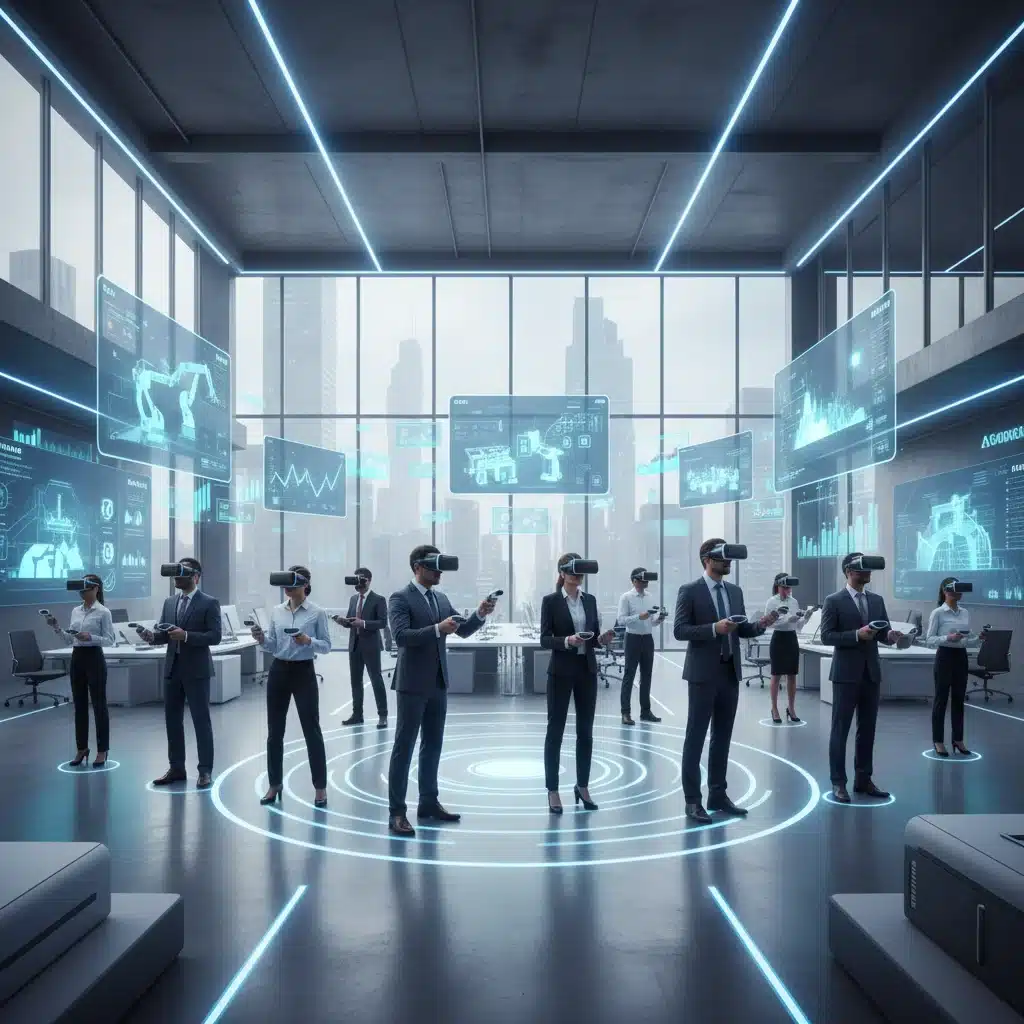
- Collaborative Exploration: VR enables multiple users, regardless of their physical location, to inhabit the same virtual data space. This fosters unprecedented levels of collaboration, allowing teams to explore datasets together, discuss findings in real-time, and collectively arrive at more robust conclusions. Imagine a global team dissecting a supply chain issue together in a virtual environment, pointing out anomalies and brainstorming solutions simultaneously.
- Identification of Hidden Patterns: The ability to visualize data in multi-dimensional forms can reveal correlations and causalities that are simply not apparent in traditional 2D representations. This is particularly true for complex datasets involving numerous variables, where the interplay of factors can be incredibly intricate.
These benefits collectively contribute to a more profound and efficient data analysis process, directly translating into a higher volume and quality of actionable insights. The U.S. business intelligence sector, always at the forefront of technological adoption, is uniquely positioned to capitalize on these advancements.
Key Applications of VR Business Intelligence in U.S. Industries
The potential applications of VR business intelligence span across virtually every industry. Here are a few examples where VR is already making inroads or is poised for significant impact:
Financial Services: Visualizing Market Dynamics and Risk
In finance, understanding market movements, portfolio performance, and risk exposure is paramount. VR can transform complex financial data into interactive 3D landscapes. Imagine traders navigating a virtual stock market, where company performance is represented by dynamic structures, and risk factors appear as fluctuating weather patterns. Portfolio managers could visualize asset correlations in a spatial graph, identifying diversification opportunities or vulnerabilities with greater clarity. Fraud detection could also benefit, with transaction networks rendered in 3D to highlight unusual patterns and connections that might be missed in a flat report.
Retail and E-commerce: Understanding Consumer Behavior
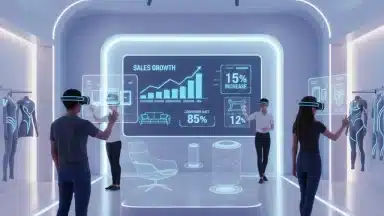
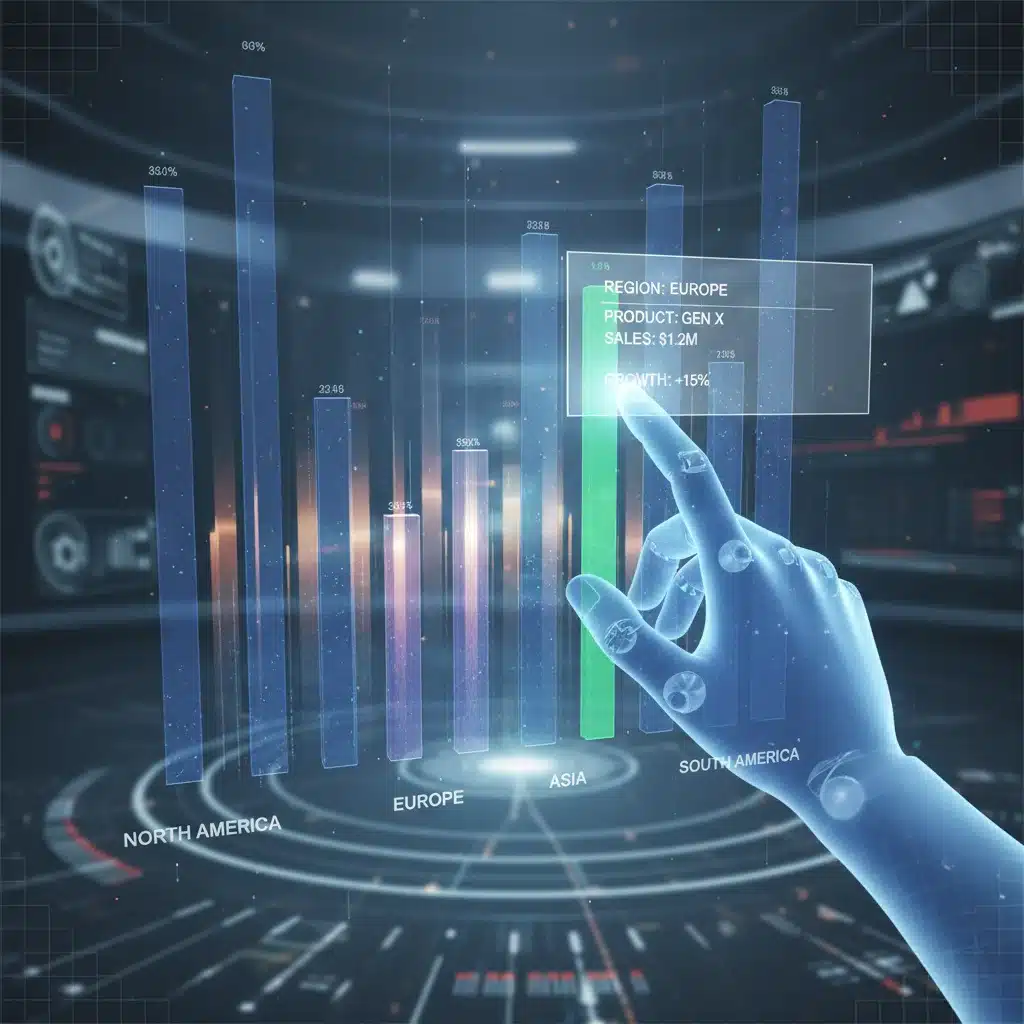
For retailers, understanding customer journey, sales patterns, and inventory management is critical. VR can allow analysts to ‘walk through’ a virtual store, seeing heatmaps of customer movement, product engagement, and conversion rates overlaid directly onto the environment. Supply chain data could be visualized as a living network, identifying bottlenecks and optimizing logistics in real-time. Understanding regional sales performance becomes more intuitive when you can literally fly over a virtual map of the U.S., seeing sales figures represented by geographical peaks and valleys.
Healthcare: Medical Data and Operational Efficiency
Healthcare generates enormous amounts of data, from patient records to operational metrics. VR could be used to visualize patient population health trends, track disease outbreaks spatially, or analyze hospital operational efficiency. Imagine administrators navigating a virtual hospital, seeing real-time data on bed occupancy, equipment utilization, and patient flow, allowing for rapid identification of inefficiencies and resource allocation optimization. Medical researchers could collaborate on complex genomic data in a shared virtual space, accelerating discovery.
Manufacturing and Logistics: Supply Chain Optimization
Optimizing complex supply chains is a constant challenge. VR can create immersive digital twins of factories and logistics networks. Users could visually track the flow of materials, identify bottlenecks, simulate different scenarios, and optimize routes in a highly intuitive 3D environment. This proactive visualization can significantly reduce costs and improve delivery times, offering a considerable competitive edge in the U.S. manufacturing sector.
Marketing and Sales: Customer Journey Mapping and Campaign Performance
Understanding the customer journey and the effectiveness of marketing campaigns is vital. VR can visualize customer touchpoints, conversion funnels, and demographic data in an immersive narrative. Sales teams could explore regional performance data in a virtual map, identifying target areas and understanding market penetration with a level of detail previously unattainable. This enhanced understanding directly translates into more effective strategies and increased sales.
Challenges and Considerations for VR Business Intelligence Adoption
While the benefits of VR business intelligence are compelling, its widespread adoption is not without challenges. U.S. businesses considering this technology must address several key factors:
Cost of Hardware and Software
High-quality VR headsets and powerful computing hardware still represent a significant investment. While prices are decreasing, equipping an entire team can be costly. Furthermore, specialized VR BI software development or licensing can add to the expense. Organizations need to conduct thorough cost-benefit analyses to justify the initial outlay.
Data Integration and Preparation
Integrating existing BI systems with VR platforms requires robust data pipelines and careful data preparation. Data needs to be clean, structured, and optimized for 3D visualization. This often involves significant effort in data engineering and transformation, which can be a barrier for companies with legacy systems or disparate data sources.
User Adoption and Training
Introducing a new technology like VR requires comprehensive user training. Employees need to become comfortable with VR hardware, navigation, and interaction paradigms. Overcoming initial resistance and ensuring a smooth learning curve is crucial for successful adoption and realizing the full potential of VR for business intelligence.
Security and Privacy Concerns
As with any advanced data technology, security and privacy are paramount. Handling sensitive business data in a virtual environment requires robust security protocols, encryption, and compliance with data protection regulations. U.S. businesses must ensure that their VR BI solutions meet the highest standards of data governance.
Developing Effective VR Visualizations
Translating complex business data into effective and intuitive 3D visualizations is an art and a science. It requires expertise in both data analytics and immersive design. Poorly designed VR interfaces can be disorienting or ineffective, negating the benefits of the technology. Companies will need to invest in skilled designers and developers who understand how to create meaningful immersive experiences.
Strategic Roadmap for U.S. Businesses to Embrace VR BI by 2026
For U.S. businesses aiming to unlock that 50% increase in insights by 2026, a strategic roadmap is essential. Simply acquiring VR headsets won’t suffice; a thoughtful, phased approach is required:
- Pilot Programs and Proof of Concept: Start small. Identify a specific business problem or a department that could significantly benefit from VR data visualization. Develop a pilot program to demonstrate the value and gather feedback. This proof of concept will be crucial for securing broader organizational buy-in.
- Invest in Data Infrastructure: Ensure your data infrastructure is robust, clean, and capable of feeding real-time or near real-time data into VR platforms. This might involve upgrading data warehouses, implementing data lakes, or improving ETL processes.
- Partner with VR/BI Experts: Collaborate with companies specializing in VR data visualization and business intelligence. These partners can provide the necessary expertise in software development, visualization design, and integration services, accelerating your adoption curve.
- Focus on User Experience (UX) and Training: Prioritize creating intuitive and user-friendly VR experiences. Invest in comprehensive training programs to ensure employees are comfortable and proficient with the technology. User acceptance is a critical success factor for VR business intelligence.
- Phased Rollout and Iteration: After successful pilots, gradually expand VR BI capabilities to other departments or use cases. Continuously gather feedback, iterate on your solutions, and refine your approach based on real-world usage.
- Stay Abreast of Hardware and Software Advancements: The VR market is evolving rapidly. Keep an eye on new hardware releases, software updates, and emerging best practices to ensure your VR BI strategy remains cutting-edge and cost-effective.
By following such a roadmap, U.S. businesses can strategically integrate VR into their existing BI ecosystems, gradually transforming how they perceive and interact with their most valuable asset: data.
The Future is Immersive: Competitive Advantage Through VR BI
The journey towards a more immersive and insightful business intelligence future is already underway. Companies that embrace VR business intelligence early will gain a significant competitive advantage. This isn’t just about pretty visualizations; it’s about making faster, more informed, and more accurate decisions that drive growth, efficiency, and innovation.
Imagine a scenario where a CEO can literally walk through their company’s global operations data, identifying supply chain vulnerabilities before they become critical, or a marketing team can collaboratively explore customer sentiment data in a shared virtual space, crafting campaigns with unparalleled precision. These are not distant dreams but tangible realities that VR is bringing closer every day.
The prediction of unlocking 50% more insights by 2026 is not an exaggeration but a conservative estimate of the transformative power of VR. As hardware becomes more affordable and software more sophisticated, the barriers to entry will continue to lower, making VR BI an indispensable tool for any U.S. business serious about data-driven decision-making. The companies that choose to invest in this technology now will be the leaders of tomorrow, navigating complex markets with clarity and foresight.
Conclusion: Stepping into a New Dimension of Data
The convergence of Virtual Reality and business intelligence marks a pivotal moment in the evolution of data analytics. For U.S. businesses, this isn’t just another technological trend; it’s an opportunity to fundamentally change how they understand their operations, markets, and customers. By moving beyond the flat screens of yesterday and stepping into the immersive data landscapes of tomorrow, organizations can unlock unprecedented levels of insight, fostering innovation, optimizing performance, and securing a decisive competitive edge.
The path to realizing a 50% increase in insights by 2026 through VR business intelligence requires strategic planning, investment, and a willingness to embrace new paradigms. However, the rewards – in terms of deeper understanding, faster decision-making, and enhanced collaboration – are too significant to ignore. The future of business intelligence is immersive, and the time for U.S. businesses to don their VR headsets and explore a new dimension of data is now.