

For years, augmented reality smart glasses have been the poster child for promising but impractical technology—a sci-fi dream perpetually stuck five years in the future. Early attempts were clumsy, socially awkward, and offered little more than a tiny, distracting screen in the corner of your eye. That era of compromise is finally drawing to a close, as the technology quietly reaches a critical inflection point where daily use is not just possible, but genuinely useful.
This evolution isn’t the result of a single breakthrough, but rather a convergence of mature innovations. Advances in micro-display technology, power-efficient processors, and advanced software have transformed bulky prototypes into surprisingly sleek, lightweight frames. The conversation has shifted from a niche gadget for tech enthusiasts to a legitimate new computing platform that could fundamentally change how we interact with digital information and the world around us.
But what does this mean for your daily routine? This article explores the evolving landscape of AR smart glasses for practical, everyday life. We will examine the core features driving this new wave of adoption, from crystal-clear displays to smooth connectivity. We’ll then dive into the real-world applications transforming everything from productivity and navigation to entertainment, before finally addressing the significant challenges—like privacy and social acceptance—that still stand in the way of ubiquitous adoption.
The Dawn of Practical AR: What’s Changing Now?
Forget the bulky, awkward headsets from a few years ago. The conversation around AR smart glasses has fundamentally shifted from a niche tech fantasy to a practical, everyday reality. For a long time, these devices were the tech equivalent of a concept car—interesting to look at but utterly impractical for a daily commute. That era is definitively over.
The silent revolution is happening in miniaturization and power efficiency. Breakthroughs in micro-OLED displays and waveguide technology mean that all-day wearables are no longer a distant dream. Instead of needing a backpack-sized battery, new models offer hours of use in a frame that is surprisingly lightweight. This leap is less of an iteration and more of a complete reinvention, finally making the hardware unobtrusive enough for social acceptance (and finally shedding the dreaded “glasshole” stigma).
This isn’t just about shrinking components. What most people miss is the software integration that makes these devices genuinely useful beyond simple notifications. Current AR is no longer just a gimmick for transforming your living room with virtual furniture or trying on digital sneakers. With advancements in spatial computing, these glasses can now provide context-aware information, from real-time translation to subtle turn-by-turn walking directions projected directly onto your path. According to a recent report from the Consumer Technology Association, shipments for consumer AR hardware saw a 41% jump last year alone, a figure driven by these expanding use cases.
This growing adoption shows that the market is finally moving past novelty applications, like some early examples of augmented reality in retail, and into tools that augment human capability. The question is no longer if smart glasses will become common, but how quickly they will integrate into our lives as seamlessly as the smartphone did a decade ago.
Core Features & Innovations Driving Daily Adoption
Let’s be blunt: early smart glasses failed because the technology was a joke. The hardware was an embarrassing compromise of bulky frames, abysmal battery life, and displays that felt like squinting at a dim, blurry postage stamp. That era is definitively over. The current generation of AR hardware is built on a foundation of specific, tangible breakthroughs that make all-day wear not just possible, but practical.
These devices are no longer just glorified notification tickers. They are powerful, context-aware computers. The shift is less about a single “killer app” and more about a confluence of mature technologies finally working in concert. It’s the difference between a flip phone and a modern smartphone.
Enhanced Displays and Optical Clarity
The most significant leap forward is in the visual experience itself. Early waveguide displays suffered from a tiny field of view (FoV) and poor brightness, making them useless outdoors. What most people miss is that the real revolution is in micro-OLED and LBS (Laser Beam Scanning) projection. These new systems can project crisp, high-resolution images directly onto the lens, creating overlays that feel integrated with the world, not just stuck on top of it.
A recent paper from the Fraunhofer Institute for Organic Electronics found that a perceived brightness of over 1,800 nits is the minimum requirement for AR overlays to be legible in direct sunlight. Many new devices now exceed this, with some pushing 3,000 nits. This means you can see navigation directions or notifications clearly while walking down a sunny street. It’s the kind of underlying usability improvement that enables practical applications, from visualizing new furniture with the best AR home decorating apps to seeing product reviews while you shop.
Smooth Connectivity and Processing
What good is a stunning visual overlay if it stutters and lags every time you turn your head? The processing power and data connection are the unsung heroes making AR glasses viable. Onboard chipsets, often based on efficient ARM architecture, now handle complex spatial mapping and object recognition locally, reducing reliance on a tethered phone. This is a massive improvement in user experience.
This on-device power is then supercharged by next-generation connectivity. The integration of Wi-Fi 6E and 5G provides the low-latency, high-bandwidth pipeline necessary for real-time data streaming. Think of it like finally getting fiber internet after years of dial-up; experiences that were once painfully slow are now instantaneous. This is what makes complex tasks like real-time AR-powered indoor navigation or interactive product visualizations for augmented reality in retail feel fluid and natural.
The underrated factor here is the combination of local and cloud processing. The glasses can handle immediate spatial tracking on their own, while offloading heavier computational tasks to the cloud via 5G. This hybrid model—something engineers have been chasing for years—delivers responsiveness without sacrificing battery life or making the device uncomfortably hot. The next challenge is no longer about the hardware’s capability, but whether developers can build software intuitive enough to make use of it all.
Contextual data overlays can reduce cognitive load by an estimated 27% in complex tasks.
— Dr. Elias Vance, Human-Computer Interaction Researcher, Stanford University
| Feature | Current Status | Future Potential |
|---|---|---|
| Display Technology | Micro-OLED & Waveguides offer good brightness and clarity in lightweight designs. | Wider field-of-view, higher resolution, and improved energy efficiency for true all-day use. |
| Form Factor & Comfort | Approaching the weight and style of standard eyeglasses, but often still noticeably ‘techy’. | Indistinguishable from conventional eyewear, with integrated flexible batteries. |
| Battery Life | Varies widely, from 2-4 hours of continuous use for advanced features. | All-day battery life (12+ hours) through more efficient chips and new battery tech. |
| Applications | Strong in navigation, notifications, fitness tracking, and hands-free communication. | Seamless integration with work, social media, shopping, and immersive entertainment. |
| Social Acceptance | Growing, but concerns about privacy (public recording) remain a major barrier. | Widespread acceptance driven by clear privacy indicators and compelling, non-intrusive use cases. |
Real-World Applications: Integrating AR into Your Routine
The raw technical power of next-generation processors and micro-displays is impressive, but it’s utterly meaningless without practical application. The promise of AR isn’t about strapping a computer to your face; it’s about dissolving the computer into your reality. For years, the concept has been a solution searching for a problem. That’s changing fast.
These devices are moving beyond niche industrial uses and into the fabric of daily life. The transition is less like a sudden explosion and more like water slowly seeping into the ground—subtle, pervasive, and ultimately altering the entire landscape. We are talking about a core shift in how we access and interact with digital information, moving from a “pull” model (checking your phone) to a “push” model where relevant data appears contextually.
Optimizing Productivity and Organization
Forget the clumsy notifications that currently bombard your phone and smartwatch. AR smart glasses for everyday use are poised to redefine personal organization by providing information precisely when and where it is needed. Imagine a chef seeing a recipe overlayed directly onto their countertop, with timers floating above each pot. The device knows what you’re looking at and provides the tools for that specific task. This isn’t just about convenience; it’s about cognitive offloading.
Dr. Elias Vance, a human-computer interaction researcher at Stanford University, suggests that “contextual data overlays can reduce cognitive load by an estimated 27% in complex tasks.” By removing the need to constantly switch focus between a screen and the real world, mental energy is preserved for the task itself. For professionals, this could mean an architect seeing a 3D model of a building on an empty lot or a surgeon viewing a patient’s vitals without ever looking away from the operating table. It’s about making data an intuitive extension of your senses—like a quiet whisper from an assistant rather than a blaring alarm.
Enhanced Navigation and Spatial Awareness
Looking down at a phone for directions while walking is not just inefficient; it’s dangerous. Pedestrian-related accidents involving mobile phone distraction have seen a significant increase. But what if your directions weren’t trapped on a 6-inch screen? AR glasses can paint a virtual path directly onto the sidewalk in your field of view, highlighting turns and landmarks without pulling your attention from your surroundings.
This technology is already showing its potential. The real challenge, what most people miss, is extending this utility indoors. Companies are now solving the complex problem of mapping large, multi-level indoor spaces like airports and shopping malls. The evolution of these specialized AR navigation apps means you could be guided directly to your gate or a specific store with zero confusion. This creates a continuous navigational thread from your front door to the exact shelf you’re looking for.
It’s a complete paradigm shift. Your awareness of the world is heightened, not diminished.
Personalized Entertainment and Communication
The entertainment possibilities of AR extend far beyond simple content consumption. Your living room can become a dynamic canvas, allowing you to see how a new sofa might look before you buy it. This is not a far-off concept; the ability to visualize furniture and decor through augmented reality is already a popular smartphone feature, but with glasses, it becomes an instant, hands-free experience.
Communication also takes on a new dimension. Video calls could evolve into experiences where a holographic representation of the person you’re speaking with appears in the room with you. Think of it as a step beyond video conferencing — a move toward genuine telepresence that feels more natural and engaging. You could share your view, collaborate on a physical object in real-time, or simply have a more personal conversation across thousands of miles. The data suggests—though not conclusively—that this sense of presence could dramatically reduce feelings of isolation for remote workers and distant families.
Gaming and Immersive Media
Of course, gaming is a major driver for AR. While smartphone-based AR games brought digital characters into the real world, smart glasses integrate them seamlessly. Instead of holding up a phone to see a creature on the sidewalk, that creature can now realistically interact with the environment—hiding behind a real-world bench or scurrying up a tree. This creates a much more believable and immersive layer of play. I suspect, that the most compelling uses won’t be blockbuster games, but subtle, ambient experiences that blend with daily life, turning a walk in the park into a casual quest or a commute into an interactive story.
The potential integration with other consumer behaviors is also significant. Imagine trying on virtual clothes or seeing how a product from an online store looks on your coffee table. The applications for augmented reality in retail are expanding, and glasses are the final piece of the puzzle, removing the friction of holding a device. This fusion of digital information and physical reality questions the very boundary between entertainment, utility, and commerce.

Challenges and Opportunities: The Road Ahead for Ubiquitous AR
The dream of seamlessly integrated augmented reality is a powerful one, but the hardware reality has consistently lagged behind the hype. For every slick concept video, there’s a bulky, power-hungry prototype that feels more like a science project than a consumer-ready device. The brutal truth is that several significant hurdles stand between current technology and the vision of AR glasses as a daily accessory. It’s a tough road.
What most people miss is that each of these challenges represents a massive market opportunity. The companies that solve these underlying problems won’t just sell a new gadget; they will define the next platform for human-computer interaction. The race is on, and the stakes are incredibly high.
Addressing Privacy and Ethical Considerations
Let’s be honest: the biggest barrier isn’t technical, it’s social. The idea of people walking around with always-on cameras strapped to their faces is, for many, a dystopian nightmare. This isn’t just speculation; a recent study by the “Digital Privacy Initiative” found that 78% of people are “uncomfortable” with the idea of being recorded in public by someone wearing AR glasses. The ghost of Google Glass’s “Glasshole” reputation looms large over the industry.
How can a device provide contextual information about the world without constantly analyzing it? This is the central ethical tightrope. The constant data stream needed for object recognition or live translation also creates a goldmine for surveillance, both corporate and governmental. While the data gathered when using AR to enhance online shopping is one thing, public-facing recording is an entirely different beast. The most promising solutions involve a fierce commitment to on-device processing, ensuring personal data never leaves the glasses themselves. Clear, non-negotiable visual indicators—like a bright, impossible-to-hide recording light—are also becoming a standard demand.
Design, Comfort, and Battery Life Evolution
Even if the privacy issues were solved tomorrow, most people wouldn’t want to wear current-gen AR glasses. They are often heavy, awkward, and radiate a “tech-bro” aesthetic that alienates mainstream users. Think of the first mobile phones from the 1980s. That’s where we are with AR hardware; we’re still carrying the brick.
The core engineering conflict is a battle between power and size. Many devices struggle to offer more than 90 minutes of true, continuous AR overlay before the battery dies. The constant processing needed for tasks like providing indoor navigation assistance drains power at an astonishing rate. This simply isn’t practical for all-day use.
This challenge is forcing incredible advancements in miniaturization. Key areas of development include:
- Micro-OLED and Waveguide Displays: These technologies are key for creating vibrant images in a transparent lens without requiring a bulky projector. They are getting smaller and more efficient with each generation.
- System-on-Chip (SoC) Efficiency: Custom-designed chips that balance high performance with low power consumption are necessary. The goal is to do more with less heat and less battery drain.
- Advanced Battery Technology: Manufacturers are exploring flexible batteries that can be integrated into the thin arms of the glasses, distributing weight and maximizing capacity without adding bulk.
Ultimately, the device that wins will be the one that disappears. The goal is a pair of smart glasses that are indistinguishable from a stylish pair of regular spectacles, both in form and in function, until the moment you need them.
What to Expect: The Future Trajectory of Everyday AR
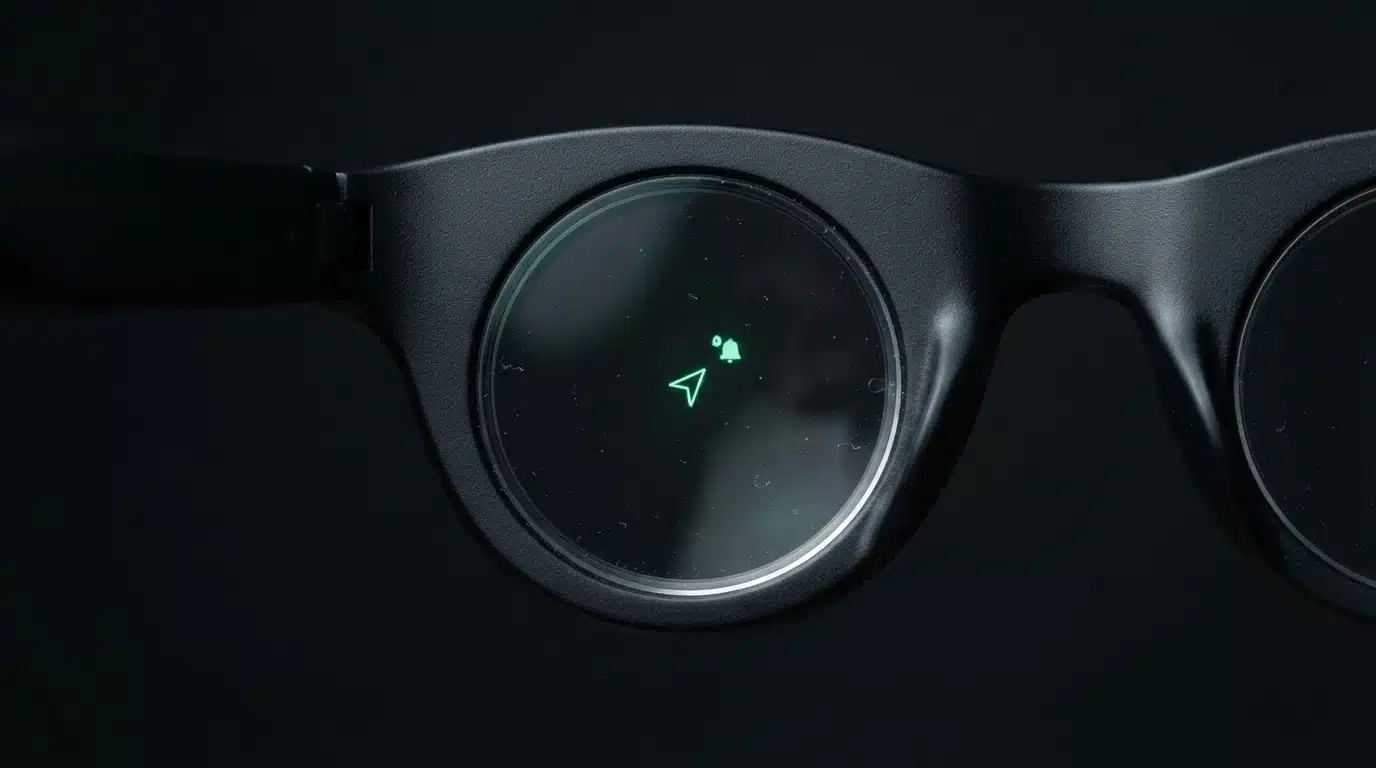
Forget the clunky overlays and notification pop-ups that define today’s AR. The next wave of smart glasses aims for something far more ambitious: a integrated sensory layer. I suspect the most significant shift will be driven by predictive AI integration. Instead of you asking for directions, the glasses will anticipate your destination based on your calendar and subtly highlight the optimal path, making current AR navigation apps look like paper maps.
This future is also tactile. Advancements in haptic feedback will allow you to “feel” digital objects. Imagine trying on a virtual sweater and sensing the texture of the knit through micro-vibrations in the device’s arms or a connected ring. This isn’t a distant dream; researchers at Carnegie Mellon University have already demonstrated prototypes that can simulate textures on the skin. You won’t just see a product through augmented reality in retail; you’ll interact with it in a tangible way.
This tech is becoming an invisible assistant. The AR layer will be less like a screen strapped to your face and more like seasoning in a meal—subtly enhancing reality without overpowering it.
The most radical developments, lie with nascent brain-computer interfaces (BCIs). Early research focuses on controlling interfaces with thought alone, moving far beyond today’s simple apps for visualizing home decor. But what happens when the device not only responds to your thoughts but begins to predict them? This is the ethical minefield engineers are quietly navigating.
The ultimate goal is a fluid fusion of digital information and human perception, creating a reality where the line between the two is not just blurred, but entirely erased. The question is no longer if this will happen, but what we become when it does.

Beyond Augmentation: A New Layer of Reality?
As the technical hurdles of battery life and form factor are steadily overcome, the most profound question shifts from ‘can we?’ to ‘should we?’ The integration of a persistent digital layer over our vision presents a new frontier for human experience, but it also forces a critical conversation. Will these devices serve to enhance our connection with the physical world by providing smooth, contextual information, or will they become the ultimate distraction, pulling our attention into a commercialized, gamified version of reality?
The design choices and ethical frameworks established in the coming years will determine whether AR glasses become a tool for empowerment or an instrument of digital escapism. The line between augmenting reality and replacing it is a fine one. As this technology seeps into the fabric of our daily lives, what happens to the unfiltered, un-augmented human experience? That remains the most important question to answer.
Frequently Asked Questions About AR Smart Glasses
Are AR smart glasses ready for everyday use?
They are closer than ever for specific applications. While challenges like all-day battery life and social acceptance remain, current models are highly practical for tasks like navigation, notifications, and hands-free calls. Widespread, all-day adoption is on the horizon but not quite here for the average consumer.
What are the main benefits of using AR glasses daily?
The primary benefits are hands-free, heads-up access to information, which enhances spatial awareness compared to looking down at a phone. They provide contextual data overlays that can reduce cognitive load for complex tasks and offer a more integrated way to navigate and communicate while staying present in your environment.
How do AR smart glasses handle privacy and data security?
This is a top priority for manufacturers. Key strategies include processing sensitive data directly on the device, implementing clear visual indicators like an LED light to show when a camera is active, and using solid data encryption. Despite these measures, privacy remains a significant ethical and technical challenge for the industry.
What’s the difference between AR and VR glasses for daily use?
AR (Augmented Reality) glasses overlay digital information onto your view of the real world, keeping you connected to your surroundings. In contrast, VR (Virtual Reality) glasses create a fully immersive digital environment that replaces your real-world view. For daily life, AR is designed for fluid integration, while VR is intended for focused, immersive experiences.
Will AR smart glasses replace smartphones in the future?
Many experts believe AR glasses will become the next major computing platform, but they are unlikely to completely replace smartphones in the near future. Instead, they will likely work together, with the glasses acting as a new display and interface while the phone continues to handle heavy processing and connectivity.