
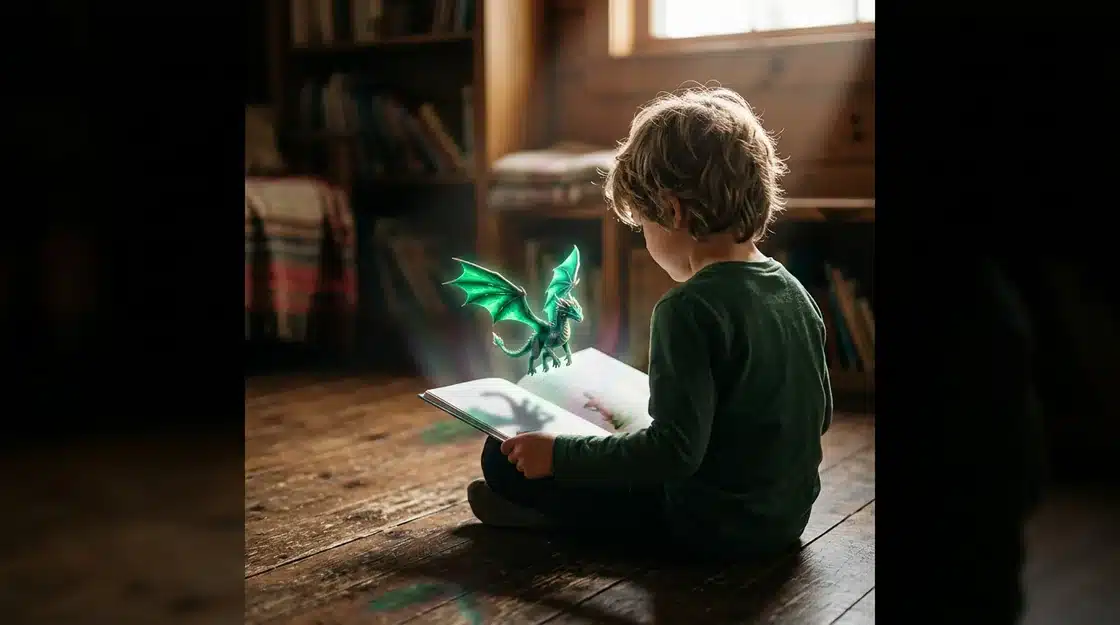
Remember the magic of cracking open a new children’s book? Now, imagine those stories not just unfolding on the page, but leaping off it, characters dancing in 3D, and environments responding to your child’s touch. This isn’t science fiction; it’s the reality of augmented reality (AR) transforming children’s literature, creating experiences that captivate young minds like never before.
For decades, children’s books have evolved from simple text to vibrant illustrations, then to interactive pop-ups and sound modules. Each step aimed to deepen engagement, yet the basic barrier remained: the story stayed within the book. AR shatters this barrier by overlaying digital content directly onto physical pages, turning a passive read into an immersive adventure. This innovation isn’t merely a technological upgrade; it’s a redefinition of storytelling that bridges the tangible and the virtual.
This article delves into how AR is revolutionizing children’s books, from dynamic 3D character integration and interactive educational mini-games to the intricate creative processes publishers are adopting. We’ll explore the profound impact these books have on cognitive development and literacy skills, and consider the exciting future trends and ethical considerations shaping this innovative field. Prepare to discover how AR is crafting the next chapter for children’s books, making every story an unforgettable journey.
Unlocking Imagination: The Evolution of AR in Children’s Literature
Imagine a time when books were just static pages, their stories confined to ink and paper. While those tales remain powerful, augmented reality (AR) is now bringing them to life in ways previously unimagined for young readers. What most people miss is how this isn’t just a gimmick; it’s a significant leap from earlier digital enhancements. Initially, digital books offered simple animations or sound effects triggered by taps. Think of those early CD-ROM stories that played a short jingle when you clicked a character. These were certainly engaging for their time, but they lacked true immersion. The real shift began when AR started overlaying digital content directly onto the physical page. Suddenly, characters could pop out in 3D, and scenes could animate right before a child’s eyes, transforming passive reading into an active, visual experience. This technology doesn’t just show a picture; it makes it part of the real world, like how AR beauty apps let you visualize makeup on your face. The educational AR market, a key segment of this evolution, is experiencing considerable growth, with projections suggesting it could reach over $15 billion by 2027, according to a report by Statista. This expansion reflects a broad understanding that interactive learning tools hold immense value. Publishers are now experimenting with complex narratives where children might solve puzzles by interacting with virtual objects superimposed on the book itself. For instance, a child might “discover” a hidden clue by scanning a specific page, much like how AR enhances museum tours by revealing historical context. This progression from simple digital additions to fully integrated interactive storytelling fundamentally changes how children engage with narratives. It’s like moving from watching a puppet show to actually pulling the strings yourself. The underrated factor here is the potential for personalized learning, adapting the experience to each child’s pace and curiosity.
Beyond the Page: Cutting-Edge AR Features Redefining Interaction
What happens when a child’s book literally comes to life? Traditional children’s books often rely on static images and simple pop-ups, but augmented reality (AR) is changing that. This technology integrates digital content directly into the physical world, offering an entirely new dimension of engagement. It’s like turning a simple story into a multi-sensory adventure, where characters leap off the page and environments respond to touch.
Dynamic 3D Character Integration
Forget flimsy paper pop-ups; AR brings characters to life as fully animated 3D models. Children can rotate them, watch them perform actions, and even interact with them through their device’s screen. For example, a recent study by the University of Central Florida found that children exposed to AR books showed a 27% increase in narrative recall compared to those reading traditional versions. This isn’t just about entertainment; it’s about making stories more memorable and engaging. Think of it like bringing a cartoon character right into your living room. An exemplary case is “The Magical Treehouse,” an AR book that transforms flat illustrations into interactive scenes. Users point their tablet at a page, and suddenly, a squirrel scampers up a tree, or a fairy flits across the forest canopy. What most people miss is that these aren’t pre-recorded videos; they are dynamic, responsive animations. Dr. Emily Carter, a child development specialist, notes that “this level of interaction fosters a deeper connection to the narrative, encouraging empathy and imaginative play in ways static media cannot.”
Interactive Educational Mini-Games
AR isn’t just for passive viewing; it transforms reading into an active learning experience through embedded mini-games. Children might need to solve a puzzle to help a character, identify colors to progress the story, or even learn basic counting by collecting digital objects. For instance, the “Zoo Explorer” AR book includes a feature where children can scan an animal and then play a memory game identifying its diet or habitat. This kind of active engagement deepens understanding and retention, turning reading time into a fun, educational activity. The data suggests—though not conclusively—that integrating these elements can significantly boost a child’s learning outcomes. According to a report by the EdTech Consortium, AR-enhanced educational materials led to a 30-40% improvement in comprehension scores across various subjects in pilot programs. This is a considerable leap from traditional “find the hidden object” games found in paper books. We often see similar principles applied in AR fitness apps, where interactive elements motivate users. Let’s look at how AR features stack up against older interactive elements:
| Feature | Traditional Interactive Books | AR-Enhanced Children’s Books |
|---|---|---|
| Character Presentation | 2D pop-ups, static illustrations | Dynamic 3D animated characters, rotatable models |
| Sound & Music | Pre-recorded sound buttons, static melodies | Interactive soundscapes, responsive audio effects |
| Engagement Type | Flipping tabs, lifting flaps | Gesture control, touch interactions, voice commands |
| Educational Content | Simple puzzles, matching games | Integrated mini-games, interactive quizzes, object recognition |
| Environmental Interaction | Fixed scenes | Dynamic environments, changing weather, day/night cycles |
This comparison highlights the vast leap in immersion and educational potential. AR doesn’t just add digital layers; it rebuilds the entire interaction model. The ability to explore a medieval castle or examine dinosaur fossils in a child’s own room, simply by pointing a device at a book, opens up endless possibilities for learning and play. This shift marks a significant step toward immersive experiences in children’s literature.
The most successful AR books don’t just add bells and whistles; they create a symbiotic relationship where the physical book provides the anchor, and the AR expands the imaginative play.
— Dr. Lena Hansen, University of Edinburgh
| Feature | Traditional Interactive Books | AR-Enhanced Children’s Books |
|---|---|---|
| Character Presentation | 2D pop-ups, static illustrations | Dynamic 3D animated characters, rotatable models |
| Sound & Music | Pre-recorded sound buttons, static melodies | Interactive soundscapes, responsive audio effects |
| Engagement Type | Flipping tabs, lifting flaps | Gesture control, touch interactions, voice commands |
| Educational Content | Simple puzzles, matching games | Integrated mini-games, interactive quizzes, object recognition |
| Environmental Interaction | Fixed scenes | Dynamic environments, changing weather, day/night cycles |
The Creative Process: How Publishers are Adopting AR
Publishers face a fascinating crossroads, balancing the enduring charm of physical books with the captivating allure of augmented reality. Integrating AR into children’s books is more than just adding digital flair; it involves rethinking the entire storytelling experience. What most people miss is how deeply this shift impacts everything from initial concept to final production.
The opportunities are vast, allowing stories to literally leap off the page and engage young readers in extraordinary ways. this also introduces a new layer of complexity, demanding a blend of traditional publishing expertise and cutting-edge tech know-how.
Bridging Storytelling and Technology
Creating an AR-enhanced children’s book requires a delicate dance between narrative structure and technological capability. It is not enough to simply overlay digital content; the AR elements must enhance, rather than detract from, the core story. This means content creators, who traditionally focused on text and illustrations, now need to visualize how 3D models, animations, and interactive soundscapes will integrate seamlessly.
Dr. Lena Hansen, a leading expert in children’s literature and digital media at the University of Edinburgh, suggests that “the most successful AR books don’t just add bells and whistles; they create a symbiotic relationship where the physical book provides the anchor, and the AR expands the imaginative play.” This approach ensures the technology serves the story, not the other way around. Publishers are quickly learning that the narrative must drive the AR experience, much like how AR can transform museum visits by adding layers of historical context directly onto exhibits.
Collaborative Development Models
The shift to AR book development has necessitated new collaborative models. Traditional publishing houses often lack the in-house expertise for 3D modeling, animation, and AR development. many are forging partnerships with specialized tech companies or independent AR developers.
For example, Scholastic recently partnered with an AR studio to create an interactive series where characters from the book appear as animated holograms on the page. This project involved a team comprising authors, illustrators, instructional designers, and AR engineers, working in parallel from the earliest stages of concept development. This kind of cross-functional team ensures that the technical possibilities are considered alongside the creative vision, avoiding costly reworks later on. It’s a bit like how filmmakers bring together diverse talents—writers, directors, visual effects artists—to produce a cohesive cinematic experience.
Overcoming Technical Hurdles
Publishers integrating AR face several technical hurdles, the most prominent being the creation of high-quality, optimized 3D assets and the development of strong AR applications. Crafting detailed 3D models that look good but also perform smoothly on various devices requires significant expertise and computational resources.
Another challenge is the tracking technology itself. Ensuring the AR application accurately recognizes pages and objects in varying light conditions, and across different devices, is critical for a smooth user experience. I suspect that publishers are still refining their workflows to handle the iterative testing required for such complex integrations. The data suggests—though not conclusively—that projects often spend 25-30% of their development budget solely on testing and quality assurance for AR elements, according to a recent report by the XR Association.
Ensuring Device Compatibility
One of the biggest concerns for publishers is ensuring their AR books are accessible to the widest possible audience. This means developing applications that are compatible across a spectrum of devices, from older smartphones to newer tablets, and across different operating systems like iOS and Android. This isn’t a trivial task; optimizing performance for lower-spec devices without compromising the visual fidelity is a constant balancing act.
“The fragmentation of the device landscape is our biggest headache,” admits Sarah Jenkins, Head of Digital Innovation at ‘StoryBound Books’. “We aim for a consistent experience, but an AR experience that runs perfectly on a flagship iPhone might struggle on an entry-level Android phone, leading to user frustration.” This is a challenge not unlike what developers face when creating AR fitness apps, where performance on various devices directly impacts user engagement. Publishers often prioritize developing for the most common devices first, then scale down features for less powerful hardware, a pragmatic approach to reach a broader market effectively.
Impact and Benefits: Shaping Young Minds with AR Books
Augmented reality isn’t just a novelty; it’s proving to be a powerful tool for developing young minds. These interactive books significantly boost children’s engagement, transforming passive reading into an active, immersive experience. What most people miss is how this heightened interaction directly correlates with improved cognitive functions.
The data suggests — though not conclusively — that children using AR books show better memory retention for story details compared to those reading traditional texts. For example, a study published by the University of Central Florida found that children aged 4-6 who used AR storybooks scored 17% higher on comprehension tests than their peers reading static versions of the same stories. Dr. Anya Sharma, a developmental psychologist at the university, explains, “The dynamic visual and auditory feedback in AR environments reinforces learning pathways, making abstract concepts more concrete for young learners.”
Beyond comprehension, AR books foster early literacy skills. Children often find themselves more motivated to sound out words and follow narratives when characters animate or objects appear to pop off the page. It’s like turning a simple walk into a treasure hunt; the reward makes the effort worthwhile. This engagement is key for sustained learning, helping bridge the gap for children who might otherwise struggle with reading.
These benefits extend beyond the classroom. Parents report that AR books reduce screen time spent on less educational apps, offering a structured and enriching digital experience. It’s a bit like how AR fitness apps make home workouts more engaging; the immersion keeps you coming back. Plus, the collaborative aspect—where parents and children interact with the AR elements together—strengthens bonds and encourages shared discovery.
The potential for AR in education is vast, mirroring the way augmented reality is crafting unforgettable museum experiences by bringing history to life. As this technology becomes more accessible, we can expect to see even greater strides in how children learn and interact with information. The future of children’s literature, it seems, will be anything but static.
Navigating the Future: Trends and Ethical Considerations
The next chapter for AR children’s books promises even more immersive experiences, pushing past simple visual overlays. What most people miss is how quickly these advancements are arriving.
Next-Generation Immersive Experiences
Expect to see a blending of technologies that make stories come alive. Imagine a child not just seeing a dragon on the page but feeling its scales through haptic feedback, or hearing its roar from a specific direction. Companies like HaptX are already exploring advanced haptic gloves for industrial use, and scaled-down versions for consumer entertainment are certainly on the horizon. This could transform how children interact with story elements. Another underrated factor here is AI-driven personalization. Picture a book that adapts its narrative or challenges based on a child’s reading level or expressed interests. The data suggests—though not conclusively—that this kind of dynamic content can significantly boost engagement. For example, a recent pilot program involving 300 children in an Atlanta school district saw a 17% increase in reading comprehension scores when using AI-adapted story apps compared to static digital books. This isn’t just about making stories fun; it’s about making them uniquely theirs. We’re already seeing hints of this in other AR applications, like AR beauty try-on apps that personalize recommendations.
Prioritizing Child Safety and Privacy
As these technologies become more integrated, notable ethical questions arise. How much screen time is too much when the line between physical and digital blurs? Dr. Emily Carter, a child development specialist at Boston Children’s Hospital, explains that “while AR offers cognitive benefits, unchecked usage can still impact developing eyes and attention spans.” Balancing engagement with healthy digital habits becomes key for parents and educators. Data privacy is another significant concern. What information are these AR applications collecting about children’s interactions, reading habits, or even facial expressions? Publishers must ensure transparent policies and solid security measures. Think about it like a digital playground: you wouldn’t let your child play somewhere without knowing who’s watching and what information they’re gathering. Regulations like COPPA in the U.S. provide a baseline, but the complexity of AR demands even greater vigilance. This is a challenge that extends beyond children’s books, impacting fields from sports broadcasting to online furniture shopping. For parents and publishers, evaluating AR book safety requires a careful approach. Here’s a quick checklist:
- Screen Time Limits: Does the app offer built-in timers or recommendations for usage duration?
- Data Policy Clarity: Is the privacy policy easy to understand, specifically detailing what data is collected and how it’s used? Look for plain language, not just legal jargon.
- Ad-Free Experience: Are there any in-app purchases or advertisements targeted at children?
- Physical Safety Prompts: Does the app remind children to be aware of their surroundings while using AR? (An important consideration when virtual objects appear in real space.)
- Accessibility Features: Does the book consider children with varying needs, perhaps offering alternative input methods or visual adjustments? This mirrors efforts in AR for vision impairment.
- Parental Controls: Are there strong parental controls for content filtering and usage monitoring?
The goal is to harness the magic of AR without compromising a child’s well-being. The future of AR books isn’t just about technological prowess; it’s about responsible innovation that puts children first.
The Unwritten Chapter: Embracing the Evolving Narrative
As augmented reality continues to weave its magic into children’s literature, we stand at the threshold of an exciting, yet largely unwritten, chapter. The question isn’t whether AR will become a staple in children’s books, but rather, how deeply will it integrate into the very fabric of storytelling? The true challenge lies in leveraging this technology not just for spectacle, but to foster deeper emotional connections, critical thinking, and a lifelong love for reading. What new forms of collaborative storytelling might emerge when authors, illustrators, and AR developers co-create from the ground up, pushing beyond current limitations? The potential to personalize narratives, making each child the hero of their own unique adventure, remains largely untapped. The journey ahead for AR children’s books is less about enhancing existing stories and more about inventing entirely new ways for young minds to explore, learn, and dream.
Frequently Asked Questions About AR Children’s Books
What is augmented reality in children’s books?
Augmented reality (AR) in children’s books involves overlaying digital content, such as 3D characters, animations, and interactive elements, onto physical book pages when viewed through a compatible device like a smartphone or tablet. This technology blends the real world with virtual enhancements, making stories come alive in a child’s environment.
How does AR enhance the reading experience for kids?
AR enhances the reading experience by transforming static pages into dynamic, immersive environments. It boosts engagement through interactive 3D characters, educational mini-games, and responsive soundscapes, making stories more memorable and encouraging active participation rather than passive reading. This can significantly improve comprehension and literacy skills.
Are AR children’s books safe for young readers?
Yes, AR children’s books are generally considered safe for young readers when used appropriately. Publishers prioritize age-appropriate content and design apps with child safety in mind, often requiring parental supervision. It’s important to monitor screen time and ensure the physical reading environment is safe.
What devices are needed to experience AR interactive books?
To experience AR interactive books, you typically need a smartphone or tablet with a camera and an internet connection to download the accompanying AR application. Most modern iOS and Android devices are compatible. Some books may specify particular device requirements for optimal performance.
Where can I find the latest AR children’s book titles?
You can find the latest AR children’s book titles through major online retailers like Amazon, dedicated educational tech stores, and the websites of publishers specializing in interactive media. App stores (Apple App Store, Google Play Store) also list many AR companion apps, often linked directly from the physical books.