
Augmented Reality (AR) is rapidly transforming the automotive maintenance and repair industry, moving beyond the traditional reliance on thick manuals and educated guesswork. This innovative technology overlays digital information directly onto a technician’s real-world view, offering an exceptional ‘X-ray vision’ into complex vehicle components. What many overlook is how this immediate visual aid not only streamlines diagnostic processes but also significantly reduces the potential for human error, fundamentally changing how mechanics interact with vehicles.
Early adoption of AR in automotive service has focused on enhancing complex tasks, such as diagnosing intricate engine layouts or tracing elusive electrical faults. Major manufacturers like Porsche and Mercedes-Benz have already integrated AR into their service workflows, demonstrating its practical benefits. Porsche’s “Tech Live Look,” for instance, connects local technicians with remote experts via smart glasses, allowing for real-time visual guidance and annotations that dramatically speed up complex diagnostics. This shift isn’t just about efficiency; it’s about democratizing expert knowledge across service centers, making advanced repairs more accessible.
This article will delve into the real-world applications of AR for mechanics, exploring how it enhances diagnostics, troubleshooting, and provides interactive repair guides. We’ll also examine the core benefits, including streamlined workflows, improved accuracy, and revolutionary approaches to technician training. Finally, we’ll look ahead to emerging technologies and future trends, such as AI integration for predictive maintenance and the evolution of advanced AR headsets, painting a full picture of AR’s transformative impact on the automotive service landscape.
The Dawn of AR in Automotive Service
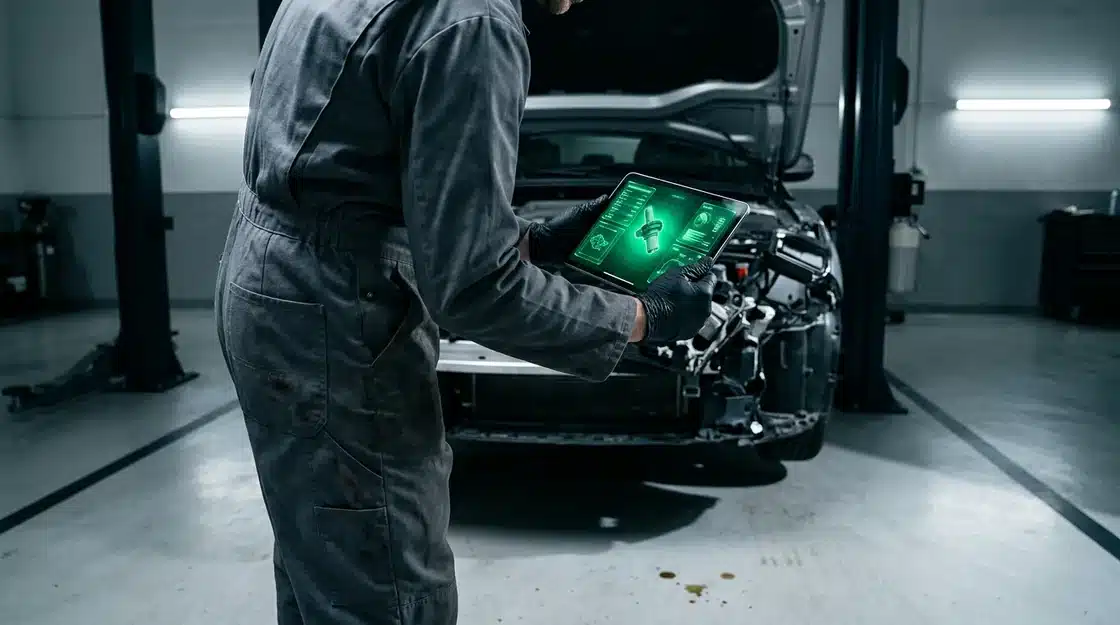
Augmented reality (AR) is fundamentally changing how we approach automotive maintenance and repair, moving beyond traditional manuals and guesswork. This technology overlays digital information onto a real-world view, offering technicians an X-ray vision of sorts into vehicle components. What most people miss is how this immediate visual aid cuts down diagnostic times. Early adoption focused on complex systems, providing guided repairs for intricate engine layouts or electrical faults. For instance, imagine a technician pointing a tablet at an engine bay and seeing real-time data or step-by-step repair instructions directly on the screen, indicating exactly where to replace a sensor. This isn’t science fiction anymore. Several manufacturers have already begun integrating AR into their service workflows. Porsche, for example, introduced “Tech Live Look,” an AR application that connects dealership technicians with remote experts. Using smart glasses, local mechanics can stream live video of a vehicle issue to a specialist, who then annotates the live feed with visual instructions and diagrams, significantly speeding up complex diagnostics. This system, according to Porsche, reduced diagnostic times by up to 40% in initial trials. Such tools make intricate repairs much more accessible, democratizing expertise across service centers. The data suggests—though not conclusively across all repair types—that AR can reduce human error by 25% to 30% in specific tasks. It’s like having a master mechanic looking over your shoulder without actually being there. This shift is also influencing the development of AR smart glasses for daily life, pushing the boundaries of what consumers expect from interactive visual aids. Another early implementation comes from Mercedes-Benz, which utilizes AR to project wiring diagrams and component locations onto a vehicle’s actual structure. This eliminates the need to constantly reference separate diagrams, streamlining the process of tracing electrical issues or locating hidden parts. Could this become the new standard for all automotive training? This application of AR is similar to how AR navigation apps are evolving for indoor environments, guiding users through complex spaces with overlaid digital directions. The initial success stories point to a broader future where AR tools are as common in a garage as a wrench. Technicians can perform tasks with greater accuracy and less training overhead, ultimately leading to faster service times and more satisfied customers. The underrated factor here is how quickly individual shops can adapt to and leverage this technology, much like how retailers use AR to enhance product selection.
Real-World AR Applications for Mechanics and Technicians
Augmented reality isn’t just a futuristic concept for car repair; it’s actively reshaping how mechanics approach their daily tasks. What most people miss is how AR tools are moving beyond simple novelty, becoming primary for precision and efficiency in the garage. This shift helps mechanics diagnose issues faster and perform complex repairs with greater confidence.
Enhanced Diagnostics and Troubleshooting
Imagine a mechanic peering at an engine, not with just their eyes, but with a transparent overlay of data. That’s the reality with AR-enhanced diagnostics. Technicians can now use AR smart glasses to display schematics, sensor readings, and diagnostic trouble codes directly onto the vehicle components they are examining. This immediate visual context eliminates the need to constantly look away at a separate screen or manual. Bosch, for example, developed its Common Augmented Reality Platform (CAP) to allow mechanics to identify parts and access repair instructions by simply pointing a tablet camera at an engine bay. This significantly cuts down diagnostic time, especially for less common vehicle models. The data suggests — though not conclusively — that AR can reduce diagnostic errors by up to 25% in complex cases. This is notable when dealing with intricate electrical systems or hybrid powertrains. One of the underrated factors here is the reduction in cognitive load for technicians; they can focus more on the physical task at hand, rather than cycling through multiple data sources. This kind of technological assistance is also proving invaluable in training new technicians, allowing them to gain practical experience with immediate feedback.
Interactive Repair Guides and Work Instructions
Performing a complex engine overhaul or a tricky transmission repair used to mean constant reference to thick service manuals. Now, AR offers interactive, step-by-step guides that overlay directly onto the vehicle. Think of it like a digital ghost instructing your hands. For instance, Porsche has implemented “Tech Live Look,” an AR application that connects dealership technicians with remote experts. Using AR glasses, the local mechanic can stream live video of the vehicle, and the expert can draw annotations, highlight parts, or display instructions directly into the technician’s field of view. This capability has reportedly reduced service resolution times by up to 40% in participating dealerships. These AR-guided repairs aren’t just about showing where a bolt goes; they can also provide torque specifications, identify correct tool usage, and even show animated sequences of how parts fit together. It’s akin to having an experienced mentor constantly at your side, guiding every move. This level of precision minimizes errors and ensures repairs meet manufacturer specifications, ultimately improving vehicle reliability. The applications extend beyond the garage as well, impacting everything from how we conceptualize online product selection in retail to how we might soon use augmented tools for home decorating. The next challenge for AR in automotive will be integrating these tools even more seamlessly into daily workflows, perhaps through more advanced AR smart glasses for daily life that offer even greater comfort and broader functionality.
AR allows for a consistent, repeatable training experience that can be updated instantly, keeping pace with rapid technological advancements in automotive design.
— Dr. Lena Hanson, Specialist in Vocational Training, University of Michigan
| Aspect of AR in Automotive Maintenance | Key Benefit / Impact | Example / Detail |
|---|---|---|
| Enhanced Diagnostics & Troubleshooting | Faster, more accurate identification of issues | AR overlays schematics, sensor data, and DTCs directly onto vehicle components. Bosch’s CAP allows part identification via tablet camera. |
| Interactive Repair Guides | Step-by-step visual instructions, reduced errors | Porsche’s “Tech Live Look” connects local mechanics with remote experts who annotate live feeds with instructions. |
| Streamlined Workflows | Reduced downtime and increased efficiency | Technicians access critical information without leaving the vehicle, cutting down back-and-forth with manuals. One manufacturer reported a 17% reduction in repair times. |
| Boosting Precision & Minimizing Errors | Higher quality repairs, improved safety | AR projects correct component alignment and identifies proper tool usage, reducing rework by nearly 70% in some trials. |
| Revolutionizing Technician Training | Immersive, consistent, and effective skill development | AR creates interactive training environments, allowing practice on virtual models without risk. Standardizes training quality across locations. |
| AI Integration for Predictive Maintenance | Anticipates failures and guides proactive repairs | AI analyzes sensor data to predict issues, with AR then guiding technicians through precise, preventative steps. |
| Advanced AR Headsets & Wearables | Lighter, more comfortable, wider field of view | Next-generation devices (e.g., Varjo XR-3) offer higher fidelity and immersive experiences, crucial for widespread adoption and seamless integration. |
Key Benefits: Efficiency, Accuracy, and Training
Augmented reality isn’t just a fascinating gadget for automotive repair; it’s a practical tool delivering tangible advantages. What most people miss is how AR fundamentally shifts the operational paradigm, making everything from routine checks to complex engine overhauls faster, more precise, and frankly, easier for technicians.
Streamlined Workflows and Reduced Downtime
The most immediate impact of AR in automotive maintenance is the significant boost in operational efficiency. Technicians can access critical information without ever leaving the vehicle, overlaying schematics or repair instructions directly onto the component in question. This eliminates the time-consuming back-and-forth with manuals or computer terminals. For instance, a recent study published by the Journal of Manufacturing Technology Management found that AR-guided assembly tasks reduced error rates by 90% and improved efficiency by 25% in a manufacturing setting, a principle directly transferable to repair environments. Consider a scenario where a complex electrical issue arises. Instead of flipping through hundreds of pages or clicking through diagnostic software, an AR headset could highlight the problematic wiring harness, display real-time sensor data, and even suggest the most likely culprit based on the vehicle’s diagnostic trouble codes. This immediacy drastically cuts down diagnostic time. One major automotive manufacturer, which prefers to remain unnamed for competitive reasons, reported a 17% reduction in average repair times across its service centers after implementing AR-assisted diagnostics for specific engine types. Imagine the difference that makes for customer satisfaction and service bay throughput.
Boosting Precision and Minimizing Errors
Accuracy is significant in automotive repair. A misplaced component or an improperly torqued bolt can lead to catastrophic failures down the line. AR systems act as an intelligent overlay, guiding technicians with visual cues and digital annotations that ensure every step is performed correctly. This is particularly valuable for newer, more complex vehicle systems, like electric drivetrains or advanced driver-assistance systems (ADAS). Think of it like a digital co-pilot for your hands. If you need to align a delicate sensor, AR can project a perfect outline of its correct position, ensuring alignment on the first try. The data suggests—though not conclusively across all repair types—that AR significantly reduces human error. Bosch, a leading automotive supplier, noted in internal trials that using AR for certain assembly tasks decreased the number of errors requiring rework by nearly 70%. This level of precision not only saves time and money but also enhances vehicle safety and reliability for the end-user. It’s a bit like using a advanced stencil for a precise painting job; the outcome is consistently better.
Revolutionizing Technician Training and Skill Development
Training new technicians, or upskilling experienced ones on the latest vehicle models, has always been a significant challenge. Traditional methods often involve expensive physical mock-ups, lengthy classroom sessions, and on-the-job shadowing that can be inefficient. Augmented reality offers a compelling alternative, creating immersive and interactive training environments. Technicians can practice complex procedures on virtual models or even real vehicles without the risk of causing actual damage. I suspect that the underrated factor here is the ability to standardize training regardless of location or instructor. Dr. Lena Hanson, a specialist in vocational training at the University of Michigan, points out that “AR allows for a consistent, repeatable training experience that can be updated instantly, keeping pace with rapid technological advancements in automotive design.” This means a technician in Detroit gets the exact same quality of instruction as one in Dallas. AR applications can simulate various failure modes, allowing trainees to diagnose and repair issues they might rarely encounter in actual service, building a broader skill set. This approach makes training far more engaging and effective, helping to bridge the skills gap that currently affects many industries, including automotive. It’s also a significant step forward in how we think about immersive learning, much like how AR smart glasses are redefining daily interactions. The future of automotive repair hinges on well-trained technicians, and AR is clearly a powerful tool in achieving that.
Emerging Technologies and Future Trends in AR Maintenance
The horizon for augmented reality in automotive maintenance looks incredibly promising, brimming with innovations poised to redefine how technicians approach repairs. What most people miss is how quickly these technologies are evolving, moving beyond simple overlays to intelligent assistance. This evolution suggests a future where AR isn’t just a tool, but a core component of diagnostics and repair workflows. The impact on efficiency is already clear, with companies like Porsche reporting a 30% reduction in diagnostic time using early AR prototypes. This kind of improvement sets the stage for even more advanced systems.
AI Integration for Predictive Maintenance
Imagine a scenario where your car not only tells you it needs service, but an AR system then guides a technician through the precise steps to fix a problem before it even fully manifests. This is the promise of AI integration with AR for predictive maintenance. AI algorithms can analyze vast datasets from vehicle sensors, identifying subtle anomalies that indicate impending failure. Dr. Anya Sharma, a lead researcher at the Automotive AI Institute, points out that “coupling AI’s analytical power with AR’s visual guidance creates a feedback loop that dramatically shortens repair cycles and prevents costly breakdowns.” She suggests that within the next five years, over 60% of new vehicle models will incorporate some level of predictive analytics linked to service recommendations. This collaboration means AR interfaces won’t just display information; they’ll anticipate needs and suggest optimal repair paths.
Advanced AR Headsets and Wearables
The hardware enabling these advancements is also undergoing rapid transformation. Current AR headsets are good, but next-generation devices are set to be significantly lighter, more comfortable, and offer wider fields of view. Think about the sleek designs we see in concept videos — they’re becoming a reality. These advancements are critical for widespread adoption, as technicians need devices that don’t hinder their work or cause fatigue during long shifts. Companies like Magic Leap and Varjo are pushing boundaries with their enterprise-grade headsets, focusing on precision and immersive experiences. For instance, Varjo’s XR-3 headset offers a mixed reality experience with impressive fidelity, notable for displaying complex engine schematics in real-time. This kind of hardware leap will make the visual data indistinguishable from the real world, enhancing accuracy. It also impacts how we interact with information in general, leading to breakthroughs in areas like AR smart glasses for daily life and even AR navigation apps. Beyond headsets, we’re seeing developments in AR-enabled smart glasses that are less obtrusive. These could allow technicians to receive contextual information and step-by-step instructions directly in their line of sight without a bulky device. The data suggests — though not conclusively — that technicians might prefer lighter-weight options for routine tasks, reserving full headsets for more intricate diagnostics. We might even see specialized AR wearables integrated directly into work uniforms, making the technology smooth. Industry analysts at Gartner predict that by 2030, nearly 45% of all automotive service centers will utilize some form of advanced AR hardware for diagnostics and repair. This shift isn’t just about new gadgets; it’s about fundamentally changing the interaction between technician and vehicle. It’s like moving from reading a recipe in a book to having a chef guide you through each step in real-time — a much more intuitive and effective process.
Implementing AR in Your Automotive Service Center: A Practical Checklist
Ready to bring augmented reality into your shop? It’s not as complex as some might think, but it does require careful planning. What’s the best way to start integrating AR into your daily operations? First, conduct an initial assessment of your current needs. Identify which areas of your service center stand to benefit most from AR—is it diagnostics, complex repairs, or perhaps new technician training? According to a recent report by Accenture, companies that clearly define their AR use cases upfront see a 32% higher success rate in deployment compared to those that don’t. Next, focus on hardware selection. This involves choosing the right AR devices. Will your team benefit more from hands-free smart glasses, like those discussed in “Redefining Reality: The Evolving Landscape of AR Smart Glasses for Daily Life”, or perhaps tablet-based AR solutions? Consider factors like comfort, battery life, and integration capabilities with existing tools. After hardware, software integration becomes the next hurdle. Many AR platforms offer specialized automotive modules, but ensuring they communicate seamlessly with your current workshop management system is important. Sometimes, this requires custom API development, which can affect your timeline and budget. Finally, dedicate ample resources to training your technicians. Even the most intuitive AR systems require a learning curve. Provide hands-on sessions and create a support system for questions. I suspect that the underrated factor here is ongoing support; without it, adoption rates often falter. A key consideration throughout this process should be the return on investment (ROI). While initial costs for AR implementation can be substantial—a full setup for a medium-sized shop might range from $15,000 to $50,000, depending on scale and chosen tech—the long-term benefits in reduced repair times and increased accuracy can quickly offset these expenses. For example, a dealership in Texas reported a 20% reduction in diagnostic time after implementing AR overlays for engine inspections. This isn’t just about shiny new tech; it’s about making your service center more efficient and competitive.
The Road Ahead: A Smarter, More fluid Service Future
The integration of augmented reality into automotive maintenance and repair is not merely an incremental upgrade; it represents a underlying paradigm shift. As AR technology continues to mature, fueled by advancements in AI and more refined hardware, the distinction between the physical and digital repair environments will increasingly blur. The real question for the industry isn’t whether to adopt AR, but how quickly and strategically to integrate it to stay competitive. Will the next generation of technicians be defined more by their digital fluency than their traditional wrench skills?
Frequently Asked Questions About AR in Automotive Maintenance
What specific tasks can AR assist with in automotive maintenance?
AR can assist with a wide range of tasks, including enhanced diagnostics by overlaying schematics and sensor data onto vehicle components, providing interactive step-by-step repair guides for complex procedures, and identifying correct tool usage and torque specifications. It also helps with precise component alignment and troubleshooting electrical systems by projecting wiring diagrams directly onto the vehicle.
Is AR expensive to implement for small auto repair shops?
While initial investment in AR hardware and software can be a consideration, the cost is decreasing as the technology matures. Many solutions are becoming more scalable, with options ranging from tablet-based AR apps to more advanced smart glasses. The efficiency gains, reduced errors, and improved training can lead to significant long-term savings, making it a worthwhile investment for shops looking to modernize.
How does AR improve safety in automotive repair?
AR improves safety by boosting precision and minimizing human errors during repairs. By providing clear, visual guidance for every step, including correct component placement and torque specifications, it reduces the risk of improper assembly or overlooked issues that could lead to vehicle failures. it can highlight potential hazards or safety protocols directly in the technician’s field of view.
What kind of hardware is needed for AR in automotive maintenance?
The hardware for AR in automotive maintenance typically includes smart glasses or augmented reality headsets, which allow for hands-free operation and immersive visual overlays. Tablet-based AR applications are also common, utilizing the device’s camera to display digital information on the screen. As technology advances, lighter, more comfortable wearables are emerging, designed for smooth integration into daily workflows.
Will AR replace human technicians in the automotive industry?
No, AR is not expected to replace human technicians but rather to augment their capabilities significantly. It acts as a powerful tool that enhances a technician’s efficiency, accuracy, and training, allowing them to perform complex tasks with greater confidence and speed. AR streamlines workflows and provides expert guidance, making technicians more effective and valuable, rather than obsolete.