
The landscape of virtual reality (VR) is constantly evolving, with each passing year bringing forth more sophisticated hardware and software. As we step into 2026, the focus has increasingly shifted towards refining the very instruments that bridge the gap between the physical and digital realms: VR controllers. These devices are no longer mere input tools; they are extensions of our will, designed to translate our intentions into tangible actions within immersive virtual worlds. The latest VR controller innovations are not just about better tracking or more buttons; they are about fundamentally enhancing user interaction, making virtual experiences feel more natural, intuitive, and deeply engaging. This article delves into three significant hardware innovations in VR controller design that are set to redefine how we interact with virtual reality in 2026 and beyond, with a keen eye on how these VR controller innovations are pushing the boundaries of immersion and usability.
The journey of VR controllers has been one of continuous improvement, from simple handheld wands to complex devices capable of intricate gesture recognition and nuanced haptic feedback. Early VR systems often struggled with controllers that felt clunky or disconnected, hindering the sense of presence that VR strives to achieve. However, advancements in sensor technology, ergonomic design, and processing power have paved the way for a new generation of controllers. These VR controller innovations are designed not just to track movement but to interpret intent, provide rich tactile feedback, and seamlessly integrate into the user’s natural motor skills. The goal is to make the controller disappear, allowing the user to feel as if they are directly manipulating the virtual environment with their own hands. This level of seamless interaction is crucial for both casual users seeking more engaging entertainment and professionals relying on VR for training, design, and collaboration. The impact of these VR controller innovations extends across all sectors utilizing VR technology.
The Evolution of VR Controller Innovations: A Brief Retrospective
Before we dive into the specifics of the 2026 innovations, it’s essential to understand the trajectory of VR controller development. Initially, VR controllers were rudimentary, often adapting existing game controllers or simple handheld devices. The HTC Vive introduced wand-like controllers with trackpads and haptic feedback, revolutionizing room-scale VR. Oculus followed suit with its Touch controllers, prioritizing ergonomics and natural hand presence with thumbsticks and finger tracking capabilities. PlayStation VR offered its Move controllers, building on a legacy of motion gaming. Each iteration brought improvements in tracking accuracy, comfort, and the range of interactions possible. However, limitations persisted, particularly concerning the naturalness of interaction and the fidelity of haptic feedback. The challenge has always been to replicate the complexity of human hand movements and tactile sensations in a digital medium. The latest VR controller innovations directly address these long-standing challenges, aiming for a level of realism and responsiveness previously thought impossible. These advancements are not merely incremental; they represent a paradigm shift in how users engage with virtual environments, paving the way for even more sophisticated applications and experiences. Understanding this progression helps contextualize the significance of the 2026 VR controller innovations.
The push for more immersive experiences has driven the demand for better controllers. Developers and users alike have yearned for devices that allow for more nuanced interactions, from picking up virtual objects with natural grip to feeling the texture of a digital surface. This desire has fueled research and development into new sensor technologies, advanced haptics, and more intuitive input methods. The 2026 VR controller innovations are the culmination of years of dedicated effort to overcome these hurdles, offering solutions that promise to elevate the VR experience to unprecedented heights. These innovations are not just about making VR ‘better’; they are about making it ‘realer’, blurring the lines between the physical and the virtual in ways that were once confined to science fiction. The focus on human-centric design is evident in each of these new technologies, ensuring that the user’s comfort and natural interaction are at the forefront. As we explore these advancements, it becomes clear that the future of VR is inextricably linked to the sophistication of its controllers.
The foundational elements of VR controller design have always revolved around tracking, input, and feedback. Early controllers excelled at basic positional tracking and button inputs, but often lacked the finesse required for truly immersive interactions. The introduction of capacitive sensors allowed for basic finger presence, giving the illusion of individual finger movement. However, achieving full finger articulation and realistic tactile sensations remained a significant challenge. The VR controller innovations of 2026 tackle these issues head-on, leveraging breakthroughs in material science, micro-actuator technology, and AI-driven predictive algorithms. These advancements are not just about adding features; they are about fundamentally rethinking the interface between human and machine, aiming for a seamless, intuitive, and deeply engaging interaction. The goal is to minimize the cognitive load associated with using a controller, allowing users to focus entirely on the virtual experience itself. This comprehensive approach to design is what makes the current wave of VR controller innovations so impactful.
Innovation 1: Haptic Feedback Gloves with Micro-Actuator Arrays
One of the most significant VR controller innovations emerging in 2026 is the widespread adoption of advanced haptic feedback gloves featuring micro-actuator arrays. Previous generations of haptic feedback in VR controllers were often limited to generalized vibrations, offering a rudimentary sense of impact or interaction. While effective for certain scenarios, they fell short in conveying the intricate textures, resistances, and nuances of virtual objects. These new haptic gloves, however, represent a monumental leap forward. They incorporate hundreds of tiny, individually programmable micro-actuators embedded across the palm and fingers. Each actuator can generate precise tactile sensations, from the smooth surface of glass to the rough texture of a brick wall, or the subtle give of a soft fabric.
The key to their effectiveness lies in the density and precision of these arrays. Unlike earlier systems that used a few large motors, micro-actuators allow for localized feedback that mimics the natural distribution of touch receptors in the human hand. This means that when a user virtually touches an object, they don’t just feel a general buzz; they feel the specific contours and textures at the exact point of contact. This level of detail dramatically enhances the sense of presence and realism. Imagine reaching out to grasp a virtual apple and feeling its cool, smooth skin, or running your fingers over a rough wooden table and sensing each individual grain. These VR controller innovations are making such experiences a reality.
Beyond texture, these gloves are also capable of simulating resistance and pressure. By subtly restricting finger movement or applying counter-pressure, they can create the illusion of grasping a solid object, pulling a lever, or pushing a button with a satisfying click. This force feedback, combined with the detailed tactile sensations, allows for an unprecedented level of interaction fidelity. Game developers can now design environments where the physical properties of objects are genuinely felt, adding a new dimension to gameplay. For professional applications, such as surgical training or product design, the ability to ‘feel’ virtual models with such accuracy is invaluable. These VR controller innovations are not just for entertainment; they are powerful tools for serious applications, bridging the physical and digital divide with unparalleled precision. The integration of advanced algorithms further refines the feedback, adapting to various virtual materials and interactions dynamically.
The technology behind these micro-actuator arrays involves piezoelectric or electroactive polymer materials that can rapidly change shape or generate force in response to electrical signals. This allows for extremely fast and precise feedback without significant latency, which is crucial for maintaining immersion. Furthermore, the gloves are designed to be lightweight and comfortable, ensuring that prolonged use doesn’t lead to fatigue. Wireless connectivity and long-lasting batteries are also standard features, reflecting the overall push for seamless user experiences. The impact of these haptic feedback gloves on VR controller innovations cannot be overstated, as they fundamentally alter the way users perceive and interact with virtual worlds, moving beyond visual and auditory cues to incorporate a rich sense of touch. The implications for immersive storytelling, interactive education, and therapeutic applications are profound.
Innovation 2: AI-Powered Predictive Hand Tracking and Gesture Recognition
The second major VR controller innovation to emerge in 2026 centers around AI-powered predictive hand tracking and gesture recognition, often integrated directly into headset cameras or lightweight wrist-worn sensors. While hand tracking has existed for some time, previous iterations often suffered from latency, occlusion issues, and a limited understanding of complex human gestures. The new AI-driven systems overcome these limitations by leveraging advanced machine learning models trained on vast datasets of human hand movements.
These systems don’t just track the current position and orientation of your hands; they anticipate your next move. By analyzing subtle cues in your hand and finger positions, as well as contextual information from the virtual environment, the AI can predict your intended gestures with remarkable accuracy and speed. This predictive capability significantly reduces latency, making interactions feel instantaneous and natural. For instance, if you’re reaching for a virtual object, the system can pre-emptively ready the grasping animation, ensuring a seamless pick-up experience. This proactive approach is a game-changer for responsive interaction, making these VR controller innovations truly transformative.
Furthermore, these AI systems are capable of recognizing a far wider array of natural gestures than ever before. Beyond simple grips and pointing, they can interpret complex sign language, subtle emotional cues expressed through hand movements, and even individual finger articulation with high fidelity. This opens up entirely new paradigms for interaction. Users can communicate with virtual characters using natural gestures, perform intricate tasks that require fine motor control, or even create art in VR with the precision of their own hands. The need for physical controllers can be significantly reduced, leading to a more unencumbered and intuitive experience. This shift towards controller-less interaction, powered by sophisticated AI, is a significant part of the VR controller innovations we’re seeing.
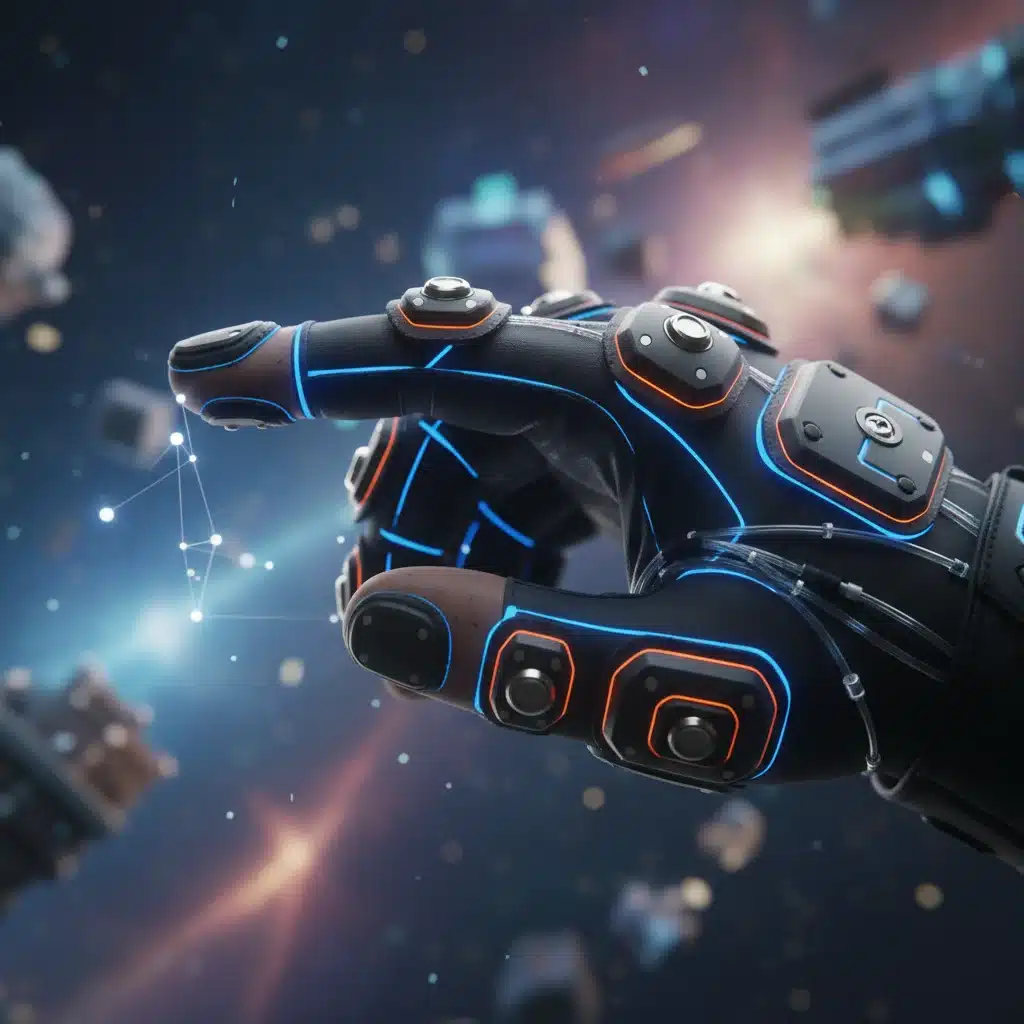
The underlying technology involves sophisticated neural networks that process real-time camera feeds or sensor data. These networks are constantly learning and adapting, meaning the system improves over time with user interaction. This personalized learning aspect ensures that the tracking becomes even more accurate and attuned to an individual’s unique hand movements and gestures. Privacy concerns are addressed through on-device processing and anonymized data collection, ensuring user data remains secure. The integration of AI into hand tracking represents a leap forward in user interface design, making VR experiences more accessible and intuitive for a broader audience. These VR controller innovations are not just about technology; they are about making VR a more human experience.
The implications for accessibility are also profound. Individuals who may struggle with traditional controllers due to physical limitations can now interact with VR using more natural movements, making virtual worlds more inclusive. For social VR, the ability to convey subtle non-verbal cues through hand gestures adds a layer of richness and realism to virtual interactions, making avatars feel more alive and expressive. This innovation fundamentally changes the relationship between user and virtual environment, moving towards a truly hands-on, intuitive interface that leverages the natural dexterity and expressiveness of human hands. These VR controller innovations are setting a new standard for how we interact with digital spaces.
Innovation 3: Modular, Biometric-Integrated Controllers
The third significant VR controller innovation in 2026 is the emergence of modular, biometric-integrated controllers. These devices move beyond one-size-fits-all designs, offering customizable form factors and incorporating advanced biometric sensors to enhance both immersion and user comfort. The modularity allows users to adapt their controllers to specific VR applications or personal preferences. For instance, a user might attach a joystick module for flight simulators, a stylus module for artistic creation, or a more minimalist grip for social VR experiences. This flexibility ensures that the controller is always optimized for the task at hand, reducing fatigue and improving performance.
The biometric integration is where these controllers truly shine. Embedded sensors can monitor a range of physiological data, including heart rate, galvanic skin response (GSR), muscle tension, and even basic brainwave patterns (EEG). This data is then used in several transformative ways. Firstly, it allows for dynamic difficulty adjustment in games, where the VR experience can respond to the user’s stress levels or excitement, making challenges harder or easier as appropriate. Imagine a horror game that intensifies its scares when your heart rate spikes, or a meditation app that guides you to calm based on your brainwave activity. These VR controller innovations create a truly personalized experience.
Secondly, biometric data can enhance immersion by providing more realistic feedback. For example, if a virtual character is supposed to be stressed, the controller could subtly increase haptic feedback or alter its resistance to simulate muscle tension in the user’s hand, mirroring the character’s state. This creates a deeper empathetic connection between the user and the virtual world. For professional training simulations, monitoring physiological responses can provide valuable insights into a trainee’s performance under pressure, allowing for more targeted and effective instruction. The ethical considerations around biometric data collection are carefully addressed, with strong encryption and user consent being paramount.
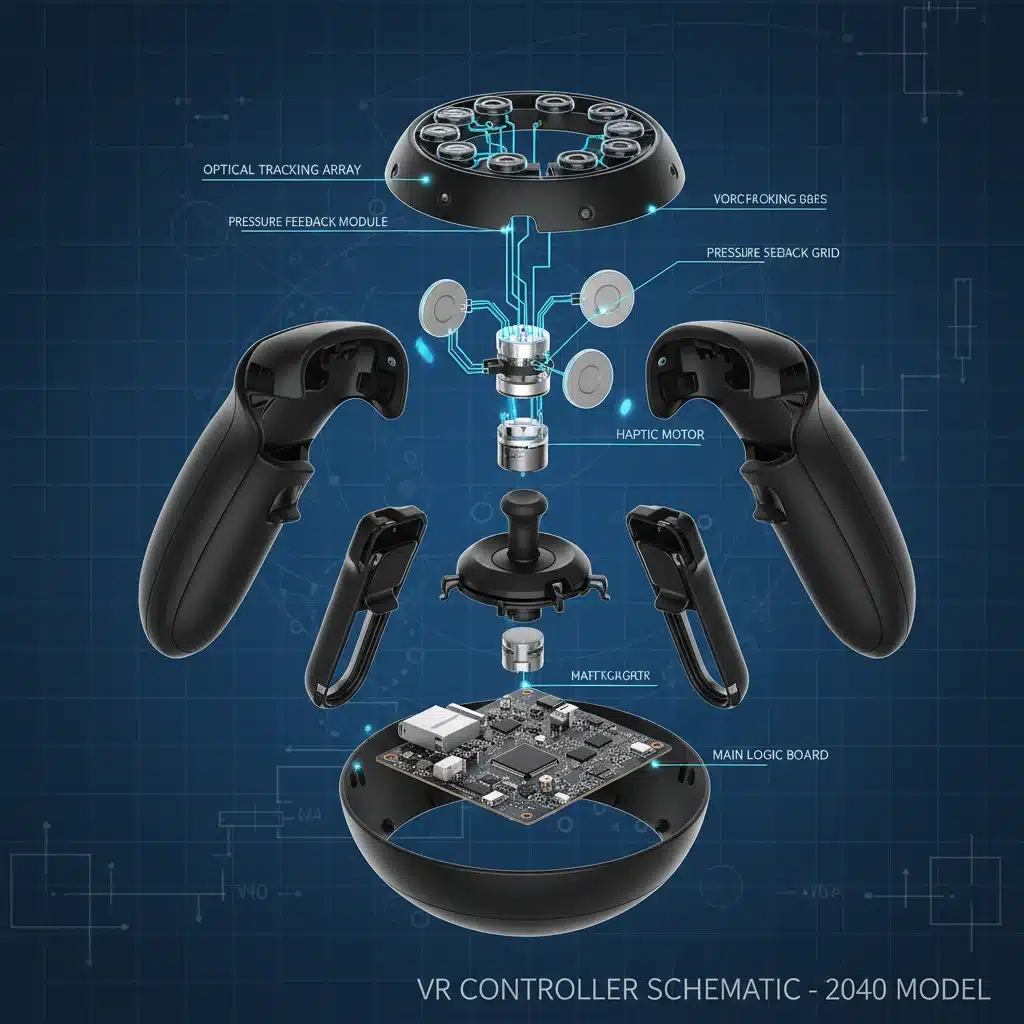
The modular nature extends beyond simple attachments. These controllers often feature interchangeable grip sizes, adjustable button layouts, and even customizable weight distribution, allowing for a truly ergonomic fit for every user. This level of personalization is crucial for long VR sessions, preventing discomfort and ensuring that the controller feels like a natural extension of the hand. The materials used are also increasingly advanced, incorporating self-cleaning surfaces and antimicrobial coatings for hygiene, especially in public or shared VR environments. These VR controller innovations prioritize both performance and user well-being, demonstrating a holistic approach to design.
Powering these modular systems are universal communication protocols and standardized connectors, ensuring compatibility across different VR platforms and future upgrades. This ‘future-proofing’ aspect is vital in a rapidly evolving tech landscape, allowing users to invest in a controller system that will grow with their VR ecosystem. The combination of adaptability, biometric intelligence, and ergonomic excellence makes these modular controllers a cornerstone of the 2026 VR controller innovations, pushing the boundaries of what a VR input device can be. They are not just tools; they are intelligent, adaptable partners in the virtual journey.
The Broader Impact of VR Controller Innovations on the VR Ecosystem
These three VR controller innovations – advanced haptic gloves, AI-powered hand tracking, and modular biometric controllers – are not operating in isolation. Their combined effect is poised to profoundly reshape the entire VR ecosystem. Enhanced user interaction leads directly to more engaging and believable virtual experiences, which in turn drives greater adoption of VR technology. As controllers become more intuitive and immersive, the barrier to entry for new users decreases, expanding the market beyond early adopters and hardcore enthusiasts. This broader appeal is crucial for the mainstream success of VR.
For content creators and developers, these VR controller innovations open up a wealth of new possibilities. Imagine designing games where players can truly ‘feel’ the weight and texture of every object, or educational simulations where students can manipulate complex machinery with unprecedented realism. The ability to integrate biometric data allows for dynamic and personalized narratives, creating experiences that respond to the user’s emotional and physiological state. This leads to a richer, more nuanced form of storytelling and interaction, moving beyond static environments to truly adaptive virtual worlds. The creative potential unlocked by these advancements is immense, inspiring a new generation of VR content.
Furthermore, the advancements in precision and feedback have significant implications for enterprise and industrial applications. In fields like architecture, engineering, and manufacturing, designers can now interact with 3D models with a level of tactile feedback that mimics physical prototypes, accelerating design cycles and reducing errors. Medical professionals can perform highly realistic surgical training, feeling the resistance of tissues and the texture of organs. Remote collaboration in VR becomes more effective when participants can interact with shared virtual objects with natural gestures and tactile feedback, fostering a stronger sense of co-presence. These VR controller innovations are not just about entertainment; they are about revolutionizing how we work, learn, and connect.
The push for open standards and interoperability is also gaining momentum, ensuring that these VR controller innovations are not locked into proprietary ecosystems. This fosters competition and encourages further innovation, ultimately benefiting consumers. As VR headsets become lighter, more powerful, and more affordable, the sophistication of their input devices will be a key differentiator. The 2026 VR controller innovations are setting a new benchmark for what is possible, paving the way for a future where the line between the physical and virtual worlds becomes increasingly blurred, and interaction feels as natural as breathing.
Challenges and Future Directions for VR Controller Innovations
While the 2026 VR controller innovations represent a significant leap forward, challenges remain. The cost of integrating highly advanced haptic arrays and sophisticated AI processing can still be a barrier for mass adoption. Miniaturization and power efficiency are ongoing areas of research, as is the development of even more robust and universal tracking algorithms that can perform flawlessly in diverse environments. Furthermore, ensuring the comfort and hygiene of these advanced devices, especially haptic gloves, for extended use or in shared settings, requires continuous attention to material science and design.
Looking ahead, the next wave of VR controller innovations might focus on even more seamless integration with the human body. This could include direct neural interfaces, allowing users to control virtual environments with thought alone, or advanced sensory feedback that stimulates other senses like smell and taste. Research into ‘soft robotics’ could lead to controllers that dynamically change shape or texture, offering an unprecedented level of physical interaction. The convergence of VR with augmented reality (AR) will also drive controller development, requiring devices that can seamlessly transition between interacting with virtual objects and augmenting the real world.
The ethical implications of biometric data collection and AI-driven predictive systems will also require careful consideration and robust regulatory frameworks. Striking a balance between innovation, user privacy, and responsible technology deployment will be paramount. However, one thing is clear: the journey towards truly immersive and intuitive VR interaction is far from over. The VR controller innovations of 2026 are not an endpoint, but a powerful springboard into an even more exciting and interactive virtual future. They signify a maturing of the VR ecosystem, where the focus is firmly on the user experience and the naturalness of interaction. These advancements are laying the groundwork for a future where virtual reality is not just a visual spectacle, but a deeply felt and intuitive experience, accessible and engaging for everyone.