
The year 2026 marks a pivotal moment in the evolution of Virtual Reality (VR) technology, particularly within the enterprise sector. For US businesses, understanding the nuances of VR software procurement is no longer a futuristic endeavor but an immediate strategic imperative. As VR moves beyond niche applications and into mainstream business operations, the complexity of acquiring, integrating, and managing these sophisticated software solutions grows exponentially. This comprehensive guide aims to demystify the 2026 VR software procurement landscape, offering actionable insights for US businesses looking to leverage VR for competitive advantage.
Navigating the New 2026 VR Software Procurement Landscape for US Businesses: Key Considerations
Virtual Reality (VR) technology is rapidly transforming various industries, from manufacturing and healthcare to education and retail. For US businesses, the strategic adoption of VR is becoming crucial for enhancing training, improving product design, facilitating remote collaboration, and creating immersive customer experiences. However, the path to successful VR integration is paved with complex decisions, especially concerning VR software procurement. In 2026, the market is more mature, yet also more fragmented and specialized, demanding a meticulous approach to selection and implementation.
The Evolving VR Landscape: What’s New in 2026?
The VR ecosystem in 2026 is significantly different from just a few years ago. Hardware has become more powerful, accessible, and comfortable, with standalone headsets dominating the enterprise space due to their ease of deployment and reduced infrastructure requirements. This hardware evolution directly impacts VR software procurement, as software solutions are increasingly optimized for specific hardware platforms and capabilities. We’re seeing a surge in cloud-based VR platforms, enabling greater scalability, remote access, and collaborative features, which is a game-changer for distributed workforces.
Furthermore, Artificial Intelligence (AI) and Machine Learning (ML) are deeply embedded within new VR software offerings. AI-powered analytics can track user performance in training simulations, providing personalized feedback and adaptive learning paths. ML algorithms are enhancing realistic virtual environments, optimizing content delivery, and improving user interaction. For US businesses, evaluating these AI/ML capabilities is now a critical part of the VR software procurement process, as they directly contribute to the ROI of VR investments.
Another significant trend is the rise of industry-specific VR applications. Generic VR platforms are giving way to tailored solutions designed for precise business needs, such as surgical training simulators, architectural visualization tools, or advanced engineering design platforms. This specialization means that businesses must look beyond broad-stroke solutions and identify software that addresses their unique operational challenges and strategic goals. This targeted approach is fundamental to effective VR software procurement in the current market.
Key Considerations for 2026 VR Software Procurement
1. Defining Your Business Objectives and Use Cases
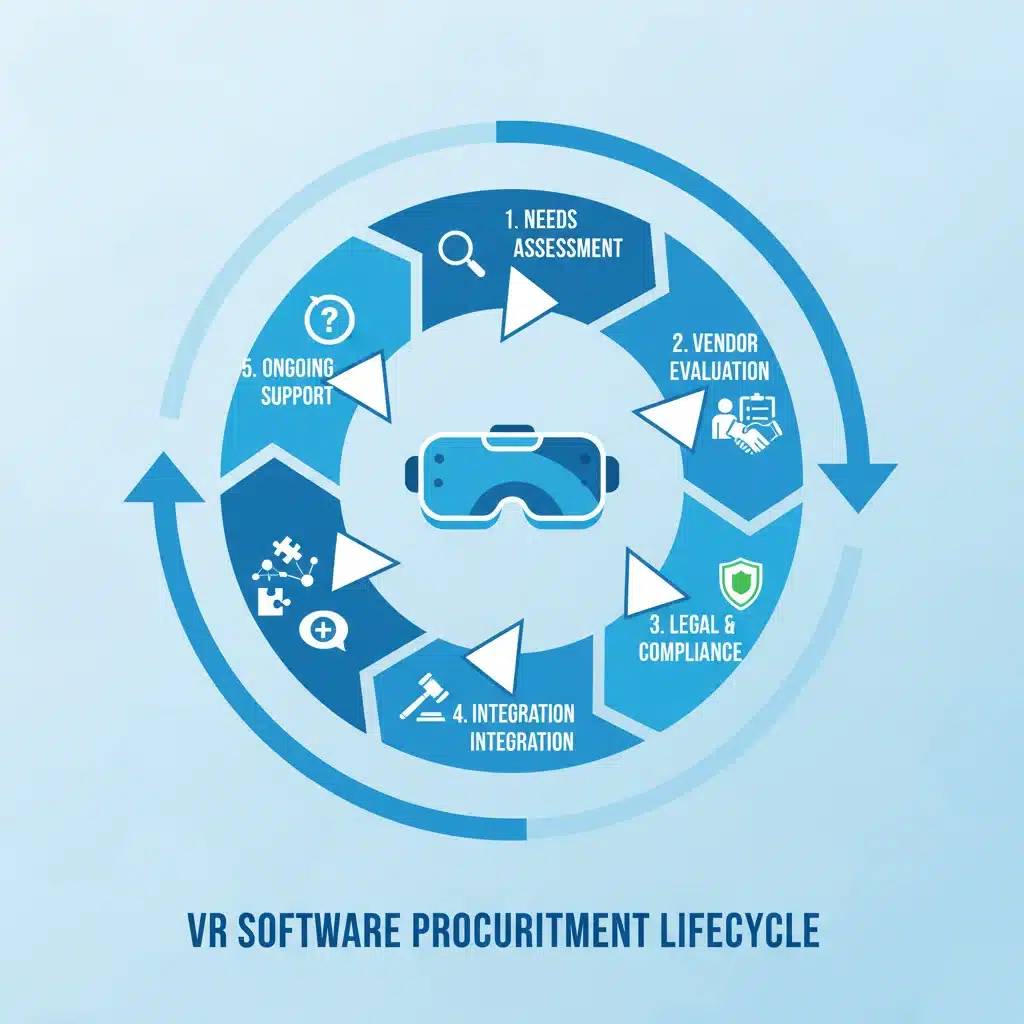
Before diving into the vast sea of VR software options, US businesses must first clearly define their objectives. What problem are you trying to solve with VR? Are you aiming to reduce training costs, accelerate product development, enhance customer engagement, or improve remote collaboration? Specific use cases, such as employee onboarding, complex machinery maintenance, virtual showrooms, or mental health therapy, will dictate the type of VR software procurement required. A detailed needs assessment, involving key stakeholders from various departments, is paramount. This initial step helps to avoid costly missteps and ensures that the procured software aligns directly with strategic business outcomes.
Consider questions like: What specific tasks will be performed in VR? Who are the end-users, and what are their technical proficiencies? What existing systems will the VR software need to integrate with? The answers to these questions will form the bedrock of your VR software procurement strategy.
2. Technical Compatibility and Integration
The best VR software is useless if it doesn’t integrate seamlessly with your existing IT infrastructure. Compatibility with current hardware (headsets, controllers, tracking systems) is a primary concern. Many enterprise VR solutions are designed to be hardware-agnostic or offer broad compatibility, but it’s crucial to verify this. Furthermore, integration with enterprise resource planning (ERP) systems, customer relationship management (CRM) platforms, product lifecycle management (PLM) tools, and other proprietary databases is often necessary to maximize the value of VR. Data flow, security protocols, and API availability are technical details that demand thorough investigation during VR software procurement.
Cloud-based VR solutions offer advantages in terms of scalability and accessibility, but they also introduce considerations around data residency, cloud security, and bandwidth requirements. On-premise solutions might offer more control but come with higher upfront infrastructure costs and maintenance. US businesses must weigh these technical trade-offs carefully to ensure a smooth deployment and optimal performance of their chosen VR software procurement.
3. Scalability and Future-Proofing
The VR market is dynamic, with new technologies and applications emerging constantly. When undertaking VR software procurement, US businesses should prioritize solutions that offer scalability and flexibility. Can the software easily accommodate an increasing number of users or expand to new use cases as your business grows? Is the vendor committed to regular updates, new feature development, and support for future hardware generations? Investing in a solution that can evolve with your business and the VR landscape will protect your investment and prevent premature obsolescence.
Look for modular architectures, open standards, and robust developer communities. A platform that allows for custom content creation or integration with third-party tools can offer significant long-term value. Future-proofing your VR software procurement decisions means anticipating not just your immediate needs but also your potential requirements five years down the line.
4. Security, Privacy, and Compliance
In 2026, data security and user privacy are non-negotiable. VR software often handles sensitive data, whether it’s proprietary product designs, employee performance metrics from training simulations, or personal health information in medical applications. US businesses must ensure that any procured VR software adheres to stringent security standards, including encryption protocols, access controls, and regular security audits. Compliance with regulations such as GDPR, CCPA, HIPAA (for healthcare), and other industry-specific mandates is absolutely critical. A failure in this area can lead to severe legal penalties, reputational damage, and loss of customer trust.
During the VR software procurement process, thoroughly vet vendors’ security practices, data handling policies, and compliance certifications. Understand where data is stored, who has access to it, and how it is protected. Consider the implications of biometric data collection, which is becoming more common in advanced VR systems for tracking eye movement, facial expressions, and physiological responses.
5. Vendor Evaluation and Support
Choosing the right vendor is as important as choosing the right software. Assess vendors based on their industry experience, track record, financial stability, and commitment to customer support. Request case studies, client testimonials, and conduct pilot programs or demos to evaluate the software’s performance and the vendor’s responsiveness. Post-purchase support, including training, technical assistance, and maintenance, is crucial for successful VR adoption and long-term operational efficiency. A strong partnership with a reliable vendor can significantly mitigate risks associated with VR software procurement.
Also, consider the vendor’s ecosystem. Do they offer professional services for custom content development? Are there community forums or knowledge bases available? A comprehensive support system ensures that your business can fully leverage the capabilities of the VR software and address any challenges promptly.
Challenges in 2026 VR Software Procurement and How to Overcome Them
A. High Upfront Costs and ROI Justification
One of the perennial challenges in technology adoption, and particularly in VR software procurement, is the initial investment. VR software, especially specialized enterprise solutions, can come with significant licensing fees, implementation costs, and ongoing subscription models. Justifying this expenditure requires a robust business case that clearly outlines the expected Return on Investment (ROI). This involves quantifying benefits such as reduced training time, decreased error rates, faster design cycles, improved remote collaboration, or enhanced customer satisfaction.
To overcome this, US businesses should conduct thorough cost-benefit analyses. Start with pilot programs in specific departments to demonstrate tangible value and gather data before a full-scale rollout. Focus on measurable KPIs that directly link VR implementation to business objectives. For instance, if VR training reduces employee onboarding time by 20%, calculate the cost savings from that efficiency. This data-driven approach is essential for securing internal buy-in and proving the long-term value of your VR software procurement.
B. Content Creation and Customization
While off-the-shelf VR software is available, many businesses require custom content, whether it’s tailored training simulations, specific product visualizations, or bespoke collaborative environments. Creating high-quality VR content can be resource-intensive, requiring specialized skills in 3D modeling, animation, game design, and VR development. This can become a bottleneck in the VR software procurement process if not addressed proactively.
To mitigate this, businesses have several options: partnering with experienced VR content development studios, hiring in-house VR developers, or utilizing user-friendly VR content creation platforms that require less specialized expertise. Increasingly, VR software platforms offer intuitive tools for non-developers to create or modify content, democratizing VR development. When evaluating software, consider its ease of content creation and whether it supports importing existing 3D assets. Factor content development costs and timelines into your overall VR software procurement budget and schedule.
C. User Adoption and Training
Even the most advanced VR software won’t deliver value if employees are unwilling or unable to use it effectively. Resistance to change, discomfort with VR hardware, or a lack of proper training can hinder user adoption. This is a critical, yet often overlooked, aspect of successful VR software procurement.
To foster adoption, US businesses should implement comprehensive training programs that introduce employees to VR technology, its benefits, and how to use the specific software. Provide ongoing support and create champions within the organization who can advocate for VR and assist colleagues. Design VR experiences that are intuitive, engaging, and directly relevant to employees’ roles, demonstrating how VR can make their jobs easier or more effective. A positive initial experience is key to widespread acceptance and integration of new VR software procurement into daily workflows.
D. Rapid Technological Obsolescence
The rapid pace of technological innovation in the VR space means that hardware and software can become outdated relatively quickly. This presents a challenge for long-term planning and investment in VR software procurement. Businesses need to balance the desire for cutting-edge technology with the need for stability and a reasonable lifespan for their investments.
To address this, prioritize software solutions that are platform-agnostic or offer strong compatibility across various hardware vendors. Look for vendors with a clear roadmap for future development and a history of providing updates and upgrades. Consider subscription-based models for software, which often include updates, rather than large upfront perpetual licenses, as this can help spread costs and provide access to the latest versions. Regular reviews of your VR strategy and technology stack will also be necessary to adapt to market changes and ensure your VR software procurement remains relevant.
Best Practices for US Businesses in 2026 VR Software Procurement
1. Adopt a Phased Implementation Approach
Instead of a ‘big bang’ deployment, consider a phased approach to VR software procurement and implementation. Start with a pilot project in a specific department or for a defined use case. This allows your business to test the software, gather feedback, refine processes, and demonstrate early successes without committing extensive resources upfront. Lessons learned from the pilot can then inform subsequent phases, ensuring a smoother and more successful enterprise-wide rollout.
2. Prioritize User Experience (UX) and User Interface (UI)
For VR software to be effective, it must offer an intuitive and engaging user experience. Poor UX can lead to frustration, reduced productivity, and low adoption rates. During VR software procurement, prioritize solutions with well-designed interfaces, natural interactions, and clear navigation. Request demos and involve end-users in the evaluation process to gather their feedback on the software’s usability and comfort.
3. Leverage Cloud-Based VR Platforms
Cloud-based VR solutions are increasingly becoming the standard for enterprise applications due to their scalability, accessibility, and collaborative features. They simplify deployment, reduce the need for powerful local hardware, and enable seamless updates. For US businesses, exploring cloud-based options should be a key part of their VR software procurement strategy, especially for distributed teams or scenarios requiring significant data processing and sharing.

4. Focus on Data Analytics and Performance Tracking
Modern VR software often comes equipped with robust analytics capabilities, allowing businesses to track user performance, engagement levels, and the effectiveness of VR experiences. For instance, in training simulations, you can monitor completion rates, error identification, decision-making patterns, and time-to-proficiency. This data is invaluable for refining content, optimizing training modules, and demonstrating the ROI of your VR software procurement.
Ensure that the VR software you choose provides comprehensive data insights and offers customizable reporting features. The ability to integrate this data with existing business intelligence (BI) tools can provide a holistic view of VR’s impact on your operations.
5. Build an Internal VR Competency Center
To truly maximize the value of your VR software procurement, consider establishing an internal VR competency center or a dedicated team. This team can be responsible for managing VR hardware and software, developing custom content, providing user support, and identifying new VR use cases within the organization. This centralized expertise ensures that VR initiatives are well-coordinated, aligned with business strategy, and continuously optimized.
This team can also serve as a liaison between business units and VR vendors, streamlining communication and ensuring that software needs are effectively communicated and met. Investing in internal expertise reduces reliance on external consultants and fosters a culture of innovation around VR technology.
6. Stay Informed on Regulatory Changes
The regulatory landscape surrounding VR, particularly concerning data privacy, user safety, and accessibility, is still evolving. US businesses engaged in VR software procurement must stay abreast of new laws and guidelines at federal, state, and even international levels. This is especially true for sectors like healthcare, finance, and defense, where regulatory compliance is exceptionally strict. Proactive monitoring and adaptation to these changes are crucial to avoid legal complications and ensure ethical VR deployment.
The Future of VR Software Procurement for US Businesses
Looking ahead, the VR software procurement landscape will continue to be shaped by advancements in several key areas. The convergence of VR with Augmented Reality (AR) into Mixed Reality (MR) will blur the lines between virtual and physical worlds, leading to more sophisticated and context-aware enterprise applications. Expect to see more emphasis on haptic feedback, advanced eye-tracking for foveated rendering and interaction, and brain-computer interfaces (BCIs) that could revolutionize how users interact with virtual environments.
Furthermore, the standardization of VR platforms and interoperability protocols will likely improve, making it easier for businesses to integrate different VR solutions and transfer content across systems. The subscription economy will continue to dominate software licensing, offering more flexible and scalable options for businesses. As the workforce becomes more distributed and remote, the demand for robust, secure, and collaborative VR software will only intensify, making strategic VR software procurement a defining element of future business success.
Conclusion
The 2026 VR software procurement landscape for US businesses is dynamic, offering immense opportunities for innovation and growth. By carefully defining objectives, prioritizing technical compatibility and scalability, ensuring robust security and compliance, and partnering with reliable vendors, businesses can navigate this complex terrain successfully. Overcoming challenges related to costs, content creation, and user adoption requires a strategic, phased approach and a commitment to continuous learning and adaptation.
Embracing VR is not just about adopting new technology; it’s about transforming how businesses operate, train, collaborate, and engage with their customers. For US companies ready to invest thoughtfully in VR software procurement, the rewards in terms of efficiency, competitive advantage, and future-readiness are substantial. The time to strategize and act on your VR vision is now.