VR Training for US Workforce: Future-Proofing Skills Beyond 2026
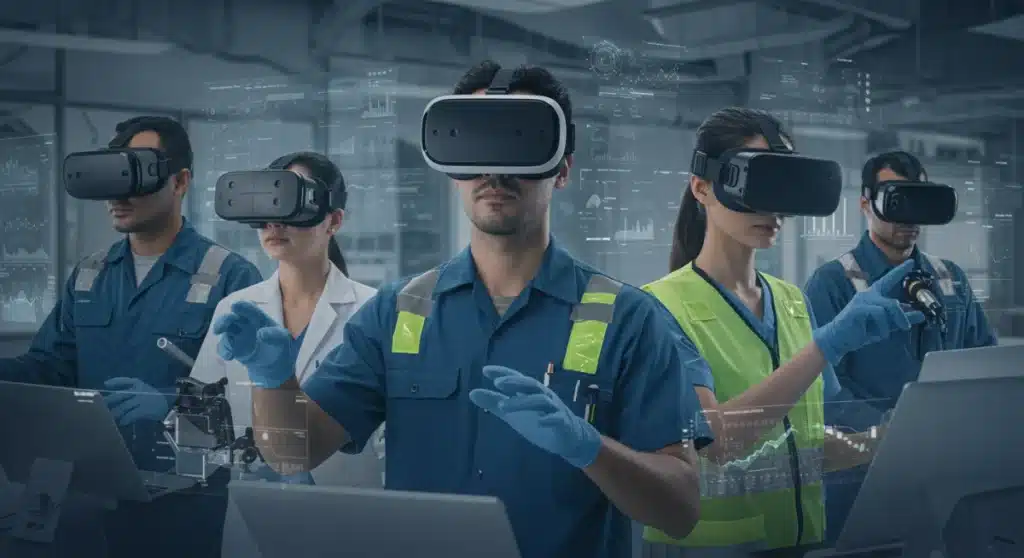
Virtual reality training programs are fundamentally reshaping how the United States workforce acquires and refines essential skills, offering immersive and effective solutions for future industry demands beyond 2026.
The landscape of work in the United States is evolving at an unprecedented pace, driven by technological advancements and shifting economic demands. To remain competitive and resilient, the US workforce must continuously adapt and acquire new skills. This urgent need has placed a spotlight on innovative training methodologies, with VR workforce training emerging as a transformative solution for future-proofing United States workforce skills: VR training programs for 2026 and beyond.
The Imperative for Skill Transformation in the US
The American economy is undergoing a profound digital transformation. Automation, artificial intelligence, and new data-driven paradigms are not just changing jobs; they are creating entirely new skill requirements. Industries from manufacturing to healthcare are grappling with skill gaps that traditional training methods struggle to address effectively.
This necessitates a proactive approach to workforce development. Without robust, scalable, and engaging training solutions, the US risks falling behind in global productivity and innovation. The demand for specialized technical skills, alongside critical soft skills like problem-solving and adaptability, is skyrocketing.
Addressing the Skills Gap with Innovative Solutions
The traditional classroom model often falls short in providing the hands-on, experiential learning necessary for complex modern roles. VR offers a compelling alternative, allowing workers to practice critical tasks in risk-free, simulated environments.
- High-stakes scenario practice: Safely rehearse procedures in medicine, aviation, or emergency services.
- Complex machinery operation: Learn to use advanced industrial equipment without costly physical prototypes.
- Soft skills development: Improve communication, leadership, and customer service through interactive simulations.
- Accessibility and scalability: Deliver consistent, high-quality training to a geographically dispersed workforce.
Ultimately, the goal is to equip American workers with the competencies needed to thrive in an increasingly complex and technologically advanced global market. VR training is not just an enhancement; it’s becoming a foundational element of this strategic imperative.
Understanding VR Training: Beyond the Hype
Virtual reality training utilizes specialized hardware, primarily VR headsets, to immerse users in a computer-generated environment. This environment can closely mimic real-world scenarios or create entirely fantastical ones, offering unparalleled opportunities for experiential learning. Unlike passive video learning or theoretical instruction, VR actively engages the learner.
The technology works by providing a sense of presence, making the user feel as if they are physically within the simulated world. This deep immersion enhances memory retention and skill transfer, as the brain processes the virtual experience much like a real one. The fidelity of these simulations continues to improve, blurring the lines between virtual and physical training.
Key Components of Effective VR Training Programs
A successful VR training program integrates several critical elements to maximize its impact. It’s more than just putting on a headset; it’s about thoughtful design and purposeful application.
- Realistic simulations: Environments and objects must accurately represent their real-world counterparts.
- Interactive feedback: Learners receive immediate feedback on their performance, allowing for real-time correction.
- Progressive learning paths: Modules should build complexity, guiding users from basic to advanced skills.
- Data analytics: Tracking performance metrics helps identify areas for improvement and personalize training.
The power of VR lies in its ability to create a safe space for failure and iteration. Mistakes in a virtual environment carry no real-world consequences, encouraging learners to experiment and master skills through repeated practice. This iterative process is crucial for deep learning and confidence building.
Industry Applications: Where VR is Making an Impact Today
VR training is no longer a futuristic concept; it’s actively being deployed across a multitude of industries within the United States. Its versatility allows for tailored solutions that address specific sectoral challenges, from precision manufacturing to intricate surgical procedures.
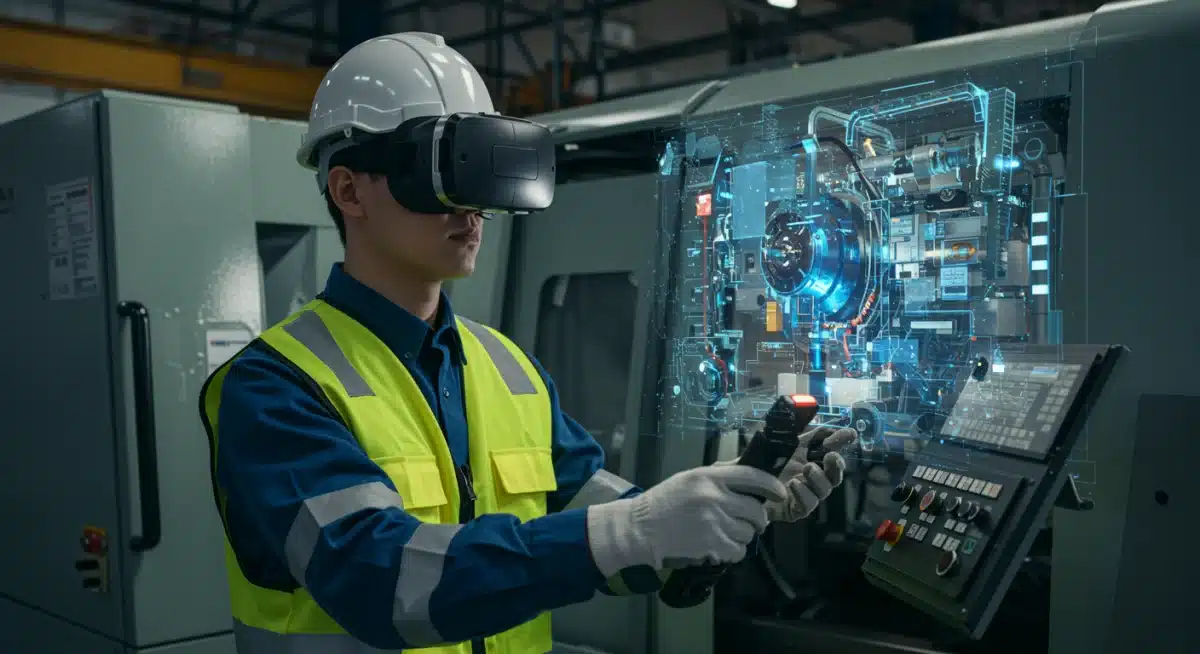
In manufacturing, VR is used to train new employees on assembly lines, equipment maintenance, and safety protocols, significantly reducing the time and cost associated with traditional on-the-job training. Similarly, in logistics, forklift operators and warehouse managers can practice complex maneuvers and inventory management in virtual warehouses.
Transforming Training in Key US Sectors
The adoption of VR is particularly impactful in sectors where errors are costly or dangerous, or where physical training resources are scarce. This includes areas like healthcare, energy, and public safety.
- Healthcare: Surgeons practice complex operations, nurses train on patient care scenarios, and medical students learn anatomy in interactive 3D.
- Aerospace and Defense: Pilots train on flight simulators, maintenance crews practice repairs on virtual aircraft, and soldiers rehearse mission scenarios.
- Energy: Technicians learn to operate and maintain power plant equipment, conduct safety inspections, and respond to emergencies without risking real infrastructure.
- Retail and Customer Service: Employees practice handling difficult customer interactions, product knowledge, and store layout familiarity in immersive scenarios.
The ability to standardize training experiences across different locations and trainers ensures a consistent quality of instruction, which is vital for compliance and operational excellence. VR is proving to be a highly effective tool for rapid upskilling and reskilling initiatives.
Benefits of VR Training Programs for US Businesses
The advantages of integrating VR into workforce development extend far beyond novel technology; they translate into tangible business benefits. Companies adopting VR training are reporting significant improvements in efficiency, safety, and employee engagement, directly impacting their bottom line and competitive edge.
One of the most compelling benefits is cost reduction. While initial investment in VR hardware and software can be substantial, it often pales in comparison to the expenses associated with physical prototypes, travel for training, or the costs of accidents and errors in real-world settings. VR minimizes these risks and expenditures.
Quantifiable Improvements and Strategic Advantages
Beyond cost savings, VR training offers a host of other strategic advantages that contribute to a more skilled, confident, and efficient workforce.
- Increased retention rates: Experiential learning in VR leads to significantly better memory recall and understanding compared to traditional methods.
- Faster skill acquisition: Learners can practice repeatedly without limitations, accelerating the mastery of complex tasks.
- Enhanced safety: Training in hazardous environments or with dangerous equipment can be done with zero risk to personnel or assets.
- Standardized training: Ensures all employees receive the same high-quality instruction, regardless of location or instructor.
- Improved employee engagement: The novelty and interactivity of VR make learning more enjoyable and motivating.
Ultimately, businesses gain a more agile and competent workforce, better prepared to tackle the challenges and opportunities of the future. This translates into higher productivity, fewer errors, and a stronger organizational culture of continuous learning.
Challenges and Considerations for VR Adoption
While the promise of VR training is immense, its widespread adoption is not without hurdles. Organizations must navigate several challenges, from initial investment to integration complexities, to unlock its full potential. Understanding these obstacles is key to successful implementation.
The upfront cost of VR headsets, powerful computing hardware, and specialized software development can be a barrier for some small and medium-sized enterprises. However, as the technology matures and becomes more mainstream, these costs are steadily decreasing, making VR more accessible.
Overcoming Implementation Obstacles
Beyond financial considerations, other factors require careful planning and strategic execution to ensure VR training programs are effective and sustainable.
- Content development: Creating high-quality, realistic, and pedagogically sound VR training modules requires specialized expertise and significant resources.
- Technical infrastructure: Ensuring adequate network capabilities and IT support for deploying and managing VR systems.
- User acceptance: Addressing potential resistance from employees unfamiliar with VR technology or concerned about comfort and motion sickness.
- Integration with existing systems: Seamlessly incorporating VR training into broader learning management systems (LMS) and HR platforms.
- Measuring ROI: Developing clear metrics and methodologies to quantify the return on investment for VR training initiatives.
Despite these challenges, the long-term benefits of a highly skilled and adaptable workforce often outweigh the initial difficulties. Thoughtful planning and pilot programs can help organizations overcome these obstacles and realize the transformative power of VR.
The Future of VR Training: Trends for 2026 and Beyond
Looking towards 2026 and beyond, the evolution of VR training promises even more sophisticated and integrated solutions. The technology is not static; it’s rapidly advancing, bringing with it new capabilities that will further revolutionize workforce development. This includes greater realism, enhanced interactivity, and deeper analytics.
Expect to see a convergence of VR with other cutting-edge technologies, such as artificial intelligence and haptics. AI will personalize training experiences, adapting to individual learning styles and performance data, while advanced haptic feedback will make virtual interactions feel even more tangible and realistic.
Emerging Technologies and Enhanced Learning Experiences
Several key trends are poised to shape the next generation of VR training, making it an even more indispensable tool for future-proofing the US workforce.
- Haptic feedback integration: Devices providing realistic touch sensations will make virtual tasks feel more authentic, crucial for medical and manufacturing training.
- AI-powered adaptive learning: AI algorithms will tailor training content and difficulty to each learner’s progress, optimizing efficiency and outcomes.
- Multiplayer VR environments: Collaborative training scenarios will allow teams to practice together in virtual spaces, fostering teamwork and communication skills.
- Cloud-based VR delivery: Easier access to high-fidelity VR experiences without requiring powerful local hardware, enabling broader deployment.
- Augmented Reality (AR) integration: Blending VR with AR will create mixed-reality training, allowing virtual overlays on real-world objects for on-the-job guidance.
These advancements will lead to more intuitive, personalized, and impactful training experiences, solidifying VR’s role as a cornerstone of modern workforce development strategies. The future workforce will be trained not just for existing jobs, but for roles that are yet to be fully defined.
| Key Aspect | Brief Description |
|---|---|
| Skill Gap Solution | VR effectively bridges critical skill gaps in US industries by providing immersive, hands-on training for complex tasks. |
| Cost & Safety Benefits | Reduces training costs and eliminates risks associated with real-world practice, improving overall workplace safety. |
| Enhanced Learning | Boosts knowledge retention, accelerates skill acquisition, and increases learner engagement through interactive experiences. |
| Future Readiness | Prepares the US workforce for emerging technologies and demands, ensuring adaptability and competitiveness beyond 2026. |
Frequently Asked Questions About VR Workforce Training
VR workforce training uses virtual reality technology to create immersive, simulated environments where employees can practice job-specific skills and procedures. This allows for hands-on learning in a safe, controlled setting, enhancing knowledge retention and practical application.
Industries like healthcare, manufacturing, aerospace, logistics, and public safety gain significant advantages from VR training. These sectors often involve high-stakes operations, complex machinery, or dangerous environments where risk-free simulation is invaluable for skill development.
VR training fosters experiential learning, engaging multiple senses and creating a sense of presence that closely mimics real-world scenarios. This deep immersion and active participation lead to stronger memory encoding and recall, significantly boosting long-term skill retention.
Key challenges include the initial investment in hardware and software, the complexity of developing high-quality content, ensuring adequate technical infrastructure, achieving user acceptance, and effectively integrating VR into existing learning management systems.
Future trends include greater integration with AI for personalized learning paths, advanced haptic feedback for realistic touch, collaborative multiplayer VR environments, cloud-based delivery for accessibility, and a blend with Augmented Reality for mixed-reality training experiences.
Conclusion
The journey to future-proof the United States workforce through VR training programs is not merely a technological upgrade; it’s a strategic investment in human capital. As industries rapidly evolve, the ability to quickly and effectively reskill and upskill employees will be paramount to maintaining economic competitiveness and fostering innovation. VR offers a powerful, immersive, and scalable solution that addresses the complexities of modern skill development, preparing workers for the demands of 2026 and far beyond. Embracing this technology is no longer optional; it’s a necessity for any organization committed to building a resilient and highly capable workforce.