AR Platforms for US Enterprises: Scaling for 2026

The landscape of enterprise technology is constantly evolving, with Augmented Reality (AR) emerging as a transformative force. For US enterprises looking to stay competitive and drive innovation, selecting the right AR platform is paramount. However, the decision isn’t just about current capabilities; it’s about future-proofing. The key question for businesses eyeing 2026 and beyond is: which AR platforms offer the best AR platform scalability?
Scalability in AR isn’t merely about supporting more users; it encompasses the ability to integrate with existing enterprise systems, adapt to new hardware, handle increasing data volumes, and evolve with emerging AR capabilities. This comprehensive guide delves into the critical aspects of AR platform scalability, comparing leading contenders and providing insights to help US enterprises make strategic decisions for their digital future.
Understanding Enterprise AR and Its Growth Trajectory
Augmented Reality overlays digital information onto the real world, enhancing perception and interaction. In an enterprise context, AR applications range from remote assistance and training to product design and retail experiences. The market for enterprise AR is experiencing exponential growth, driven by advancements in hardware, software, and connectivity (5G).
For US enterprises, the adoption of AR is no longer a futuristic concept but a present-day imperative. Industries such as manufacturing, healthcare, retail, and logistics are already leveraging AR to improve efficiency, reduce costs, and create new customer experiences. As these applications become more sophisticated and widespread, the demand for robust and scalable AR platforms will intensify.
By 2026, we anticipate a significant maturation of the enterprise AR ecosystem. This means platforms will need to offer not just core AR functionalities but also advanced features like AI-powered object recognition, persistent AR experiences, and seamless integration with IoT devices and cloud services. The ability of an AR platform to meet these evolving demands is central to its AR platform scalability.
Defining Scalability in the Context of Enterprise AR
When we talk about AR platform scalability, we’re referring to several critical dimensions:
- User Scalability: Can the platform efficiently support a growing number of concurrent users, from tens to thousands, across various geographic locations? This includes managing user accounts, permissions, and data access.
- Content Scalability: How easily can new AR content (3D models, animations, interactive elements) be created, deployed, updated, and managed? Does the platform offer robust content management systems (CMS) and asset pipelines?
- Data Scalability: Can the platform handle increasing volumes of data generated by AR interactions, sensors, and integrations? This involves efficient data storage, processing, and analytics capabilities.
- Integration Scalability: How well does the AR platform integrate with existing enterprise systems such as ERP, CRM, PLM, and IoT platforms? Seamless integration is crucial for leveraging existing data and workflows.
- Hardware Scalability: Is the platform compatible with a wide range of AR hardware (smartphones, tablets, smart glasses, head-mounted displays) and can it adapt to new devices as they emerge?
- Feature Scalability: Can the platform’s functionality be extended and customized to meet specific business needs? This often involves SDKs, APIs, and a thriving developer ecosystem.
- Geographic Scalability: Can the platform support global deployments, considering data sovereignty, latency, and regional regulations?
A truly scalable AR platform for 2026 will excel in all these areas, providing a flexible foundation upon which US enterprises can build and expand their AR initiatives without encountering significant technical roadblocks or prohibitive costs.
Key Considerations for Choosing a Scalable AR Platform
Before diving into specific platforms, US enterprises should establish clear criteria for evaluating AR platform scalability:
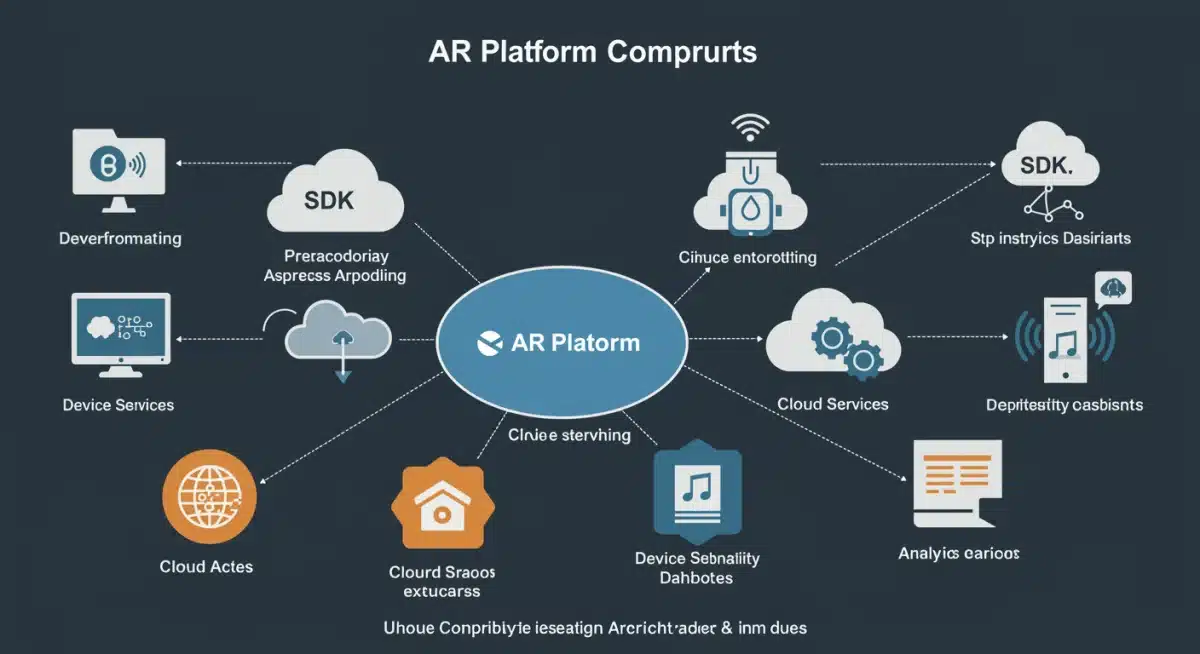
- Cloud Infrastructure: Does the platform leverage robust cloud services (AWS, Azure, Google Cloud) for compute, storage, and networking? Cloud-native platforms generally offer better inherent scalability.
- API and SDK Support: Comprehensive APIs and SDKs are vital for integration and customization. A platform with a rich set of developer tools allows businesses to extend functionality and connect with their unique tech stack.
- Content Creation and Management Tools: Ease of content creation, deployment, and updating directly impacts scalability. Look for platforms with intuitive authoring tools and efficient content pipelines.
- Security and Compliance: Enterprise-grade security, data privacy, and compliance with industry regulations (e.g., HIPAA, GDPR, CCPA) are non-negotiable, especially for US businesses.
- Performance Optimization: The platform must deliver smooth and responsive AR experiences, even with complex 3D models and multiple concurrent users. This includes efficient rendering, tracking, and network management.
- Analytics and Insights: Scalable platforms offer robust analytics to track user engagement, content performance, and identify areas for improvement, enabling data-driven decision-making.
- Ecosystem and Support: A strong developer community, extensive documentation, and responsive technical support are crucial for long-term success and scalability.
- Cost Model: Understand the licensing, usage, and support costs, and how they scale with increased adoption and functionality.
Leading AR Platforms and Their Scalability Strengths for US Enterprises
Let’s examine some of the prominent AR platforms and assess their potential for AR platform scalability by 2026 for US enterprises.
1. PTC Vuforia
PTC Vuforia has long been a leader in the enterprise AR space, particularly strong in industrial and manufacturing applications. Its suite of products – including Vuforia Engine (for core AR development), Vuforia Studio (for authoring AR experiences without coding), and Vuforia Expert Capture (for capturing and documenting expert knowledge) – offers a comprehensive solution.
- Scalability Strengths:
- Industrial Focus: Deep integration with CAD data and PLM systems (especially PTC’s Windchill) makes it highly scalable for existing industrial enterprises.
- Cloud-Agnostic: While it can leverage cloud services, its core engine is flexible, allowing for on-premise or hybrid deployments, which can be crucial for data-sensitive industries.
- Content Management: Vuforia Studio simplifies content creation for non-programmers, enabling rapid development and deployment of AR experiences across an organization.
- Hardware Agnostic: Supports a wide range of devices, from smartphones to industrial smart glasses like RealWear and Microsoft HoloLens.
- Expert Capture: The ability to quickly digitize and disseminate expert knowledge through AR provides immense scalability for training and remote assistance programs.
- Considerations: While its industrial strength is a boon, enterprises in other sectors might find its ecosystem less tailored to their specific needs. The cost model can also be a significant factor for large-scale deployments.
2. Microsoft Dynamics 365 Guides & Remote Assist (Powered by Azure)
Microsoft’s AR offerings, particularly Dynamics 365 Guides and Remote Assist, are tightly integrated with the broader Microsoft ecosystem, benefiting from Azure’s immense cloud infrastructure. These solutions are designed to empower frontline workers and facilitate remote collaboration.
- Scalability Strengths:
- Azure Cloud: Leveraging Microsoft Azure provides unparalleled global scalability, reliability, and security for data storage, processing, and content delivery. This is a massive advantage for US enterprises with global operations.
- Integration with Dynamics 365: Seamless integration with Microsoft’s ERP and CRM platforms allows for powerful data-driven AR experiences and streamlines workflows.
- HoloLens Optimization: While supporting other devices, these platforms are optimized for HoloLens, offering a premium mixed reality experience for specific enterprise use cases.
- User Management: Integrates with Azure Active Directory for robust user authentication and management, simplifying large-scale deployments.
- AI Capabilities: Access to Azure AI services allows for advanced functionalities like object recognition and spatial understanding, enhancing AR platform scalability.
- Considerations: While powerful, the cost of HoloLens hardware can be a barrier for some widespread deployments. The focus is primarily on guided workflows and remote collaboration, which might not cover all AR use cases.
3. Google ARCore & Cloud Anchors
Google ARCore provides the foundational AR capabilities for Android devices, while Cloud Anchors enable persistent and shared AR experiences. While not a complete enterprise platform on its own, it forms the backbone for many custom AR solutions.
- Scalability Strengths:
- Massive Device Reach: ARCore’s presence on billions of Android devices offers incredible reach for consumer-facing or field-based AR applications, making it highly scalable in terms of user access.
- Cloud Anchors: Enable multi-user, persistent AR experiences that can be shared across devices and over time, a critical component for scalable collaborative AR.
- Google Cloud Integration: Leverages Google Cloud’s robust infrastructure for back-end services, data storage, and AI/ML capabilities, supporting large-scale data processing.
- Open Ecosystem: As a foundational SDK, it allows for significant customization and integration with other enterprise systems through custom development.
- Considerations: Enterprises often need to build a significant portion of the platform stack themselves on top of ARCore, which requires substantial development resources. It’s more of a toolkit than a ready-to-deploy enterprise solution.
4. Apple ARKit (with USDZ & RealityKit)
Similar to ARCore, Apple ARKit provides core AR functionalities for iOS devices. Coupled with USDZ for 3D content and RealityKit for rendering and animation, it offers a powerful framework for developing AR experiences.
- Scalability Strengths:
- Vast User Base: Billions of iOS devices globally provide an enormous potential audience for AR applications, particularly in retail, marketing, and consumer services.
- Performance and Optimization: Apple’s tight hardware-software integration often results in highly optimized and fluid AR experiences.
- RealityKit & USDZ: These frameworks simplify the creation and deployment of high-quality 3D content, essential for scalable AR content pipelines.
- Enterprise Device Management: Apple’s robust enterprise device management (MDM) capabilities facilitate secure and scalable deployment of AR apps across corporate iOS fleets.
- Considerations: Primarily focused on the iOS ecosystem, limiting cross-platform deployment without additional development. Like ARCore, it requires significant custom development to become a full-fledged enterprise platform.
5. Magic Leap & Lumin OS
Magic Leap offers a complete AR hardware-software stack with its Magic Leap devices and Lumin OS. While initially focused on consumer, it has increasingly pivoted towards enterprise applications, particularly in design, healthcare, and training.
- Scalability Strengths:
- Integrated Stack: A tightly integrated hardware and software solution can offer a consistent and optimized AR experience, simplifying development and deployment for specific use cases.
- Spatial Computing: Focus on persistent spatial maps and robust environmental understanding is crucial for complex, interactive AR environments that need to scale.
- Enterprise Focus: Magic Leap is actively building out enterprise features, security, and support, aiming for specific high-value industrial applications.
- Considerations: The hardware is still relatively expensive, limiting widespread deployment. The ecosystem is smaller than general-purpose platforms, which could impact developer availability and integration options.
6. Custom-Built Platforms (Leveraging Cloud & Open Source)
For some US enterprises with unique requirements or a strong in-house development team, a custom-built AR platform leveraging various SDKs (ARKit, ARCore, Vuforia Engine) and cloud services (AWS Sumerian, Azure Spatial Anchors, Google Cloud) might offer the ultimate AR platform scalability and flexibility.
- Scalability Strengths:
- Maximum Customization: Tailored precisely to specific business needs, workflows, and existing tech stacks.
- Vendor Lock-in Avoidance: Greater control over the technology stack reduces reliance on a single vendor.
- Optimized Performance: Can be highly optimized for specific hardware and use cases.
- Hybrid Cloud: Ability to design hybrid cloud solutions for maximum data security and compliance.
- Considerations: Requires significant upfront investment in development, maintenance, and expertise. The long-term cost of ownership can be higher, and it demands a mature internal tech organization.
Future Trends Impacting AR Platform Scalability by 2026
Looking ahead to 2026, several trends will profoundly influence AR platform scalability:
- 5G and Edge Computing: The rollout of 5G will significantly reduce latency and increase bandwidth, enabling more complex, real-time AR experiences that rely on cloud processing. Edge computing will bring computation closer to the user, further enhancing performance and reducing reliance on centralized cloud infrastructure. This is critical for industrial AR applications where real-time response is paramount.
- AI and Machine Learning Integration: AI will become even more integral to AR platforms, powering advanced object recognition, semantic understanding of environments, predictive analytics for maintenance, and intelligent content generation. This will enable AR applications to be more intuitive, adaptive, and scalable in their intelligence.
- Persistent and Shared AR Experiences: The ability for AR content to persist in the real world and be shared seamlessly across multiple users will be a standard expectation. Platforms excelling in spatial mapping and cloud anchors will have a distinct advantage in offering true AR platform scalability for collaborative work.
- Interoperability and Open Standards: As the AR market matures, there will be a greater push for interoperability between platforms, devices, and content formats. Standards like OpenXR will become more important, allowing enterprises to avoid vendor lock-in and ensure their AR investments are future-proof.
- Augmented Reality Cloud (ARC): The concept of a global, persistent digital twin of the real world, often referred to as the ‘Augmented Reality Cloud’ or ‘Mirrorworld’, will gain traction. Platforms that can contribute to and leverage such a cloud will offer unprecedented levels of scalability for shared and contextual AR experiences across vast areas.
- Advanced Sensors and Haptics: Improved sensors in AR devices (e.g., LiDAR, eye-tracking) and more sophisticated haptic feedback will create more immersive and intuitive AR interactions, demanding platforms that can process and integrate this rich data stream efficiently.
Strategic Recommendations for US Enterprises
To ensure optimal AR platform scalability for 2026, US enterprises should:
- Define Clear Use Cases: Start with well-defined AR use cases that address specific business challenges. This will help prioritize platform features and integration requirements.
- Assess Existing Infrastructure: Evaluate your current IT infrastructure, cloud strategy, and data management practices. Choose a platform that integrates seamlessly or offers a clear migration path.
- Prioritize Integration Capabilities: Look for platforms with robust APIs and SDKs that allow for deep integration with your existing ERP, CRM, PLM, and IoT systems. Integration is a cornerstone of enterprise scalability.
- Consider Hybrid Solutions: For sensitive data or specific performance needs, a hybrid AR solution combining on-premise components with cloud services might offer the best balance of security, control, and scalability.
- Evaluate Developer Ecosystem and Support: A thriving developer community and strong vendor support are critical for long-term success, especially as AR technologies continue to evolve.
- Plan for Content Management: Establish a strategy for creating, managing, and updating AR content. Platforms with intuitive authoring tools and efficient content pipelines will save time and resources in the long run.
- Focus on Security and Compliance: Ensure the chosen platform meets all relevant industry regulations and security standards, especially for data stored and processed in the cloud.
- Start Small, Think Big: Begin with pilot projects to test the platform’s capabilities and gather user feedback. However, always have a long-term vision for how the platform will scale across the organization and adapt to future innovations.
- Stay Agile and Adaptive: The AR landscape is dynamic. Be prepared to adapt your strategy and potentially your platform choices as new technologies and standards emerge.
Conclusion: Paving the Way for AR-Driven Growth
The journey towards widespread enterprise AR adoption is well underway. For US businesses, the decision of which AR platform to invest in for 2026 is critical, with AR platform scalability being the ultimate differentiator. Whether opting for established industrial players like PTC Vuforia, leveraging the comprehensive cloud power of Microsoft Dynamics 365, or building custom solutions atop foundational SDKs like Google ARCore and Apple ARKit, the choice must align with long-term strategic goals.
The future of enterprise AR is one of pervasive, intelligent, and interconnected experiences. Platforms that can seamlessly grow with your user base, integrate with your evolving digital ecosystem, handle increasing data complexity, and adapt to new hardware and AI advancements will be the ones that empower US enterprises to unlock the full potential of augmented reality, driving unprecedented levels of efficiency, innovation, and competitive advantage for years to come.