The Evolution of VR Headset Displays: A 2026 Technical Deep Dive for US Professionals on Resolution and Field of View
Virtual Reality (VR) has transcended its niche origins to become a pivotal technology across numerous industries, from healthcare and education to engineering and entertainment. As we approach 2026, the bedrock of the immersive experience – the VR headset display – continues its relentless evolution. For US professionals in fields leveraging VR, understanding the nuances of display technology, particularly resolution and field of view (FoV), is not merely academic; it’s critical for strategic planning, hardware procurement, and application development. This deep dive into VR Display Technology 2026 will unpack the current state, emerging trends, and future trajectories of these vital components.
The Quest for Visual Fidelity: Resolution in VR Headsets
Resolution in VR headsets is arguably the most talked-about specification, and for good reason. It directly correlates with the perceived clarity, sharpness, and realism of the virtual world. Unlike traditional screens where resolution is measured across a fixed area, VR’s unique optical systems and proximity to the eye introduce complexities, leading to metrics like pixels per degree (PPD) and subpixel arrangements becoming increasingly important.
Understanding Resolution Metrics Beyond Pixels
Historically, VR headsets were judged by their total pixel count, such as 1440×1600 per eye or 2160×2160 per eye. While these numbers provide a baseline, they don’t tell the whole story. The lens system magnifies these pixels, often exposing the ‘screen-door effect’ – the visible gaps between pixels. This is where PPD comes into play. PPD measures how many pixels are packed into each degree of your field of view. A higher PPD signifies a sharper image and a reduction in the screen-door effect, moving closer to ‘retinal resolution’ where individual pixels are no longer discernible to the human eye. In 2026, premium VR headsets are pushing well beyond 20 PPD, with some experimental models reaching upwards of 30 PPD in their foveated regions.
Micro-OLED and QLED: The New Frontier in VR Display Technology
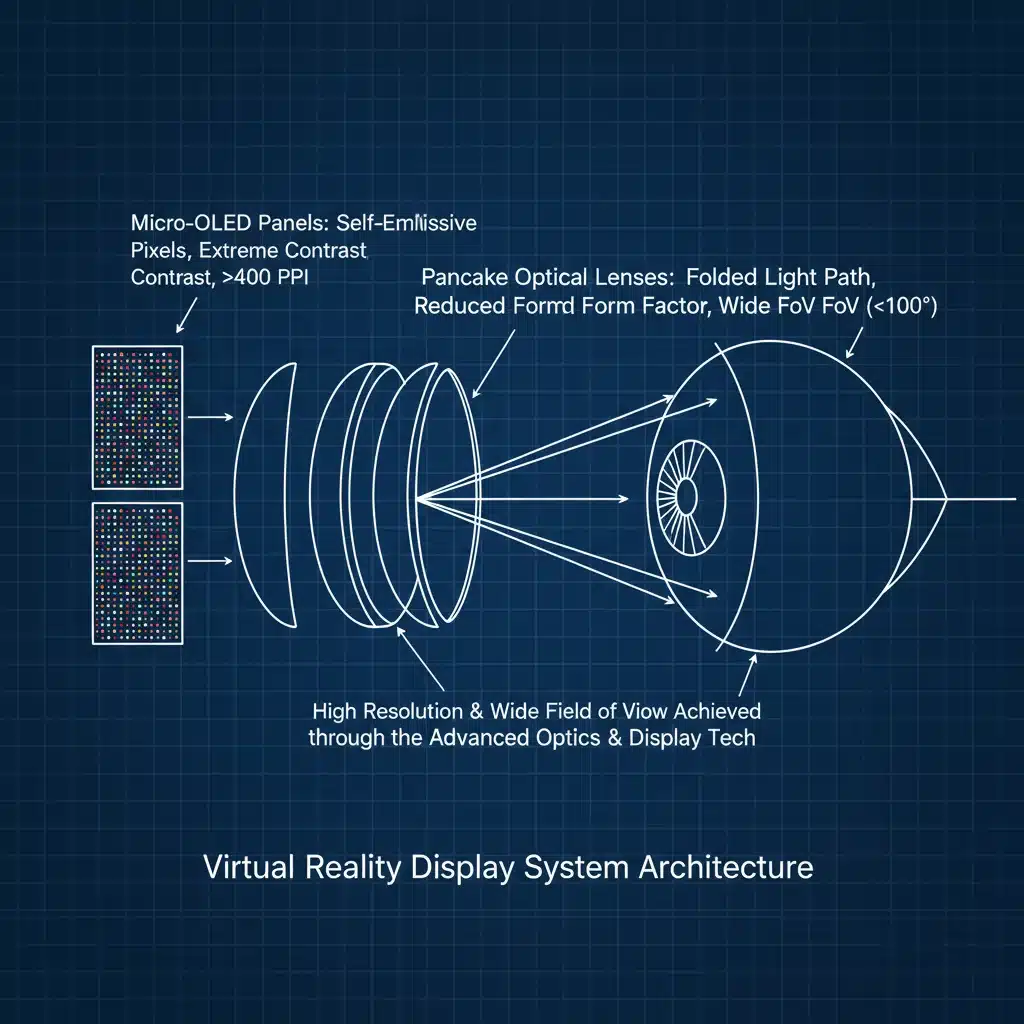
The pixel race is being driven by advancements in display panel technology. While LCDs and traditional OLEDs have served well, 2026 sees Micro-OLED (also known as OLEDoS – OLED on Silicon) and QLED-VR gaining significant traction, especially in high-end professional and enterprise-grade VR systems. Micro-OLEDs offer incredibly high pixel densities, superior contrast ratios, and faster response times, all within a much smaller physical footprint. This allows for lighter, more compact headset designs without compromising visual quality. QLED-VR, leveraging quantum dot technology, promises brighter displays with wider color gamuts and improved energy efficiency, crucial for untethered VR experiences.
The benefits of these advanced display types for US professionals are manifold. In fields like medical imaging, architectural visualization, or detailed engineering design, the ability to discern fine details without pixelation is paramount. Surgeons training in VR can identify subtle anatomical features, architects can review intricate building models with high fidelity, and engineers can inspect complex machinery with unprecedented clarity. The improved color accuracy of QLED-VR also plays a significant role in applications where color critical analysis is required, such as product design or scientific visualization.
Foveated Rendering and Dynamic Resolution Scaling
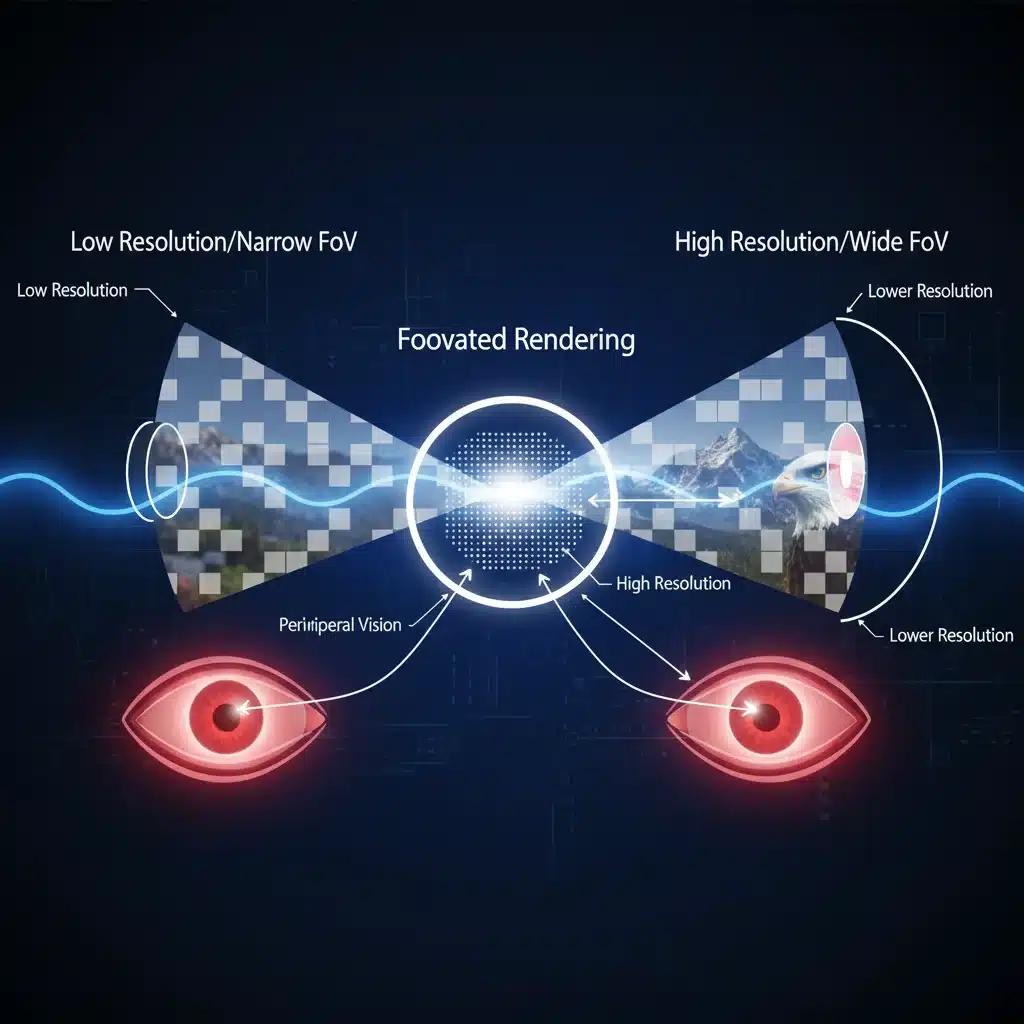
Achieving ultra-high resolutions across the entire field of view demands immense computational power, often exceeding the capabilities of even high-end GPUs. This challenge is being addressed by sophisticated rendering techniques like foveated rendering. Leveraging eye-tracking technology, foveated rendering dynamically renders the area where the user is looking (the fovea) at maximum resolution, while progressively reducing the resolution in the peripheral vision where human acuity is lower. This technique significantly reduces the rendering workload without a noticeable drop in perceived quality, making high-resolution VR Display Technology 2026 a practical reality.
Dynamic resolution scaling further optimizes performance by adjusting the render resolution in real-time based on GPU load and scene complexity. This ensures a consistent frame rate, minimizing motion sickness and enhancing overall user comfort. These intelligent rendering strategies are essential enablers for the next generation of VR experiences, allowing developers to push visual boundaries without sacrificing performance.
Expanding Horizons: Field of View in VR Headsets
While resolution is critical for clarity, the field of view (FoV) is equally important for immersion. FoV dictates how much of the virtual world you can see at any given moment. A narrow FoV can feel like looking through binoculars, breaking the sense of presence. A wider FoV, closer to natural human vision, envelops the user, making the virtual environment feel more expansive and realistic.
The Importance of a Wide Field of View for Immersion
Human horizontal FoV is approximately 200-220 degrees. Most consumer VR headsets currently offer FoVs ranging from 90 to 110 degrees. While significant improvements have been made, closing this gap is a major focus for VR Display Technology 2026. A wider FoV enhances peripheral awareness, which is vital for navigation, spatial understanding, and reactive tasks in VR. For pilots training in flight simulators, a wider FoV allows them to scan instruments and monitor their surroundings more naturally. In collaborative design reviews, a broader perspective enables participants to take in more of a virtual model at once, facilitating better communication and decision-making.
Optical Innovations: Pancake Lenses and Freeform Optics
Achieving a wider FoV while maintaining a compact form factor and minimizing optical distortions is a complex engineering challenge. Traditional Fresnel lenses, while effective, often introduce glare and God rays. The industry in 2026 is increasingly adopting advanced optical solutions such as pancake lenses and freeform optics. Pancake lenses use multiple reflective surfaces to fold the light path, allowing for significantly thinner and lighter headsets with improved edge-to-edge clarity and wider FoV. This design choice is becoming prevalent in newer, more consumer-friendly and professional-grade devices.
Freeform optics, on the other hand, utilize non-spherical, complex lens shapes to correct aberrations and expand the FoV more efficiently. These lenses are often custom-designed for specific display panels and eye-tracking systems, pushing the boundaries of what’s optically possible. The combination of these advanced optics with high-density Micro-OLED displays is enabling a new generation of VR headsets that offer both stunning clarity and expansive immersion, making VR Display Technology 2026 a truly transformative force.
Beyond the Horizontal: Vertical FoV and Overlap
While horizontal FoV often gets the spotlight, vertical FoV is equally important for a complete immersive experience. A balanced vertical FoV ensures that the virtual world extends naturally above and below the user’s direct line of sight. Furthermore, the overlap between the left and right eye’s FoV significantly impacts stereoscopic depth perception. A larger overlap contributes to a more convincing sense of 3D and presence. Advanced headset designs are meticulously optimizing these aspects to create a seamless and natural visual experience.
The Interplay of Resolution and Field of View: A Balanced Approach
It’s crucial to understand that resolution and FoV are not independent variables; they are deeply intertwined. A high-resolution display with a narrow FoV might offer incredible clarity in a limited window, but lack immersion. Conversely, a wide FoV with low resolution will result in a blurry, pixelated experience. The sweet spot lies in a balanced approach, where both metrics are optimized to deliver the best possible PPD across a comfortable and expansive FoV.
PPD as the Unifying Metric
As mentioned earlier, PPD serves as a more accurate indicator of perceived visual quality in VR than raw pixel count alone. For professional applications, a PPD of 20-30 is becoming the target for the central foveal region in 2026, with peripheral regions benefiting from foveated rendering to maintain performance. This ensures that critical details are always rendered with photographic realism, while the overall scene remains immersive.
Addressing the Computational Demands
The pursuit of higher resolution and wider FoV inevitably leads to increased computational demands. Rendering a high-resolution, wide FoV scene at a high refresh rate (e.g., 90Hz or 120Hz to prevent motion sickness) requires powerful GPUs and efficient rendering pipelines. This is where cloud rendering, edge computing, and advanced compression techniques are playing an increasingly vital role. For US professionals, understanding these backend processes is as important as understanding the display specifications themselves, as they dictate the practical deployment and scalability of VR solutions.
Emerging Trends and Future Outlook for VR Display Technology 2026 and Beyond
The landscape of VR display technology is dynamic, with continuous innovation pushing the boundaries of what’s possible. Beyond current advancements, several exciting trends are on the horizon for VR Display Technology 2026 and beyond.
Varifocal Displays and Accommodation-Vergence Conflict
One of the persistent challenges in VR is the accommodation-vergence conflict. Our eyes naturally adjust their focus (accommodation) based on the distance of an object, while also converging to look at it. In current VR headsets, the display is at a fixed focal distance, meaning our eyes are always focused on the screen, even if the virtual object appears far away. This mismatch can cause eye strain and discomfort.
Varifocal displays, which dynamically adjust the focal plane to match the virtual object’s depth, are a significant area of research and development. While still largely in the experimental phase for broad consumer adoption, some high-end professional VR systems in 2026 are beginning to integrate rudimentary varifocal capabilities, offering a more comfortable and realistic visual experience, particularly for extended use in training or design. This technology holds immense promise for reducing eye fatigue and enhancing the naturalness of interaction with virtual objects.
Light Field Displays and Holographic VR
Looking further into the future, light field displays and holographic VR represent the ultimate goal: creating truly indistinguishable virtual realities. Light field displays project light rays that accurately mimic those from real-world objects, allowing users to focus naturally at different depths without any accommodation-vergence conflict. Holographic displays take this a step further, generating three-dimensional images in free space, eliminating the need for a physical screen. While these technologies are still in their infancy and face significant engineering hurdles, they represent the long-term vision for immersive VR Display Technology 2026 and beyond, promising unparalleled realism.
Mini-LED and Micro-LED for Enhanced Brightness and Contrast
While Micro-OLED is gaining traction, Mini-LED and Micro-LED technologies are also being explored for VR applications. Mini-LED offers superior local dimming zones, leading to exceptional contrast and HDR capabilities, which are vital for realistic lighting in virtual environments. Micro-LED, the self-emissive successor to Mini-LED, promises even higher brightness, perfect blacks, and incredible pixel densities, all with potentially longer lifespans than OLED. As manufacturing processes mature and costs decrease, these technologies could become dominant in future VR headsets, further elevating the visual fidelity of VR Display Technology 2026.
Integration with Augmented Reality (AR) and Mixed Reality (MR)
The distinctions between VR, AR, and MR are becoming increasingly blurred. Display advancements in VR are directly influencing the capabilities of AR and MR headsets. High-resolution, wide FoV, and compact optical systems developed for VR are being adapted to create more convincing pass-through AR experiences and truly immersive mixed reality environments. Professionals should consider how these converging display technologies will impact their broader immersive computing strategies, allowing for seamless transitions between purely virtual and augmented realities.
Choosing the Right VR Display Technology for US Professionals in 2026
For US professionals, selecting the appropriate VR headset and its underlying display technology requires careful consideration of several factors:
- Application Requirements: What level of visual fidelity is essential for your specific use case? Is pixel-perfect clarity for intricate details paramount, or is a wider, more immersive FoV for spatial awareness more critical?
- Budget Constraints: Cutting-edge display technologies often come with a premium price tag. Balance performance needs with budgetary realities.
- Hardware Ecosystem: Consider the computational power required to drive high-resolution, wide FoV displays. Do you have the necessary GPUs, or will you rely on cloud-based solutions?
- User Comfort and Ergonomics: While not strictly a display feature, a lighter, more balanced headset enabled by advanced optics directly impacts user comfort, especially during extended sessions.
- Future-Proofing: Invest in technology that offers a clear upgrade path and aligns with anticipated advancements in VR Display Technology 2026 and beyond.
Conclusion: A Vision of Unprecedented Immersion
As we navigate 2026, the evolution of VR headset displays is marked by a relentless pursuit of visual perfection. The synergy between high-resolution Micro-OLED and QLED panels, innovative pancake and freeform optics, and intelligent rendering techniques like foveated rendering is delivering experiences of unprecedented clarity and immersion. For US professionals across engineering, medicine, design, and beyond, these advancements in VR Display Technology 2026 are not just incremental improvements; they are foundational shifts that unlock new possibilities for training, collaboration, visualization, and interaction with digital information.
The journey towards truly indistinguishable virtual reality is ongoing, with varifocal, light field, and holographic displays waiting in the wings. However, the current trajectory of display innovation ensures that the VR experiences available today, and those rapidly approaching in the near future, are more powerful, comfortable, and transformative than ever before. Staying abreast of these technological advancements is key for any professional looking to harness the full potential of virtual reality in their respective fields.